Despite the city admitting its error, a judge found it was too late to undo the mistake.
"The Department is here to state that that decision was a misstep. The Department has been taking measures to correct that misstep."
— Bennett Harrison, attorney, Philadelphia Department of Human Services, February 8, 2022
"I would call it 'Legally Kidnapped.' I know that sounds crazy. It's just off the top of my head. That's how I summarize it in a weird way."
— Renee Muth
+ + +
By the fall of 2020, Renee Muth had closed her wellness business due to COVID. For all the sadness closing a business can bring, her home life was still full and joy because of three adopted children who were also blood-related: all three were half-siblings, birthed by a cousin of Muth’s who had a history of drug addiction.
November 9, 2020 — Muth recalls the date with ease. Having worked that day at a Catholic school, she kept her phone off per the school rules. But leaving that afternoon, something obviously had changed.
“I have a gazillion messages on my phone, and lo and behold, it is the birth mom trying to get through to me through social media, begging me to call her. She had a baby and she needs help, and I need to adopt it, and she wants to keep [the half-siblings] together,” Muth remembered. “And I'm like, ‘Okay, well, maybe she got pregnant again.’ This one was by accident. She wants to do the right thing. Okay, fine. I'll call her back.”
Two days earlier, unbeknownst to Muth, her cousin had given birth to another child, a baby girl, Cora*, born substance-exposed and weighing three pounds fourteen ounces. (*The child’s name has been changed for this article.)
Keeping these half-brothers and -sisters together was everyone’s plan from the beginning, according to court transcripts. Philadelphia’s Department of Human Services identified the Muths as the target placement home.
“Cora was born Nov. 7, and we knew about the Muths. It's clear that the Muths had been contacted by both the investigative and social work teams. It was clear that the Lankenau Hospital social work staff had been engaged and planning with the Muths regarding Cora since November,” DHS operations director Staci Morgan Boyd told a court.
Despite all of that clarity, what unfolded was something else entirely.
As Cora grew stronger in the hospital, plans went forward. On Dec. 2, 2020, a Wednesday, a DHS caseworker confirmed the Muths would be the placement home. Cora would come home with them as soon as she could be released. Someone would be in touch on Thursday to talk about procedures.
Two days of silence.
Late on Friday, Dec. 4, Renee Muth received a new phone call.
After some confusing back and forth chats, the caseworker told Renee, “Well, she's not going home with you.”
“And I said, ‘I'm really confused. You mean maybe she needs to stay in the hospital later? Is there something wrong with her?’ I started getting concerned something was wrong. And she goes, ‘No, she's just not going home with you,’” Muth recalls.
Is she going home with the birth parents? “Obviously not,” the caseworker said.
“And I said, ‘Okay. So who else would she be going home to? I'm the cousin, and I'm the adoptive mother of three — the biological siblings, not one, not two, three. What are you talking about?’ And [the caseworker] goes, ‘She's coming home with somebody else. The birth parents decided to place her.’”
The mistake — the “misstep” — was made.
At the birth mother’s own request, Cora had been released to go home with someone Muth described as “a friend of a friend of a friend.” In the wake of the previously unthinkable phone call, Muth spent several days in a panic.
"My children are devastated trying to figure out where their sister is,” Muth said. “My family's looking to me for answers. My aunts, my uncles, my cousins are like, 'where's this beautiful child?' — thinking I have the most power out of anybody. Where is she? And I'm like, ‘I have no answers.’"
A phone call frenzy and letter-writing campaign for weeks produced nothing. In March 2021, the picture took on more definition. Renee finally was on the phone with someone with authority — Staci Morgan Boyd, an operations director with Philadelphia DHS.
“I literally broke down and cried on the phone with her,” Muth said, explaining that she bonded with Boyd, crediting her with being one of the few persons who listened empathetically.
“You don't understand this nightmare that we have been living. This child has been stolen from us. Nobody is talking to us. They won't respond to anything,” she said to Boyd. “I said to her, ‘Thank you for being so kind.’ She says, ‘Listen, I investigated it. We have an investigation open, and we made a mistake. That case worker should have never sent that child home with those people. They should have never laid eyes on her. We don't know how it happened.’”
The court battle that unfolded over the next several years wasn’t just bitter and demoralizing for the Muths — it became part of the problem. The longer the Muths waited for each next court date, the more the courts were inclined to keep Cora with the parents chosen by the birth mother, the Ruggias.
“So when did we start taking advice from the parents that we were removing the child from?” Philadelphia Court of Common Pleas Judge Allan Tereshko asked at a court hearing over the matter in February 2022 — fifteen months later.
“Respectfully, Your Honor, the department is here to say that that decision was a misstep. The department has been taking measures to correct that misstep,” Bennett Harrison, an attorney for the Philadelphia DHS, responded.
“Democracy admitting they were wrong. I’m sure we got that on the record,” Tereshko replied.
Later in the same hearing, Harrison asked, “Would the court be inclined to authorize at least sibling visitation to begin so that the Muths and their children could get to know Cora, their sibling?”
“I’m shocked that one hasn’t been already entered,” Tereshko answered.
A new hearing, seven weeks later at the end of March 2022, quickly became about whether the home Cora had been placed in with the Ruggia family was unlawful, not whether any mistake should be remedied. As the DHS lawyer Harrison questioned Staci Morgan Boyd on the stand, the issue of any mistake was quickly bulldozed.
“If you want to go back and have them walk back their decision — that may be your intention,” Judge Tereshko said to Harrison, “but I’m not going to permit it. The decision was made by the Department of Human Services to place the child with the Ruggias. Your burden is to prove that the child – the placement of the Ruggias is no longer in the child’s best interest.”
When Judge Tereshko asked what steps DHS took to remedy its mistake, Harrison said a permanency hearing review was listed for June 2021, when Cora would’ve been about seven months old. The first judge listed for that hearing recused himself, then there were scheduling difficulties between the many attorneys.
“And so, the department has been waiting to present this information to the court since May of 2021, approximately a month after it came to DHS leadership’s attention,” Harrison said to the judge.
Boyd testified that DHS investigative social worker Kathryn Savage had called Lankenau Hospital and, against department policy, redirected Cora's discharge to the Ruggias. Savage was never called to testify.
“So, the Muths were not ruled out. They were just moved out,” Boyd told the court.
With the help of hindsight, Muth says they should have hired their own attorney.
“[Bennett] Harrison [a DHS lawyer] kept saying, 'Well, I don't want you to waste your money because we're going to make this right and we have to, and this is our mistake.' So we were like, we should have never trusted them. Not that we trusted them, but we just believed in the justice system. That's our fault."
Closing out the March hearing, Judge Tereshko scolded the DHS, not only for its original error, but for a weak attempt to correct it.
“[N]obody ever called the person who was the DHS person who made the original decision. You couldn't even come up with that person to explain the reason why the child was placed with the Ruggias,” Tereshko said.
"Your evidence falls so far from establishing the basis for removing this child... it signals to me that there was some inappropriate decision-making in the beginning when you allowed the child to go with the Ruggias. And then you come back in at the eleventh hour and somehow want to blame it on the bureaucracy that the child didn't get placed."
"The petition is denied. Child to remain as placed," Tereshko ruled.
The case wasn’t closed, but that petition was denied March 31, 2022.
August 1, 2024 — 854 days later — the DHS “misstep” was front and center in the final hearing on Cora’s future, Cora’s family life. The days that had passed would rule more than the law.
DHS attorney Michael Mon made the only closing pitch he could under the circumstances.
"I think the testimony came out that, yeah, we [DHS] messed up in the beginning, okay?” Mon told the court. “We messed up, and we can't go back, right? But the issue is, you know, do we need to fix it, right? And the answer is yeah, we need to fix it."
It was a cruel moment for Renee and the family if for nothing else than this new admission raised their hopes again.
"When DHS said at the end there that she should have always been with us, we were like, 'Did DHS just admit they made a mistake and she should... Oh my gosh.' And my attorney's squeezing my hand going, 'This is it. We got her. She's coming home finally.' And I'm crying hysterically. We did not think we were going to lose."
A new judge, Daine Grey, confessed to the difficulty that lay before him.
“This is the kind of case that honestly makes me question why I joined this profession,” Judge Grey said.
“There’s no doubt in my mind that DHS screwed this up. DHS screwed this up,” Grey said moments later. “This child was supposed to be placed with the Muths, but you guys messed it up. When you messed it up, the child was placed with the Ruggias, and has been there ever since, the last three-and-a-half, almost-four years, and that is the only family that Cora’s ever known.”
“And I’m tasked with ultimately determining what’s in Cora’s best interest, breaking a connection or allowing a new one to form. I know, or I believe – I do not believe it would be in Cora’s best interest to take her out of the Ruggias' home at this juncture.”
The Pennsylvania Superior Court upheld Judge Grey’s decision on appeal, and the Pennsylvania Supreme Court declined to hear the case. On that day in December 2020, a “misstep” changed the fates of a dozen lives. By the end of the hearing in 2024, it was set in stone, no going back. Cora would stay with Ruggias for good.
The toll was not Renee’s alone. Throughout the ordeal, three children spent years expecting any day to meet their new baby sister. As court dates and delays rolled on, Renee tried to prepare a foundation for the larger family — sending Cora letters and care packages so she would at least know the family waiting for her.
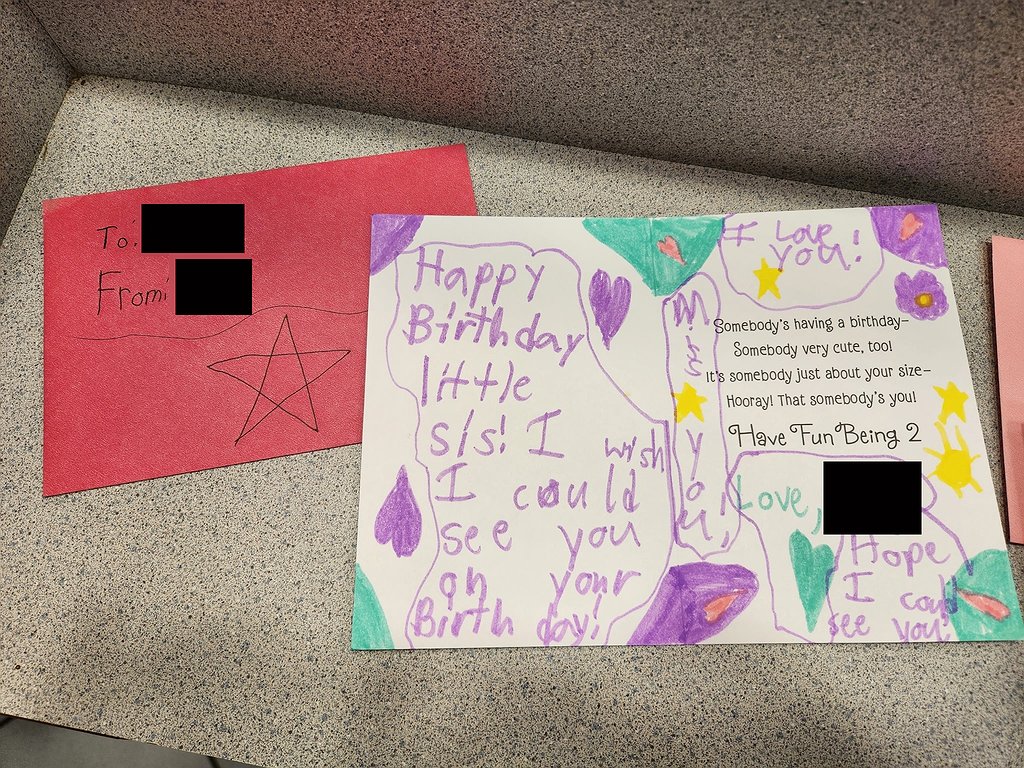 A birthday card drawn by one of Cora's half-siblings, who has never lived with her sister.
Philadelphia Department of Human Services Director Kimberly Ali said because of confidentiality rules, it could not comment on this case directly. But her comment for this story obliquely still indicates DHS should have placed Cora with her three half-siblings.
“In terms of placement decisions, by law and regulation, if it is necessary for a child to be removed from their home, the placement of the child is expected to be the least restrictive, family-like setting available, consistent with the best interests and needs of the child,” Ali told Broad + Liberty. “Where appropriate and possible, both law and Philadelphia DHS policy require efforts to place siblings together when out-of-home placement is necessary.”
Muth's ordeal — when she tells it to others, they respond by saying she should write a book telling the full story.
“And I say, I would call it 'Legally Kidnapped.' I know that sounds crazy. It's just off the top of my head. That's how I summarize it in a weird way."
Requests for comment to the following were not returned or were unsuccessful: Sandra Morris, Nicholas and Beth Ruggia, Brittany Linsk (birth mother), Charles Hodjus (birth father), and James Martin.