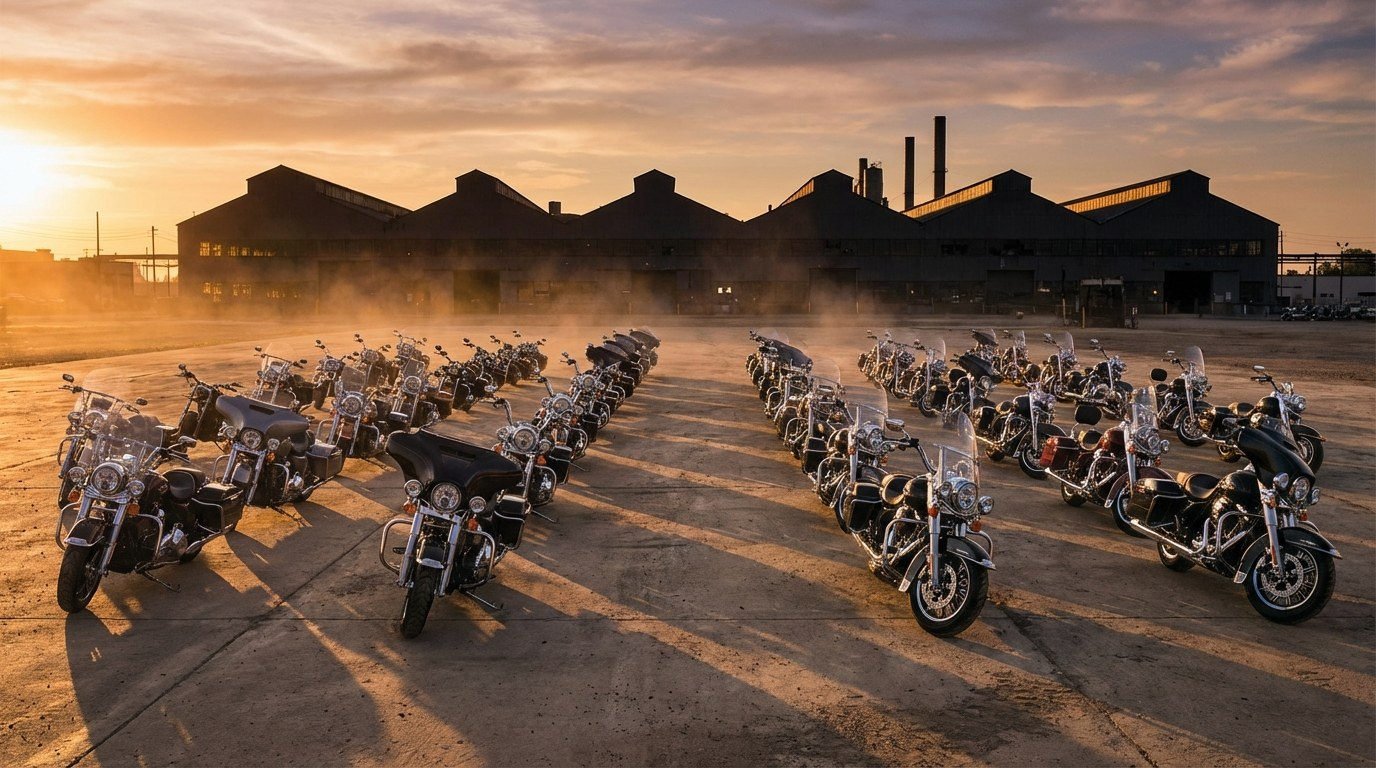
Drive east on Route 30 through central Pennsylvania and you'll pass it without a sign telling you what it is. A long, low industrial complex set back from Eden Road in Springettsbury Township. Acres of parking. In the back lot — if you catch it on the right day — rows of newly-built motorcycles lined up waiting to ship. This is the Harley-Davidson York PA plant, the largest factory the company operates anywhere in the world. Most riders in Pennsylvania know exactly where it is. Most people driving past on their way to a Phillies game have no idea they're looking at the heart of American motorcycle manufacturing. Both reactions make sense. This story is about why.
The first surprise for people who think "Harley-Davidson" and picture Milwaukee: the York plant isn't in Wisconsin. It sits at 1425 Eden Road in Springettsbury Township, a few miles northeast of York city proper, about ninety miles west of the Delaware River. York is the county seat. Springettsbury is where the motorcycles actually get built.
The company was founded in Milwaukee in 1903 and still keeps its headquarters, museum, and Wisconsin manufacturing facilities there. But the York plant is bigger than any of them. It's Harley-Davidson's single largest manufacturing facility anywhere, employing roughly half of the company's total production workforce. The people who clock in there every weekday are building the bikes that end up on dealer floors from Alaska to Florida to Spain.
Here's the unglamorous part of the story. In 1969, American Machine and Foundry — known in American households as AMF, the conglomerate that made bowling equipment, factory machinery, and a dozen other unrelated products — bought Harley-Davidson. The motorcycle company was struggling. AMF had cash. The deal made financial sense on paper. It would take twelve years before anyone admitted it was a disaster for the brand's reputation.
During the AMF years, York became the plant where most of the motorcycles were put together. The facility had room for larger assembly lines than the Wisconsin plants allowed. But AMF's management style didn't fit the product. Build quality dropped. Leaks, loose fasteners, and electrical problems became common. By the late 1970s, "AMF Harley" was used as an insult among riders.
In 1975, AMF hired an engineer named Vaughn Beals to take over Harley-Davidson's operations and clean up the quality mess. Beals had been around heavy industry long enough to recognize the real problem. He eventually concluded that Harley-Davidson's issues weren't about foreign competition from Honda and Yamaha. They were about AMF itself not understanding what kind of company they owned.
AMF in the late 1960s was a holding company that swept up American manufacturing brands the way private equity firms do today. Bowling lanes, ski equipment, power tools, industrial machinery — if it needed a factory floor and a union workforce, AMF was interested. Harley-Davidson fit the profile: a struggling American manufacturer with brand recognition and industrial real estate. The York plant was part of the appeal. It gave AMF an existing assembly operation that could be scaled up. That scaling worked on the manufacturing side. It broke everything else.
By 1981, Vaughn Beals had seen enough. He teamed up with Willie G. Davidson — grandson of one of Harley-Davidson's original founders. Together, they pulled together a group of investors and offered to buy the company back from AMF. The price: eighty million dollars. The structure: a debt-financed buyout, with most of the money borrowed against the company's own assets.
AMF accepted. In June 1981, Harley-Davidson went private under a 13-investor $80 million leveraged buyout led by Beals and Davidson. The York plant came with the deal. So did the reputation problem AMF had created.
Beals spent the next several years rebuilding HD's quality systems. He borrowed ideas from Japanese manufacturing — famously studying Honda's Marysville, Ohio plant to figure out what the York PA operation could learn from it. He launched what would become the Harley Owners Group in 1983.
The turnaround took the rest of the decade. By the late 1980s, "AMF Harley" was a joke from another era, and the York plant was building some of the best motorcycles the brand had ever produced.
For riders who live in Pennsylvania, the Harley-Davidson York PA facility isn't a destination — it's a landmark. People from Lansdale, Quakertown, Bethlehem, and Reading have been riding out to the York area for decades. Sometimes for the plant itself. Sometimes for the scenic roads around the Susquehanna River. Sometimes because York sits at a convenient intersection for riders coming up from Maryland.
The plant's economic footprint matches its cultural one. Harley-Davidson has consistently been one of the largest employers in Springettsbury Township. In 2008, the township listed more than 2,100 HD workers as its single biggest employer line item. The number has moved up and down with economic cycles, but the plant has stayed anchored in York County through every shift in the motorcycle industry.
That kind of permanence shapes local culture. It's the reason biker charity rides in this part of the state so often start or finish somewhere near York. It's the reason a lot of Pennsylvania riders keep sterling silver motorcycle guardian bells hanging from their frame — a superstition that spread out from HD dealerships long before the internet made it a global riding tradition. Local riders learned the custom from other Pennsylvania riders who had learned it around this plant.
Strip away the factory tour photos and the company mythology, and what the Harley-Davidson York PA plant produces isn't just bikes. It produces a specific aesthetic that has shaped American men's style for sixty years. Look at the heavy chains, the skull iconography, the sterling silver rings, the leather wallets with chains running to a belt loop. All of it traces back to the culture Harley-Davidson built around its riders. The rings came from club patches. The wallet chains came from bikers who wore them so they wouldn't lose their paperwork on the highway. The style spread outward from the plant through dealer networks, riders' gatherings, and decades of customer loyalty.
There's more trivia that didn't fit in this article. The 1983 founding of HOG. The famous Japanese tariff fight. The forgotten Rikuo licensed Harleys of 1930s Japan. Bikerringshop's deeper dive into Harley-Davidson facts covers the parts most company histories skip.
A biker ring or a sterling silver pendant isn't technically made at the Harley-Davidson York PA plant. But the culture those pieces belong to was shaped by the people who worked there, by the riders who bought what came off the assembly lines, and by decades of loyalty to a single American brand. When a Pennsylvania rider puts on a heavy silver skull ring before a weekend ride, that's a visual line running through sixty years of factory workers in Springettsbury Township.
Q: Does Harley-Davidson offer a factory tour at the York, PA plant?
Harley-Davidson has offered public factory tours at York in the past, though availability depends on current company policy and may pause during production changes or security updates. Check Harley-Davidson's official website before planning a trip. Tour schedules, age requirements, and closed-toe footwear rules are updated seasonally.
Q: What motorcycles are built at the Harley-Davidson York plant?
The York plant handles assembly for a significant portion of Harley-Davidson's larger-displacement models. Specific model assignments shift over time as production lines are retooled, so the current lineup is best confirmed on HD's corporate site. Historically, York has been associated with the company's touring and cruiser bikes.
Q: How many people work at the Harley-Davidson York PA facility?
The plant employs roughly half of Harley-Davidson's total US production workforce, which has translated to numbers in the range of 2,000 to 3,000-plus workers across different eras. In 2008, Springettsbury Township listed HD as its largest employer with more than 2,100 workers. The headcount has fluctuated with the motorcycle industry's economic cycles.
Q: How far is the York plant from Philadelphia and Harrisburg?
York sits roughly ninety miles west of Philadelphia along Route 30, and about thirty miles south of Harrisburg on I-83. For Lansdale and other North Penn-area riders, it's a comfortable two-hour cruise — one of the most accessible motorcycle destinations in southeastern Pennsylvania.
The Harley-Davidson York PA plant doesn't announce itself on the drive past. No giant bar and shield out front. No visitor center billboard on Route 30. Just a long, low building set back from Eden Road, with rows of finished motorcycles staging in the back lot and decades of American manufacturing history pressed into the concrete under the assembly floor. That's fitting for a factory that built a brand on the idea of understated identity — the kind riders wear on their hand or their jacket, not on a highway sign.