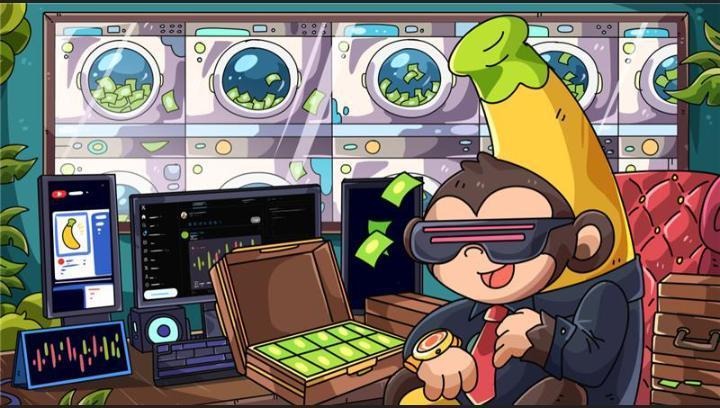
Researchers on X mapped total fee extraction across the major trading bot platforms and arrived at a figure that stopped a lot of people cold: $2.29 billion, collected from traders, distributed back to traders at essentially zero. The users who generated that revenue got nothing. The platforms kept everything.
Banana Gun does the opposite. Forty percent of every dollar in platform trading fees goes back to $BANANA token holders, paid out automatically every four hours. That is not a promotional commitment or a future roadmap item. It has been running continuously since launch, across more than $16 billion in cumulative trading volume and 25.3 million executed trades.
Photon collected $440 million in lifetime trading fees. Users received nothing. BullX collected $203 million in lifetime fees and distributed zero dollars to the traders who generated them. BullX also drew particular criticism for what community members called "airdrop baiting," a sustained implication that loyal users would eventually receive a token distribution. No airdrop materialized. The frustration that followed was not minor.
These are not accusations. They are the platform operators' own implied economics: collect fees, retain revenue, issue no share to users. For platforms that market themselves on community and trader alignment, the gap between the pitch and the structure is hard to paper over once you run the numbers.
The total $2.29 billion figure covers all major bots in aggregate. The point is not that any individual platform acted illegally. The point is structural: when a trading platform generates billions in fees and the users who paid those fees receive no share of the upside, the incentives are misaligned by design.
The $BANANA revenue share is not complicated. Every four hours, 40% of all platform trading fees collected during that period is distributed to qualifying holders. Six distributions per day, every day, regardless of market conditions. You need to hold a minimum of 50 $BANANA to qualify. No staking contract, no lock-up period, no vesting schedule.
The claim frequency is once per 24 hours, with a minimum threshold of 0.1 ETH or 0.1 SOL accrued before the gasless claim activates. When you claim $BANANA as your reward currency rather than ETH or SOL, those tokens are bought back from the open market. No new supply is created. The buyback comes directly from fee revenue.
One structural detail worth understanding: selling or transferring more than 300 $BANANA in a given epoch forfeits that epoch's rewards. Drop below the 50-token minimum and accrued rewards redistribute to other holders. These rules prevent extractive behavior on the reward mechanism itself, keeping the distribution directed at committed holders rather than rotating speculators.
The full weekly breakdown of fees, volume, and platform performance is published regularly. The weekly recap shows exactly what was collected, what was distributed, and what the platform activity looked like that week.
The most telling data point in Banana Gun's fee history is not the average week. It is the week of October 6-12, 2025, when crypto markets recorded $19.13 billion in liquidations in a single day, the largest such event in the market's history. That week, platform trading fees hit an all-time peak of $843,038.
This is the inverse of what most token models produce. When markets crash, most protocol revenues collapse alongside asset prices. Trading bots are different: volatility generates volume, and volume generates fees. A trader trying to exit a position during a liquidation cascade pays the same percentage fee as a trader buying during a rally. The fee share model means $BANANA holders received 40% of that $843,038 peak week, distributed across six payouts in 24-hour intervals.
That week tested whether the alignment holds under pressure. It does. The model does not require a bull market to generate revenue. It requires volume, which a market moving fast in any direction produces reliably.
$BANANA has a fixed total supply of 10,000,000 tokens. Of those, 1,100,000 have been permanently burned, reducing circulating supply by 11%. The team allocation of 1,000,000 tokens sits under an 8-year cliff followed by 3-year linear vesting. There is no buy tax, sell tax, or transfer tax at any percentage.
$BANANA was listed on Binance on July 20, 2024. The circulating supply currently sits at approximately 3,220,000 tokens, roughly 32.2% of total supply, with 4,500,000 tokens in a locked treasury that releases as Banana Bonus cashback at 250,000 tokens per month.
When the reward mechanism buys $BANANA from the open market to fulfill claims, that is fee revenue converting into buy pressure on a fixed-supply asset. The supply does not expand to cover reward payouts. This is the structural difference between a dilutive emissions model and a fee-share model backed by real trading revenue.
The fee-share model is the headline, but Banana Gun's custody architecture is the foundation. Private keys are generated locally on the user's device and never leave it. The platform has zero custody of user funds at any point. This is not a terms-of-service commitment that can change; it is an architectural constraint. Banana Pro, the browser-based trading terminal at pro.bananagun.io, authenticates through Privy social login without requiring a browser wallet extension, while maintaining this non-custodial structure throughout.
The fee share is not charity. It is an alignment mechanism: the platform earns more when traders trade more, so the platform's interest is to build better tools, not to extract more per trade. When 40% of fees flow back to holders, the users who generate that revenue have a direct financial stake in the platform's continued volume. That is the structural argument, and it holds regardless of where markets move next.
Banana Gun currently supports trading across five chains: Ethereum, Solana, BNB Chain, Base, and MegaETH, with 1.3 million registered users and 25.3 million lifetime trades on record.