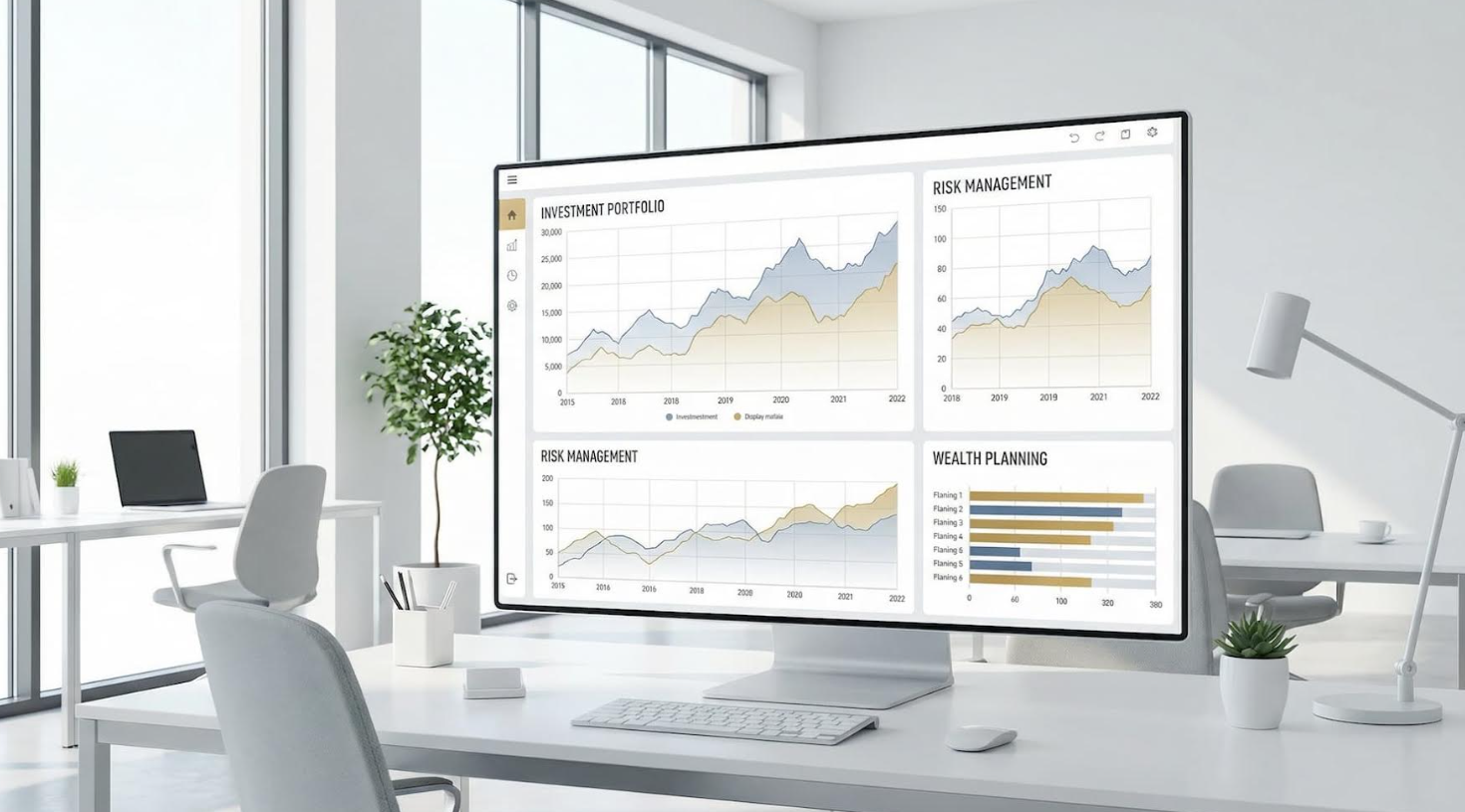
Asora and Aleta are both modern, cloud-native family office software platforms, but they serve meaningfully different needs. Asora is a portfolio tracking and visualization tool. Aleta is a data intelligence platform built around AI-driven ingestion, private market forecasting, and a flexible self-service reporting layer called the Data Cube.
The difference in monthly cost is roughly $100. The difference in capability is considerably larger.
Quick Comparison: Asora vs Aleta
What Is Asora?
Asora is a portfolio tracking platform based in Ireland, designed primarily for smaller European family offices. It positions itself as a modern upgrade from spreadsheets, offering clean dashboards, broad asset coverage, and an intuitive interface that requires minimal onboarding effort.
The platform handles most traditional investment types in a visually appealing way, and for a family office that primarily wants a consolidated view of holdings – a simple pie chart, a list of assets, a performance summary – it delivers that experience well. The setup process is relatively straightforward, and the learning curve is low.
Where Asora runs into limitations is depth. The platform tracks what has happened, but it does not model what will happen. There is no native forecasting capability for private market cash flows, no AI engine for processing PDF capital call statements automatically, and no open API layer for integrating with external tools. With a team of approximately 15 people, feature development velocity and US time zone support availability are also more constrained than at larger peers.
Asora is a reasonable entry point for offices leaving Excel that need a visual upgrade without requiring advanced analytical capabilities.
What Is Aleta?
Aleta is an AI-ready family office wealth management platform that delivers an intuitive picture of total wealth for the principal, deep investment reporting for the family office professionals, and an open data layer built for the age of AI. The platform features private market forecasting, AI-powered data ingestion, and self-service business intelligence for single and multi-family offices.
Aleta is headquartered in New York with a team of approximately 50 people and additional offices in Denmark and Bangkok. It is built for offices that need more than a dashboard—specifically, those managing private equity portfolios, requiring liquidity forecasting, or wanting to build custom reports beyond what pre-set templates allow.
Three capabilities define Aleta's positioning relative to lighter-weight trackers:
Private Market Forecasting. Aleta models future capital calls and distributions based on standard pacing models, giving CFOs a forward-looking view of liquidity needs 12 to 24 months out. This is a materially different function from simply displaying current NAV.
AI Data Reader. Aleta's proprietary AI engine reads, extracts, and digitizes data from capital call PDFs and K-1 documents automatically. Documents that would otherwise require manual data entry are converted into live, structured data without staff intervention. Aleta's AI ingestion works by parsing unstructured PDF documents — capital call notices, K-1s, quarterly fund reports — and extracting structured data fields automatically. The system identifies fund names, call amounts, distribution figures, and dates without manual input, then maps them to the correct entities and asset classes in the portfolio. This is distinct from standard bank feed aggregation, which only works for institutions with digital APIs. Aleta's AI reader covers the long tail of private market documents that aggregators cannot reach.
The Data Cube. Aleta's Data Cube is a pre-structured, self-service business intelligence layer connected directly to live portfolio data. It functions like a pivot table that is always current, allowing analysts to filter by entity, asset class, vintage year, or any other dimension in seconds—without writing code. A query like "show me all distributions from 2024 vintage funds across these three trusts" can be answered immediately.
Aleta is the only family office software platform that combines private market cash flow forecasting, AI-driven document ingestion, and a self-service BI layer (the Data Cube) in a single product.
Aleta also operates on a fully open architecture. Its API is publicly documented, and the same API that powers Aleta's own frontend is available to clients for integrating with CRMs, ERPs, or custom analytics tools. SQL access to the underlying data is also available.
Private Markets: Tracking vs. Forecasting
The most consequential difference between Asora and Aleta for offices with private equity exposure is the treatment of future cash flows.
Knowing the current NAV of a private equity fund is useful. Knowing how much cash will be required for capital calls next quarter—and whether that aligns with available liquidity—is what actually drives decision-making. Asora provides the former. Aleta provides both.
Aleta's forecasting layer models out future cash flows and pacing based on fund-level data, giving the investment team and CFO a structured view of upcoming obligations. This matters particularly for multi-asset offices where private equity commitments sit alongside liquid holdings, and where mismatches between capital call timing and available cash can create real operational pressure.
Aleta also addresses the data ingestion problem that makes private market reporting time-consuming. Capital call notices and K-1s arrive as PDFs. Asora relies on manual input or standard aggregator feeds for this data. Aleta's AI reader processes these documents automatically, reducing the administrative burden on the operations team and improving data timeliness.
Aleta monitors over $100 billion in assets across its client base and reports that clients save more than 50% of the time previously spent on quarterly reporting — a reduction that is largely attributable to the AI ingestion layer eliminating manual data entry from PDF statements.
Reporting: Standard Dashboards vs. the Data Cube
Every family office has reporting requirements that are at least slightly different from every other family office. Beneficiary reports, trustee summaries, consolidated views across holding structures, performance attribution by asset class—the combinations multiply quickly.
Asora offers pre-set dashboard templates. They are well-designed and cover standard reporting needs, but customization is bounded by what the platform allows. When a report falls outside the available templates, the options are limited.
Aleta’s Data Cube makes data easy to access and analyze. It provides a structured, queryable format that analysts can slice and pivot without technical help. Fully integrated into the platform, it uses the same live data as the dashboards—adding flexibility for custom analysis without extra complexity.
Stability and Support: The $100 Difference
At roughly $900/month for Asora and $1,000/month for Aleta, the pricing gap is approximately $100 per month. The organizational gap is wider.
Aleta operates with a team of approximately 50 people—more than three times the size of Asora's team of approximately 15. For a family office that is entrusting its consolidated financial data to a SaaS vendor, team size has practical implications: faster feature development, more robust API maintenance, and more available support capacity.
For US-based offices, location also matters in two ways. First, Aleta operates on US Eastern time, meaning support aligns with trading hours and operational workflows. Asora, based in Ireland, can introduce support delays for US clients. Second, Aleta is attuned to US-specific reporting standards—K-1s, US custodian formats, US tax reporting conventions—in a way that European-headquartered platforms are not always optimized for.
Aleta ensures full connectivity by building custom data feeds when standard ones don’t exist. For institutions using paper or PDF statements, its AI reader enables complete portfolio coverage—unlike typical aggregators that only offer partial data.
Onboarding: DIY vs. White Glove
Setup experience differs between the two platforms in a way that affects how quickly an office gets to clean, usable data.
With Asora, there is a meaningful DIY element to the initial setup and historical data entry. The platform is designed to be self-service, which suits offices with the internal capacity to manage that process.
Aleta takes a white glove approach to onboarding. A dedicated data engineering team cleans, reconciles, and imports historical data during the implementation process. The outcome is a clean, reconciled set of books from day one, without requiring the client's team to manage the migration manually.
Which Platform Should You Choose?
Asora is a reasonable fit for smaller, Europe-centric family offices with relatively straightforward portfolio structures and a primary need for visual consolidation. If the goal is a clean, intuitive upgrade from Excel without advanced analytical requirements, Asora delivers that experience at a competitive price point.
Aleta is ideal for offices investing in private markets, requiring liquidity forecasting, AI-powered PDF statement processing, custom reporting, US time zone support, or an open platform with API and SQL access for easy integration.
For the marginal cost difference of approximately $100 per month, Aleta provides a materially broader set of capabilities, a larger engineering team, and an architecture that does not require a platform migration as the office's needs grow.
Frequently Asked Questions
Is Aleta's Data Cube difficult to use?
No. The Data Cube is designed to function like a pre-structured pivot table that is always connected to live data. It allows users to answer complex questions—such as filtering distributions by vintage year across multiple trusts—in seconds, without writing code or requiring technical support.
Why does the location difference (Ireland vs. New York) matter?
For US-based clients, it matters for two reasons: support timing and data standards. Aleta operates on US Eastern time, ensuring support availability during the trading day. Aleta is also attuned to US-specific reporting formats such as K-1s, which European-headquartered platforms are not always optimized for.
Is Aleta's forecasting feature automatic?
Aleta's forecasting tools model future capital calls and distributions based on standard pacing models. This gives the CFO a forward-looking view of liquidity needs 12 to 24 months out—a capability that basic portfolio trackers like Asora do not offer.
Do I have to set up the data myself?
With Asora, there is a significant DIY element to initial setup and historical data entry. Aleta takes a white glove approach: a dedicated data engineering team cleans, reconciles, and imports historical data during onboarding, so clients start with a clean set of books from day one.