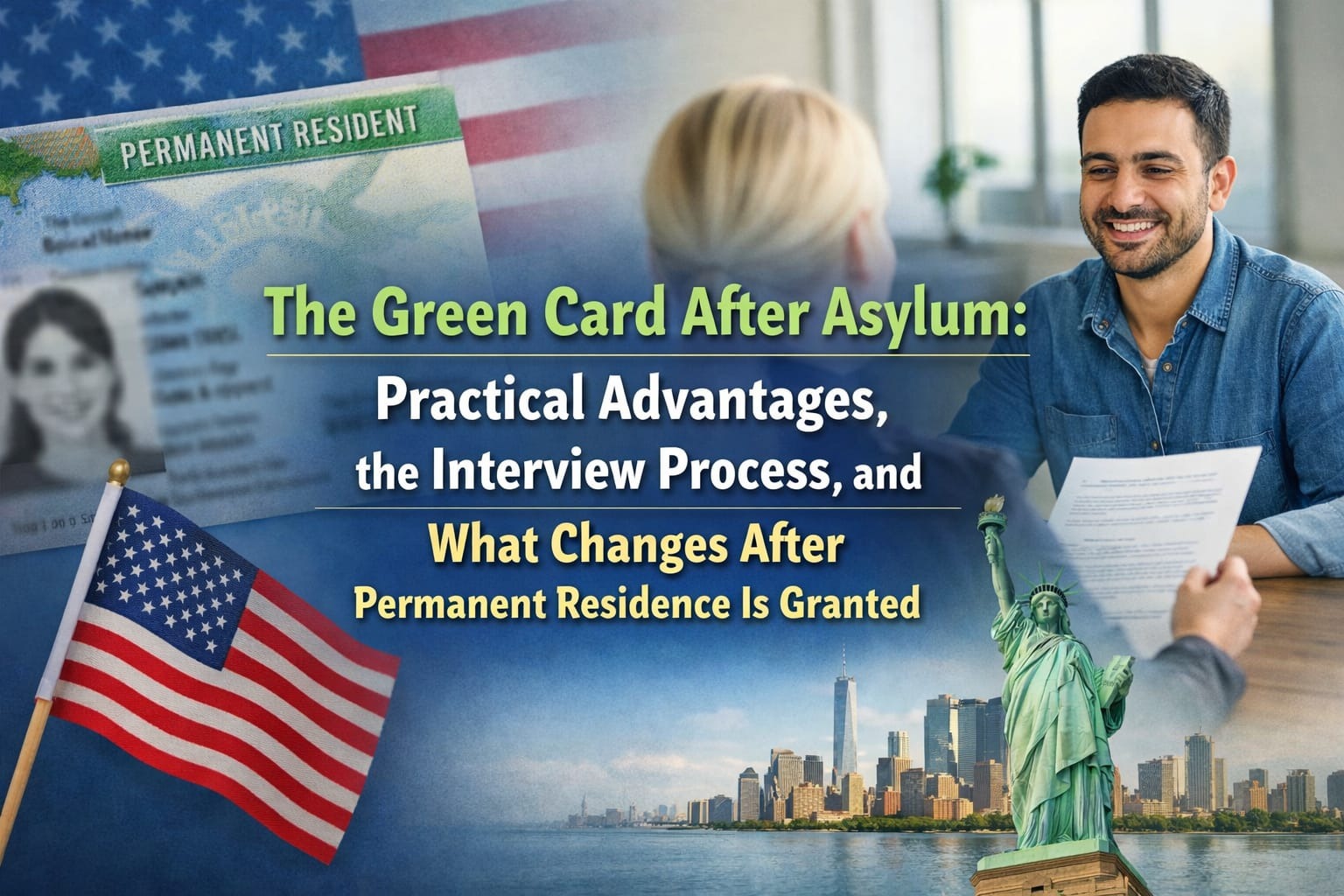
Among the various pathways to a green card in the United States, asylee adjustment of status offers several significant practical advantages that are not always well understood by asylum recipients who are eligible to apply. Understanding these advantages, and the specific features of the asylee adjustment process that distinguish it from the family-based and employment-based pathways, gives asylum recipients a clearer picture of what to expect when they pursue permanent residence.
Family-based green card categories other than immediate relatives of U.S. citizens, and most employment-based green card categories, are subject to annual numerical limits that create visa backlogs measured in years or even decades for applicants born in high-demand countries. An asylee applying under INA 209(b) is not subject to these numerical limits. Asylee adjustment is not numerically capped in the same way as preference category family and employment-based visas, which means that once an asylee meets the one-year physical presence requirement and files a complete I-485 package, they do not face an additional wait for a visa number to become available.
This is a practical advantage of significant magnitude for asylum recipients from countries whose nationals face multi-year waits in family or employment-based preference categories. The asylee who is eligible to apply can move to permanent residence on a timeline determined by USCIS processing, rather than by the State Department's visa bulletin priority date system.
Family-based adjustment of status requires a U.S. citizen or permanent resident petitioner who must file an Affidavit of Support demonstrating sufficient income to prevent the immigrant from becoming a public charge. Asylee adjustment under INA 209(b) does not require this. There is no petitioner in asylee adjustment and no Affidavit of Support requirement. The asylee applies on their own behalf, without needing a qualifying relative in the United States willing and financially able to act as sponsor.
This removes a significant obstacle for asylum recipients who do not have close family members in the United States or whose family members could not meet the income thresholds required by the Affidavit of Support. The asylee's own income, assets, and resources are considered in the public charge analysis, but the absence of a mandatory sponsor requirement makes asylee adjustment accessible to people who would face barriers in family-based pathways.
Adjustment of status interviews for asylees may be conducted either at a USCIS asylum office or at a USCIS field office, depending on the specific circumstances of the case. In some cases, USCIS may waive the adjustment interview entirely for asylees whose asylum application was thoroughly adjudicated relatively recently and whose I-485 record does not present new issues requiring in-person review.
When an interview is conducted, the officer reviews the I-485 application, verifies the identity documents, and confirms that the applicant continues to meet the definition of a refugee and has not been firmly resettled. The officer also reviews the applicant's travel history and any changes in circumstances since the asylum grant that could be relevant to the continued validity of refugee status or to inadmissibility grounds. The interview is generally less intensive than the asylum hearing itself, because the underlying refugee status has already been established.
When an asylee's I-485 is approved and permanent residence is granted, the asylum status is effectively subsumed into the permanent resident status. The person is no longer an asylee but a lawful permanent resident. The green card is valid for ten years and can be renewed indefinitely, and the permanent resident can begin counting toward the five-year continuous residence requirement for naturalization.
One important consideration for recently naturalized citizens who obtained their green card through asylum is the effect of return visits to the country from which they fled persecution. Travel to that country may raise questions about the continued validity of the original asylum claim if it suggests that the person was not genuinely at risk. This is a more significant consideration for the naturalization application than for the green card itself, but it is worth understanding from the beginning of the post-asylum journey toward citizenship.
The USCIS guidance on asylee adjustment processing details the specific interview procedures and post-approval steps applicable to applying for a green card after asylum approval, including the travel document requirements during the adjustment period.