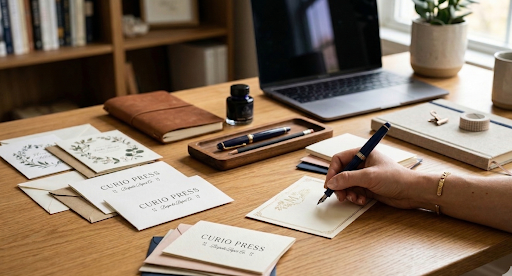
A well-chosen notecard says something about you before the recipient even reads a word. The weight of the paper, the design on the front, the way your name sits in a particular typeface: these details communicate care, taste, and intention. Whether you're sending a thank-you after a dinner party, following up with a client, or just dropping a note to a friend who needs one, personalized notecards turn a small gesture into something memorable. But designing and buying custom notecards can feel surprisingly tricky. There are dozens of decisions to make: paper stock, size, fold style, typography, color palette, and where to actually order them. Most people end up settling for whatever generic box they find at the bookstore, not because they don't want something better, but because the process feels overwhelming. This guide breaks down every step, from understanding why these small cards still carry weight in a digital world to choosing the right shop for your order. Think of it as a practical roadmap for anyone who wants their stationery to feel intentional rather than an afterthought.
There's a reason a handwritten note on a beautiful card hits differently than a text message. Physical mail engages multiple senses: touch, sight, and even smell if the paper has a subtle texture or coating. In an era where most communication is disposable and digital, a notecard occupies real space on someone's desk or refrigerator. That staying power is part of what makes personalized notecards such an effective way to connect.
A handwritten card signals effort. You chose the card, wrote the message by hand, addressed the envelope, and mailed it. That sequence of small actions communicates something no email can: you mattered enough for me to slow down. Studies on gratitude correspondence consistently show that recipients value handwritten notes far more than senders expect. The perceived effort is part of the gift itself. Custom note cards with your name or monogram add another layer, suggesting this isn't a random card grabbed from a rack but something you keep on hand because writing notes is part of who you are.
Thank-you notes are the obvious use case, but they're just the beginning. Sympathy cards, congratulations, quick "thinking of you" messages, housewarming acknowledgments, and even brief apologies all work beautifully on a personalized notecard. Business contexts offer even more opportunities: post-meeting follow-ups, client appreciation notes, and holiday greetings. The versatility of a well-designed notecard means a single box can serve you for months across wildly different situations.
Personal notecards tend to be more expressive, with floral patterns, bright colors, and playful fonts. Business notecards lean toward restraint: a monogram, a company logo, clean typography on heavy stock. The key difference is the audience. Personal cards reflect your personality. Business cards reflect your brand. Some people keep two sets, and that's a smart move if you send notes regularly in both contexts.
Style isn't just a matter of aesthetic preference; it shapes how your message is received. A whimsical watercolor border sets a different tone than a crisp navy monogram on white linen paper. Understanding the main style categories helps you choose what actually fits your needs rather than defaulting to whatever looks pretty on a website.
Minimalist notecards rely on white space, simple typography, and restrained color palettes. They're versatile and tend to feel more formal. Decorative notecards feature illustrations, patterns, borders, or colorful backgrounds. They're expressive and feel more casual or creative. Neither is inherently better. A real estate agent sending client thank-yous probably wants a minimalist approach. Match the style to your communication context.
Folded cards open like a tiny book, giving you a front panel for design and an interior for your message. They feel more substantial and ceremonial. Flat notecards are single-sided, with writing space on the back or along the edge of the design. They're quicker to write on and work well for shorter messages. Folded cards typically cost a bit more due to extra paper and printing. If you write long, heartfelt notes, go folded. If your style is a quick three-line message, flat cards are perfectly fine.
Holiday-themed notecards, birthday designs, and seasonal motifs are popular for people who like their stationery to match the moment. The downside is limited shelf life: a snowflake-bordered card feels odd in July. If you want maximum flexibility, stick with an all-season design and save themed cards for specific occasions.
Size matters more than most people realize. A card that's too small feels like an afterthought. One that's too large feels like you couldn't decide between a notecard and a letter.
The most popular notecard sizes fall into a few standard categories. A4 bar cards (3.5 x 4.875 inches) are a classic choice for brief correspondence. A6 cards (4.5 x 6.25 inches) offer more writing room and feel substantial. A2 cards (4.25 x 5.5 inches) split the difference and are probably the most common size you'll encounter. Correspondence cards, which are flat and typically around 6.25 x 4.5 inches, are another popular format.
Small notecards (around 3.5 x 5 inches or smaller) work well for quick thank-yous, gift enclosures, and brief messages. They fit neatly into small envelopes and feel intimate. Larger notecards (5 x 7 inches) give you more space for longer messages and make a greater visual impact. They're great for detailed thank-you notes or business correspondence where you want to say more than two sentences.
Think about how much you typically write. If your notes tend to be three or four sentences, a smaller card works fine. If you regularly fill both sides of a page, go bigger. Also, consider your handwriting size. People with large handwriting need more space than they think. A good rule of thumb: buy one card in your target size and write a sample note on it before ordering a full box.
Quality separates a notecard that gets kept on someone's mantel from one that goes straight into the recycling bin.
Paper weight is measured in grams per square meter (GSM) or pounds. For notecards, you want at least 80 lb cover stock. Premium cards often use 100-130 lb stock. Texture options include smooth, linen, felt, and cotton. Smooth paper works best for detailed printing. Linen and felt textures add tactile interest and hide minor printing imperfections. Cotton paper has a distinctive soft feel and is considered the gold standard for fine stationery.
Flat printing is the most affordable and works well for most designs. Letterpress creates a debossed impression in the paper and feels luxurious, but costs significantly more. Thermography produces raised lettering at a mid-range price point. Foil stamping adds metallic accents. Each method produces a different look and feel. Pay attention to finishing details too: rounded corners, deckled edges, and lined envelopes all elevate the overall impression.
How your notecards arrive matters, especially if you're giving them as a gift. Look for sets that come in a sturdy box rather than shrink wrap. Some brands use ribbon-tied packaging or custom boxes that double as storage. If you're ordering for yourself, packaging is less critical, but a good box keeps cards protected from humidity and dust. Envelopes should be included and color-matched.
This is where the fun starts. Designing your own notecards means making choices about personalization, color, type, and branding.
The most common personalization is your name or monogram on the front. But there are other options worth considering: a custom illustration, a meaningful quote, or a hand-drawn border. Some people include their address on the back flap of the envelope. The best personalized notecards reflect something genuine about the sender.
Stick to two or three colors maximum. A single accent color on white or cream paper is a classic approach that almost always looks good. Navy, forest green, burgundy, and charcoal are safe choices. For typography, choose one font for your name and one for any secondary text. Serif fonts feel traditional. Sans-serif fonts feel modern. Script fonts add formality but can be hard to read at small sizes.
If you're creating business note cards, subtle branding is key. A small logo on the back or incorporating your brand color into the design works better than placing your company name across the front. The card should still feel personal.
Knowing what you want is half the battle. Knowing where to buy it is the other half.
Online shops offer the widest selection and usually the best prices for custom orders. Local stationery stores and print shops offer the advantage of touching paper samples before you commit. Some local shops also offer design services.
Look for shops that show real product photos, list paper specifications clearly, offer sample kits, and have responsive customer service. Reviews that mention print quality and paper feel are more useful than generic ratings. A shop that offers a single sample card before you commit to a full box is worth considering.
Order a sample first if possible. Check that the envelope size matches standard postage requirements. Proofread your personalization carefully. Consider ordering in smaller batches if this is your first custom order. Always check the estimated delivery time.
Anyone who values relationships benefits from keeping personalized notecards on hand. Small business owners, professionals, parents, and anyone who regularly attends events often get the most value.
A box of 50 quality custom notecards typically costs between $30 and $80, depending on paper quality and printing method. That's roughly $0.60 to $1.60 per card. Compared to store-bought greeting cards, custom notecards are often more economical.
Start with one versatile set: your name on quality paper in a classic color. Use it for six months and pay attention to what you wish were different. Maybe you want a larger size, a different font, or a second set for business use. Designing and buying personalized notecards is less about getting it perfect the first time and more about developing a stationery habit that becomes second nature. The best notecard is the one you actually use, so pick something you love, keep it accessible, and start writing.