Creating contemporary software is not all about coding lines. Numerous layers should be well-coordinated. Typically, three domains call for various specialists. Frontend programmers deal with appearance and user experience. Backend programmers deal with servers and databases. Data scientists analyze lots of data to forecast or identify patterns. It takes time, collaboration, and good communication to organize these roles. MetaGPT redesigns this process by combining all three domains, frontend, backend, and data science into one system. Through the application of AI agents that function similarly to a complete development team, MetaGPT can architect, create, and test all layers of an application within a single fluid workflow.
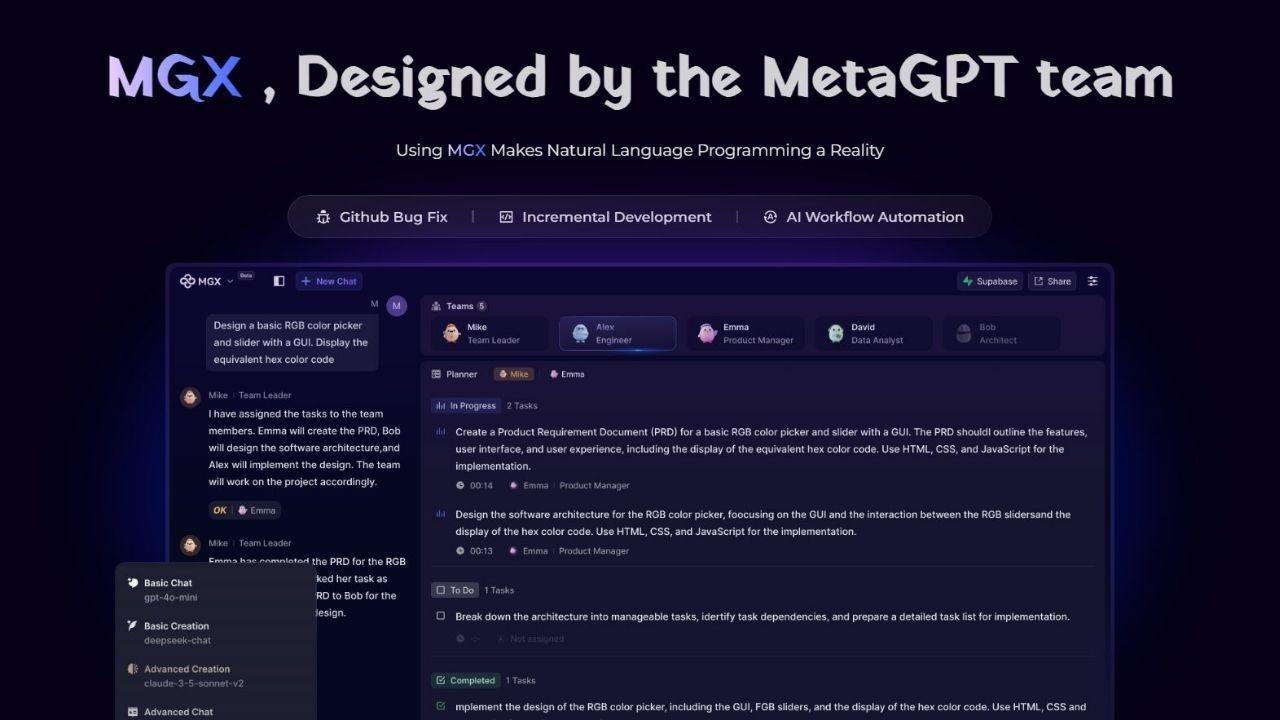
MetaGPT is an AI-based system that functions as an expert software team. Rather than employing numerous individuals with various skills, MetaGPT employs AI agents, each performing a specific role. An agent can be a product manager, another an architect, another a software engineer, and another a data analyst. These agents follow a structured process, just like human teams. They plan, design, code, test, and deliver software. The difference is that they can do this much faster, around the clock, and without the usual barriers of human communication delays. What is unique about MetaGPT is that it is capable of integrating the various aspects of software development, frontend, backend, and data science, such that the end product functions as a cohesive and well-balanced system.
Frontend refers to the aspect of software that is visible and interacted with by humans. Layouts, colors, menus, forms, and all other things that make an app user-friendly and fun to use are part of the frontend. In classical development, frontend engineers do coding in languages like HTML, CSS, and JavaScript to implement the design. Using MetaGPT, the engineer agent receives the product manager's written requirements and converts them into frontend code. For instance, if the specification reads, "Make a shopping app that has a homepage, a cart, and a checkout button," MetaGPT creates the design and layout for all those features. The AI system ensures that the frontend is optimized for the user's requirements while the design remains clean and functional. It also verifies that the frontend correctly interfaces with the backend in a way that actions like clicking "Buy" actually trigger the appropriate processes behind the scenes.
The backend is the unseen framework that drives an application. It stores information, executes processes, and handles the communication among various components of the system. Without a robust backend, no matter how gorgeous the frontend may be, it won't work in the first place. In MetaGPT, the architect agent initially determines how the backend is to be arranged. Subsequently, the engineer agent codes to develop it.
Data science is gaining relevance in contemporary software. It enables apps to transcend mere features and provide intelligent insights. These range from recommendations, trend identification, and forecasting. MetaGPT boasts a dedicated data analyst agent that performs these activities. This agent processes raw data, sanitizes it, and applies algorithms to identify patterns. The output may then be used to enhance the app. For instance, if in a shopping application, the data science could provide product recommendations based on purchase history or forecast which products would be out of stock in the near future. MetaGPT incorporates such capabilities directly into the system and makes it a part of the workflow. Incorporating data science with frontend and backend, MetaGPT makes sure that the apps are not only operational but also smart.
In conventional development, frontend, backend, and data science are usually developed independently. This creates issues. Frontend will not align with the backend properly, or the data science functionality might not be integrated with the rest of the system completely. Coordination requires additional time and effort. MetaGPT does not have these problems. Since it handles all three domains in one flow, consistency is assured, and nice integration is achieved.
MetaGPT can be used in most industries and scenarios. Reflect on these instances: In medicine, MetaGPT might develop an application where the frontend is used to schedule appointments, the backend is used to store medical records safely, and data science forecasts patients' needs based on previous visits. In schooling, the frontend would display lessons and quizzes, the backend would keep track of students' advancement, and data science would propose study paths for improved learning outcomes. In finance, the frontend might show user dashboards, the backend would manage transactions securely, and data science might recognize suspicious spending behavior for anti-fraud purposes. These illustrations depict how all three layers come together to build strong applications that are both user-centric and intelligent.
MetaGPT mitigates a bug in the backend and a defect in data science risks through its organized workflow. The product manager agent specifies strong requirements, the architect provides solid design, the engineer codes responsibly, and the data analyst checks for results. Lastly, the system tests and verifies for flaws before generating the output. This collaboration between agents serves as a safety net. Each agent has reviewed work in its domain, and collectively they have produced a more robust final product.
It is meant to be simple to use MetaGPT. Below is a basic step-by-step illustration of how a project could go:
This flow illustrates how MetaGPT manages each level of development while making the process easy and tidy.
The future of software development will be marked by even tighter integrations among frontend, backend, and data science. As more applications rely on data insights, the demand for integrations without friction will increase. MetaGPT is already demonstrating how this can be done by employing AI agents to manage the whole process. In the future, the agents will be able to play even more specialized roles, like security specialists or user experience designers. This will make the workflow even more comprehensive and trustworthy. The vision is clear: a future in which creating complicated apps is as easy as explaining an idea.
MetaGPT shows how AI can integrate frontend, backend, and data science into a seamless process. With the utilization of agents that simulate a professional software team, it keeps in mind that apps are not just good-looking but also strong and smart.