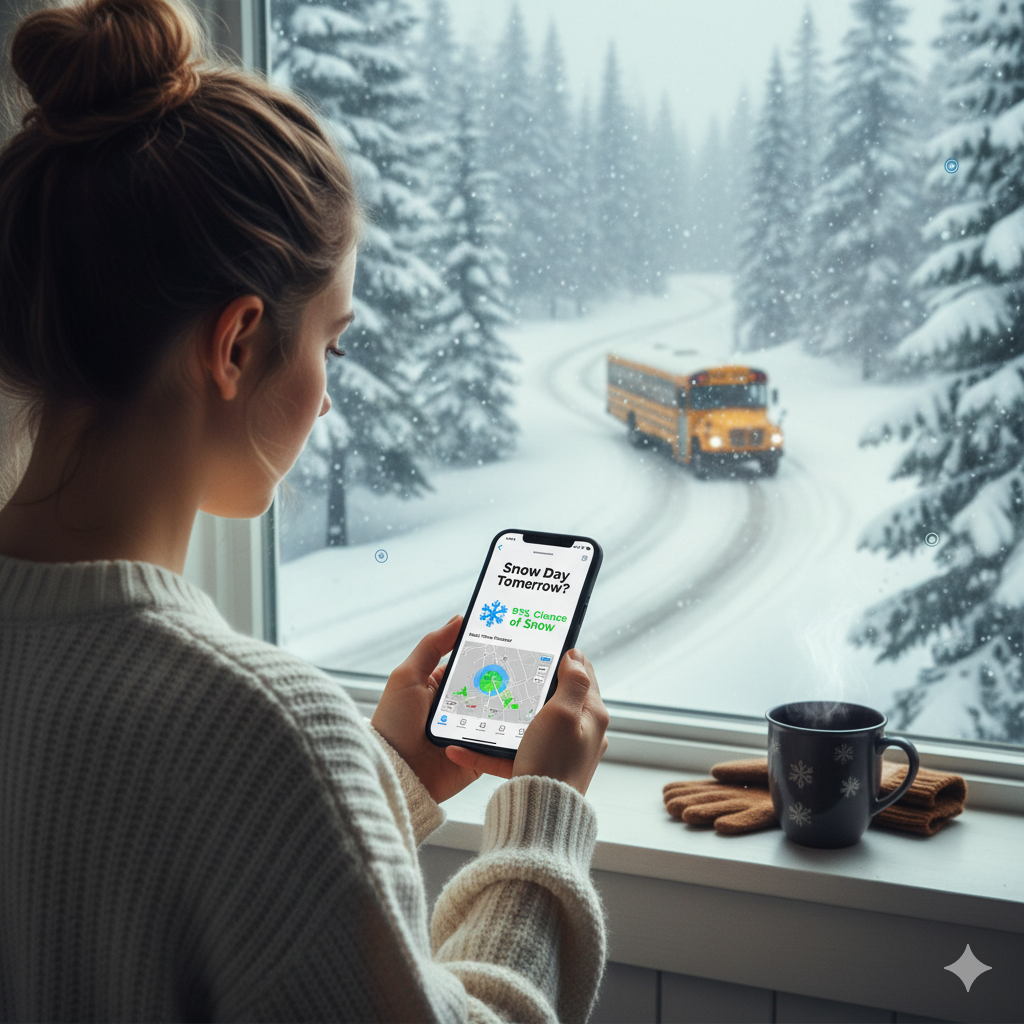
There’s nothing quite like waking up to find a blanket of snow outside your window and realizing school might just be canceled. But instead of guessing or scrolling endlessly through social media rumors, you can now check your snow day chances in real time. Accurate, data-driven snow day forecasts have become an essential winter tool for parents, students, and teachers alike. So, if you’re wondering, “Will there be a snow day tomorrow?” this guide will help you understand how modern snow day prediction works—and how to check your chances instantly.
Just a decade ago, snow day predictions were mostly based on local gossip, hunches, and the occasional news broadcast. Today, however, real-time snow day forecasts use advanced meteorological data, machine learning models, and regional weather algorithms to estimate the probability of school closures. These tools combine temperature patterns, storm tracking radar, and historical snow day trends to give you a clear percentage chance of a snow day.
Sites like Snow Day Calculator, AccuWeather, and The Weather Channel have revolutionized how communities prepare for winter storms. Instead of waiting for a morning announcement, you can see a live forecast of your area’s closure likelihood hours—or even days—before the first snowflake lands.
To understand your chances, it helps to know what goes on behind the scenes. Modern snow day calculators don’t just rely on snowfall totals. They analyze several critical factors simultaneously. These include forecasted snow accumulation, timing of the storm, wind chill, road conditions, and school district policies.
For example, if a storm is expected to drop six inches of snow overnight with temperatures below freezing, many algorithms will assign a high probability of school closures. However, if the same amount of snow is forecasted for the afternoon after classes begin, your chances might drop significantly. The system also accounts for urban versus rural areas, since schools in dense cities often have faster snow removal, while smaller towns may close more easily due to limited resources.
The easiest way to find out if school might be canceled tomorrow is to use an online snow day calculator. These platforms typically ask for your zip code, school type, and sometimes your grade level. Once submitted, they’ll instantly analyze meteorological data from sources like NOAA (National Oceanic and Atmospheric Administration) and local radar updates. Within seconds, you’ll receive a prediction percentage—for example, “78% chance of a snow day.”
In addition to calculators, you can cross-check real-time radar maps on websites such as Weather.com or your local TV station’s weather page. Pairing both tools helps you get a full picture: the data-based forecast plus local insight from meteorologists familiar with your region. This two-step check can be particularly helpful when storms are borderline—just enough to close some schools, but not all.
The accuracy of snow day forecasts has improved dramatically in recent years. Thanks to advancements in weather modeling and AI integration, predictions are now based on hyperlocal data rather than broad regional averages. That means your snow day chances are calculated specifically for your area, not an entire state or county.
Machine learning plays a major role in this improvement. Algorithms can now analyze years of historical school closure data alongside recent weather events to refine their predictions. They learn patterns—such as how likely certain districts are to cancel classes under specific conditions—and adjust future forecasts accordingly. This has made predictions not just more scientific, but also more reliable for real-world decisions like planning childcare, commutes, or remote workdays.
Even the best forecast can’t make the final call—that’s still up to your local district. School administrators evaluate weather reports, road conditions, and safety concerns before announcing a closure or delay. Many districts collaborate closely with transportation departments and local meteorologists to assess how safe it is for buses and students.
Typically, decisions are made early in the morning, around 5–6 a.m., or sometimes the night before when a major storm is certain. If your forecast shows a 90% chance of a snow day, it usually means the weather indicators strongly suggest conditions that would prompt most schools in your area to close. Still, keep an eye on your district’s official channels for confirmation.
Once you know there’s a solid chance of a snow day tomorrow, it’s smart to plan ahead. Have your devices charged, gather some indoor activities for kids, and keep an eye on local weather updates. If you’re working from home, communicate with your employer early about potential disruptions.
For families, snow days can become an unexpected bonding opportunity—hot chocolate, board games, and watching the snow fall outside the window never lose their charm. But it’s equally important to stay safe: limit travel when roads are icy and ensure you have essential supplies in case of extended closures or power outages.
Winter weather can be unpredictable, and sometimes forecasts shift dramatically within hours. A predicted snowstorm might weaken, or temperatures could rise enough to turn snow into rain. That’s why real-time updates are so valuable. Many snow day calculators refresh every few hours as new data becomes available.
Before going to bed, it’s a good idea to check the latest forecast and set alerts on your weather app. In the morning, recheck for any updates before assuming school is closed. Staying informed in real time helps avoid unnecessary confusion and ensures you’re ready for whatever the morning brings.
As weather technology continues to evolve, snow day forecasting will only become more precise. We’re entering an era where hyperlocal AI-driven systems can predict not just closures but also bus delays and after-school activity cancellations. In some areas, districts are already testing predictive tools that automatically send alerts based on threshold weather conditions.
In the future, families might not even need to check—they’ll simply receive a personalized notification the moment snow day probability crosses a certain level. That’s the next step in making weather prediction both proactive and personalized.
While no forecast is perfect, real-time snow day prediction tools give you the power to plan ahead with confidence. They turn uncertainty into insight, letting you know whether to set your alarm—or sleep in. So the next time a snowstorm is brewing and you’re wondering if school will be closed, skip the guessing game. Check your chances using a reliable snow day calculator, follow your local weather alerts, and prepare to make the most of your winter day—whatever the forecast brings.