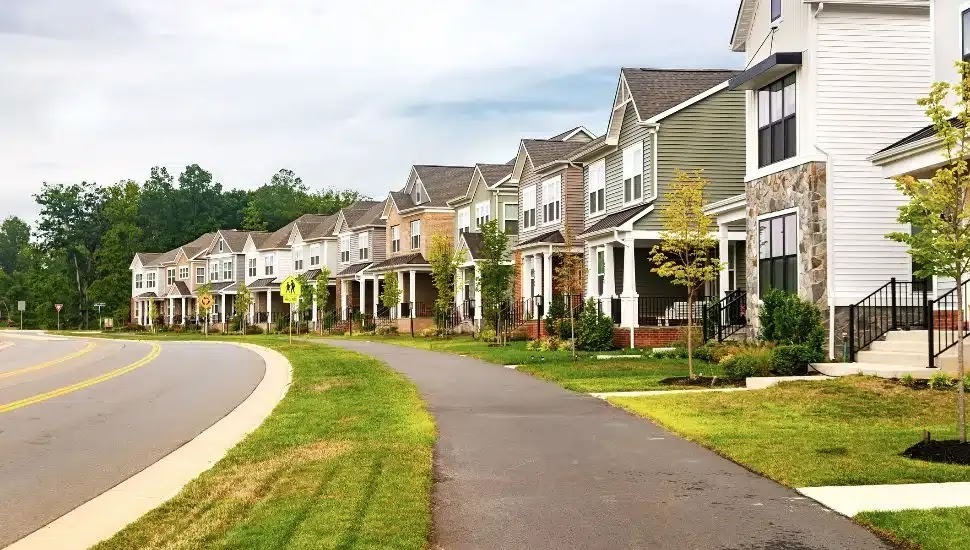
Montgomery County's median home price reached $480,000 in May 2025, up 6.7% from the previous year. The county saw 800 homes sold in May, with 51% closing above asking price. Properties spent an average of 20 days on the market.
A household earning the county's median income of $111,521 faces tight math. After federal and state taxes, monthly take-home pay sits around $7,100. A $480,000 home with 20% down requires a $96,000 down payment. The remaining $384,000 financed at 6.25% for 30 years creates a monthly payment of $2,364 in principal and interest.
Property taxes add $3,834 annually ($319 monthly). Homeowners insurance averages $125 monthly. Utilities run $300. Total monthly housing expense hits $3,108, or 44% of take-home pay before maintenance or mortgage insurance for buyers putting down less than 20%.
Competition varies by area. Abington homes sold for a median of $418,000, up $23,000 from 2023. Bridgeport recorded a 31.1% increase to $450,000. Lower Merion commanded the highest prices in the county.
The county added 1,870 active listings in March 2025, up 40.6% from February. During March, 323 homes sold or entered pending status. Of those sales, 51% went above asking price. Only 31% sold under asking.
First-time buyers face higher barriers. Conventional loans require a 620 credit score and debt-to-income ratio under 45%. Buyers putting down less than 20% pay private mortgage insurance, typically $200 to $300 monthly. Closing costs run approximately 3% of purchase price, adding $14,400 in upfront expenses on a $480,000 home.
Mortgage rates stabilized around 6.25% for 30-year fixed loans as of October 2025, down from a peak near 8% in October 2023. Current rates remain more than double the 3% rates available during 2020-2021. A borrower who financed $400,000 at 3% pays $1,686 monthly. The same loan at 6.25% costs $2,462, a difference of $776 monthly or $9,312 annually.
Montgomery County recorded a median household income of $111,521 in 2023, up 3.8% from 2022's $107,441. Housing costs strain different income brackets unevenly.
The county classifies 29% of households as ALICE (Asset Limited, Income Constrained, Employed) or below poverty level. That's 97,222 households earning above poverty thresholds but below what's needed for basic expenses like housing, childcare, healthcare, food, and transportation.
Personal care aides in Pennsylvania earn a median hourly wage of $13.65, or $28,392 annually before taxes. Fast food workers average $10.82 hourly ($22,506 annually). Cashiers make $11.03 per hour ($22,942 annually). These occupations employ significant numbers of ALICE households.
A single person earning $28,000 annually takes home roughly $1,850 monthly after taxes. With median rent for a one-bedroom at approximately $1,400, that leaves $450 for food, transportation, healthcare, and everything else.
Census data shows 21.1% of Montgomery County workers operated from home in 2023, up from 5.4% in 2019. Remote work eliminated commute costs averaging $200 to $400 monthly in gas, tolls, and vehicle wear.
Gig economy participation increased across the county. Rideshare driving, food delivery, and freelance work through digital platforms became common second jobs. Platform-based work appeals to people managing irregular schedules or childcare responsibilities.
Online income streams diversified. Some residents sell products through e-commerce platforms. Others offer services like graphic design, writing, or bookkeeping remotely. These flexible arrangements let workers choose hours around primary employment.
Gaming and betting platforms represent another category of online activity. Some Montgomery County residents use international gambling sites as entertainment and occasional income supplements. Casinos not GAMSTOP gained users among Pennsylvania residents during 2024-2025. These platforms operate outside the UK's GAMSTOP self-exclusion system, offering different betting markets than domestic options.The sites let users place bets on sports, play casino games, and participate in poker rooms from home.
Players typically deposit $50 to $200 initially. The sites accept various payment methods including credit cards, e-wallets, and cryptocurrency. Some win occasionally. Most lose over time, as probability favors the house on all games. A person betting $100 monthly with average luck might see returns of $80 to $90.
Financial advisors note gambling shouldn't replace income planning. A slot machine with 96% return-to-player still takes $4 from every $100 wagered long-term. Sports betting margins run 5% to 10% in the house's favor. Poker rooms charge rake on every pot. Consistent profit requires skill levels most casual players don't possess.
Pennsylvania legalized online sports betting and casino gaming in 2017. State-regulated platforms operate through established casinos and report winnings to tax authorities. International platforms don't report to Pennsylvania or IRS. Users technically owe taxes on any net winnings, but enforcement remains limited for amounts under $10,000 annually.
Some households allocate $50 to $100 monthly toward these platforms, categorizing it as entertainment rather than income strategy. Wins occasionally cover car repairs or medical copays. Losses accumulate when people chase previous losses or increase bet sizes during losing streaks.
Families reassess priorities constantly. Vacation spending dropped for households near the ALICE threshold. Restaurant visits decreased. New vehicle purchases got delayed. The average vehicle age in Pennsylvania reached 12.5 years in 2024, up from 11.2 years in 2020.
Multigenerational housing arrangements increased. Adult children aged 25-34 living with parents rose from 24% in 2019 to 31% in 2023. A 2,000-square-foot home housing two generations saves one household $2,000 to $3,000 monthly in rent or mortgage costs.
Workers at companies offering 401(k) matches face difficult choices. A person earning $60,000 who cuts retirement savings from 6% to 2% gives up $2,400 annually in employer contributions. Over 30 years at 7% growth, that's $226,000 in lost retirement funds.
Home price forecasts for 2026 predict 2% to 4% annual growth. At the midpoint, today's $480,000 home costs $494,400 in twelve months. Inventory constraints continue driving prices upward. Homeowners who financed at 2.5% to 3.5% between 2020-2021 hold properties rather than buy at current 6.25% rates.
New construction costs increased 18% from 2020 to 2024. Labor shortages in skilled trades pushed wages up 15% to 20%. Impact fees and zoning requirements add $15,000 to $30,000 per new home in many municipalities.
The Federal Reserve maintained benchmark rates in the 5% to 5.25% range through October 2025. Unless inflation drops significantly or recession forces rate cuts, mortgage rates will likely stay between 5.75% and 6.75% through 2026.
Teachers, police officers, nurses, and municipal workers increasingly commute from outside Montgomery County. A teacher earning $65,000 annually takes home approximately $4,100 monthly. With housing costs exceeding $3,000 monthly in the county, these workers relocate to Berks or Lehigh counties where median home prices run $280,000 to $320,000.
Montgomery County's housing costs rose faster than wage growth over the past five years. Median home prices increased 35% from 2020 to 2025. Median household income rose 18% over the same period. This divergence forces households into choices: longer commutes, reduced savings, delayed homeownership, or supplemental income through additional employment.