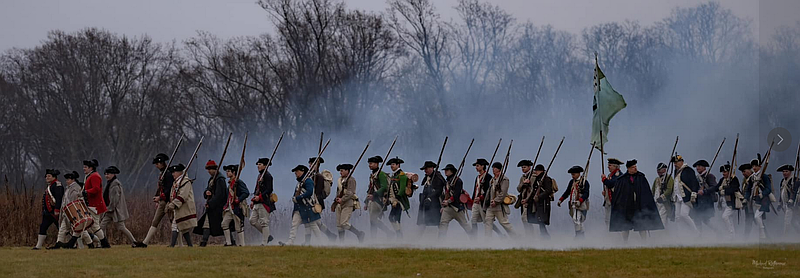
Continental Army troops on the march (Credit: Towamencin History)
The Revolutionary War for Independence that began in Lexington, Massachusetts on April 19, 1775, over a year before independence was declared, eventually made its way to Towamencin on Oct. 8, 1777
(The following is a share from the Towamencin History Facebook page)
TODAY IN TOWAMENCIN - OCTOBER 8, 1777
General Washington and Continental soldiers begin marching into Towamencin. Within a few days 11,000 soldiers were encamped in Towamencin, marching out of Towamencin the morning of October 16, 1777.
The Revolutionary War for Independence that began in Lexington, Massachusetts on April 19, 1775, over a year before independence was declared, eventually made its way to Towamencin.
Although no battles were fought here, Towamencin residents became personally involved in the American War for Independence when General Washington moved his headquarters and most of the Continental Army from various local townships to Towamencin on the morning of October 8, 1777.
On that cool autumn day, hundreds of soldiers marched east on the Skippack Road from Schwenksville, fording the banks of the Skippack, while others came up from Skippack and still more westward from Worcester along the Skippack Road. They all merged into one large army of thousands marching along the present-day Old Forty Foot Road, crossing the Great Road, referred to as the North Wales Road (present day Sumneytown Pike) arriving all day onto quiet Towamencin fields. What a sight that must have been to Towamencin farm families on an otherwise quiet autumn day.
The population of Towamencin at that time was about 390 people. Within the course of a few days, approximately 11,000 soldiers had moved into the township. It would not be until the census of 1980 that the population of Towamencin was again as large!
Today Towamencin holds the honor for having provided General Washington, soon to be the first President of the United States, and the Continental Army a much-needed rest during the war. For nine days and eight nights, thousands of Continental soldiers were camped across Towamencin fields on the Wambold (Wampole) farm. Washington’s headquarters were in the Wambold farmhouse that once stood along present-day Detwiler Road behind the MedComp building.
Continental soldiers were encamped along the Skippack Creek near the Sumneytown Pike and on Lower Salford fields. Farther north along the east bank of the Skippack Creek on Fretz Road in Lower Salford, Brigadier General Pulaski, head of the Continental cavalry known as the Corps of American Light Dragoons, and his staff stayed at Schwenkfelder preacher and farmer Christopher and Rosina Hoffman’s farmhouse. For most of the 19th and 20th centuries, locals knew this farm as the Derstine farm. Soldiers also camped across Fretz Road on Schwenkfelder Christopher Kriebel’s farm.
A thorough examination of General Washington’s personal account books, his correspondence with the Continental Congress, officers in the field, Continental Army ledgers, general orders, General Muhlenberg’s orderly books, and his officers' firsthand accounts reveal how General Washington conducted the business of war each day in October of 1777, from the Frederick Wambold farmhouse at "Headquarters Towamensing" as was penned in official Continental Army records.
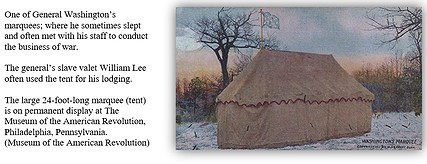 Washington's Marquee used at Towamencin in October of 1777. (Credit: Towamencin History)
Day 1 in Towamencin - Wednesday October 8, 1777
This morning General Washington sent a courier dispatch from his temporary headquarters along the Perkiomen Creek at Pawling’s mill (Pennypacker Mills) in Schwenksville to Brigadier General Varnum. Much of the army was spread throughout Whitpain, Skippack, Evansburg and Schwenksville. The dispatch read "The army here marches this morning [the march was to begin at eight o'clock in the morning] from hence to the Baptist meeting house in Montgomery Township." General Varnum’s brigade in New Jersey was ordered to meet him there. The Baptist meetinghouse built in 1721 was along the Bethlehem Road near present-day Richardson Road in Montgomery Township, on the site of the present-day Montgomery Baptist church. The Baptist meetinghouse is shown on William Scull’s 1759 and 1770 Pennsylvania maps. Nineteenth century historian William Spohn Baker believed General Washington mistakenly meant the Mennonite Meetinghouse in Towamencin Township instead of the Baptist Meetinghouse in Montgomery Township (Mennonites were often referred to as Baptists) since the march ended in Towamencin. Many historians simply followed his conclusion. However, records seem to point to the fact that the Towamencin Mennonite Meetinghouse may not have been present in 1777. The meetinghouse is not shown on the 1752 Christian Lehman survey map of the Skippack Creek area along the Sumneytown Pike in Towamencin, nor is it shown on the 1777 Continental Amy map. Additionally, the Towamencin Mennonite meetinghouse is not referenced in any eighteenth century church, civilian or military accounts.
On October 8, the weather was unusually cool, and the creeks were high from recent rains. Some soldiers had difficulty marching, and men with wagons were assigned to stay behind to pick up stragglers along the way. General Washington halted the Continental Army’s march in Towamencin. This evening it was cold and damp and the first soldiers to arrive were unable to sleep comfortably under the stars. Some huddled together in crowded barns and farmhouses, others in and underneath supply wagons until more tents arrived the next day.
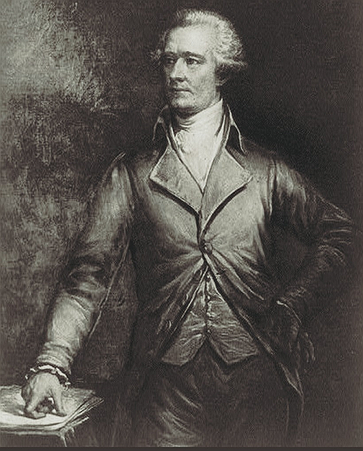 Alexander Hamilton one of General Washington's Aide-de-Camp also spent the week in Towamencin. (Credit: Library of Congress)
One of several general orders issued was "The commanding officers of corps are immediately to select the most suitable of their men, and set them to making mockasins [sic] for their corps. The Commissaries are to order the skins of the heads and legs of bullocks to be taken off and applied to that use so far as they will go. The Commissaries also are to issue the raw hides for the purpose, upon the returns of the officers commanding corps." On several occasions, General Washington penned orders or lamented to congress regarding a lack of proper footwear and other needed supplies and money for the Continental Army. Could the cool and wet conditions coupled with a lack of adequate footwear be why the march ended prematurely in Towamencin?
First Lieutenant James McMichael of the 13th Pennsylvania Regiment wrote in his journal about today’s march into Towamencin.
"8th. At 8 oClock A. M. we march’d from Camp on the W. bank of Perkyomen and Steering S. E. we pass’d Pennybeckers Mill and proceeded some Distance on the Skippack road [Rt. 73] then turning N. N. E. we Cross’d the N. Wales road, [Sumneytown Pike] and proceeded to the road leading from Philad. to Bethlehem [Allentown Road] on Which we Encamp’d 26 miles from Philada. in the Township of Towamensing where we remained for some Days but our Common occurences were not worthy of record"