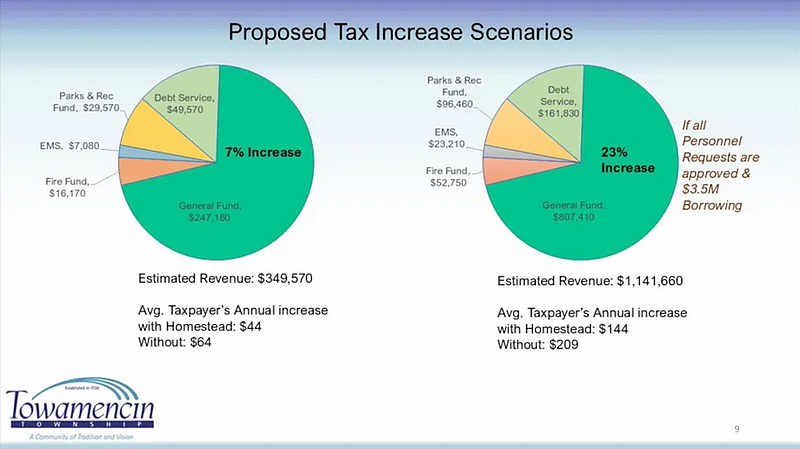
Charts showing projected 2026 tax increase scenarios for Towamencin Township, as presented to that township’s board of supervisors during their Nov. 12, 2025 meeting. (Screenshot of meeting video)
$64 increase would be township's first since 2023
2026 could bring a tax increase for Towamencin’s taxpayers, but one smaller than in recent years.
The township’s supervisors heard several options for possible increases earlier this month, voting ahead a 7 percent tax hike that could cost the average resident an additional $64 per year.
“The main takeaway is a request from the board to consider our recommendations for the tax increase, and for the amount of borrowing that the township needs to consider to fund capital projects,” said township Manager David Kraynik.
In 2024 the township’s supervisors adopted a 2025 budget with no tax or sewer rate increase, the first time in four years neither had been raised, amid an ongoing debate about the sale of the township’s sewer system and how to meet long-term capital needs at their sewer plant and elsewhere around the town. During the Nov. 12 supervisors meeting, Kraynik told the supervisors that staff had held four public budget meetings over the past two months to discuss details, yielding a budget similar to that discussed in the last of those workshops, while incorporating more info asked for by the board including a list of roughly $6.5 million in capital projects requested by department heads.
2025 budget so far
Finance director Eric Reinbott then brought the board up to speed on the 2025 budget picture so far, with the township’s general fund “performing well,” and expected to finish ahead of projections by roughly $700,000 as of mid-November, thanks to several factors: “That’s largely due to lower expenditure costs, strong realty transfer tax revenue, strong public safety revenues, and strong interest earnings.”
That’s before subtracting roughly $1.2 million in annual debt service payments, transfers of $706,000 to the township park and recreation — offset by roughly $670,000 in parks revenue — and a roughly $122,000 deficit from the township fire fund, yielding an overall net deficit of just under $260,000.

With no tax increase, Reinbott told the board, current tax levels are projected to yield a roughly $849,000 deficit in 2026, due to increased costs for the pool, fire, and debt service funds, and the total general fund reserves at the end of 2026 are projected to dip from just over $2 million, down to $1.4 million, “which represents 13.8 percent of the general fund budgeted expenditures,” a number the finance director said is above the township’s fund balance policy requiring ten percent of expense be kept in reserves, but below state recommendations of about 16 percent.
Since the last budget workshop, Reinbott told the board, staff have updated budget projections to include roughly $25,000 in new healthcare costs, and the first draft with no tax increase carries a $650,000 transfer from reserves to balance the budget. Expenses are currently projected to total just under $4.8 million for township police, $2.3 million for public works and parks and recreation, $1.9 million for general government and administration and another $1.5 million for debt service, with an additional $1 million for insurance costs, $700,000 for capital projects and $512,000 for fire expenses included, Reinbott said.
“We had a decrease in workers comp(ensation expenses below projections), so there was a decrease on that section,” he said.
On the revenue side of the budget, projections before any tax increase show the township receiving just under $5 million in real estate tax revenue – less than projected, due to a roughly $5 million drop in the township’s total assessed value — plus another $4.2 million from earned income taxes, $600,000 in real estate transfer taxes and $375,000 in local services taxes, with line items of $1.1 million to account for interfund transfers and $631,000 for intergovernmental transfers from the sewer fund and state aid respectively, Reinbott said.

The finance director then showed a lengthy list of capital projects totaling $10.7 million in requests from department heads, of which $4.6 million would go to sewer infrastructure at the heart of the township’s long-running sewer sale debate, another $2.3 million in stormwater work, $1.2 million for paving and road construction, and just under $1.3 million for projects in several township parks and at the pool.
“This is just the township’s portion of costs, this does not include liquid fuels (state funding), this does not include grant funding, this is strictly just the township’s costs,” he said.
Subtracting those capital requests from various township reserve funds yield a series of deficits, Reinbott added: the township’s parks capital fund currently contains just under $143,000 but staff have requested roughly $1.2 million in parks projects, and general capital reserves start at roughly $145,000 but more than $4.6 million in general capital projects including the stormwater and road work have been identified, he said, yielding a deficit of roughly $3.8 million even if nearly all reserves are tapped.
“The general capital and parks capital alone, represent a funding gap of $4.9 million,” he said.
Talking tax options
The finance director then outlined a series of tax increase scenarios, with the smallest being one that would raise current tax levels by 3.5 percent and yield just over $176,000 in new revenue, and a 5 percent increase that would bring roughly $250,000 in new revenue. The 3.5 percent increase would raise taxes on the average resident by $32, or $22 if factoring in the township’s homestead exemption level of $50,000, while the 5 percent increase would cost the average homeowner an additional $46 without the homestead exemption or $31 with it. A proposed 7 percent increase would yield just under $350,000 in new revenue and cost the average homeowner an additional $64 without the exemption or $44 with it, and a 23 percent increase would yield $1.1 million in new revenue and cost the average homeowner $209 without the homestead exemption or $144 with it, the finance director said.
“This reflects all of the personnel requests, throughout the budget preparation, and a $3.5 million borrowing — that’s the amount we would need to meet that gap for 2026,” Reinbott said. Those personnel requests from department heads break down as three new hires for the police department, one for public works and one for building maintenance, Kraynik added.
As for long-term borrowing, Reinbott said staff and the board have also discussed three possible scenarios: 15-year borrowings of either $3.5 million or $5 million, or a 20-year borrowing of $7.5 million, all of which would go to long-term capital infrastructure and parks capital upgrades. The $3.5 million borrowing would cost the average taxpayer a total of $762 or about $51 per year in added debt service payments, the $5 million borrowing would cost $1,088 or $73 per year, and the $7.5 million borrowing would cost the average taxpayer $1,815 or $90 per year, the finance director said, all based on current interest rates.

The finance director then showed a bar chart depicting the township’s debt schedule over time, with just over $500,000 in payments from a 2019 debt issue scheduled to drop off after 2026, and two new public works dump truck lease-to-purchase debts falling off after 2031. The new borrowings would be wrapped around existing debt so payments on the new borrowings would ramp up as older ones are paid off, Reinbott said, and a Towamencin Municipal Authority note from 2012 scheduled to be paid off in 2035.
“The current debt service in 2027 is about $636,000 lower than 2026 levels,” prior to any new borrowing, Reinbott said.
He then showed a series of charts with the debt payments for the new borrowings overlaid above the current debt, and takin those debt payment schedules out as far as 2046, with a chart of interest rates over the past year.
Staff’s recommendations are that the board consider the 7 percent or 0.4 mill tax increase for 2026, which would create about $247,000 in new revenue and cost the average resident $64 per year, or $44 if they claim the homestead exemption, plus proceeding with a $5 million borrowing to be paid back over 15 years. Doing so would raise the township’s real estate tax millage rate to 6.089 mills and be the first such increase since 2023, the finance director said.
“The township raised taxes in 2010, and there was no tax increase for another 10 years. In ’21 there was an increase of 19.7 percent. In ’23, almost a 25 percent increase. The tax increase we’re talking about here, is 7 percent,” Kraynik said.
Board debate options
Supervisor Kofi Osei asked about the impact to the township’s tax millage if they borrowed $3.5 million in the first year and $1.5 million in the second year, and Reinbott said he would recommend doing the full tax increase in the first year, instead of two in back to back years.
“That way, we’re having a principal payment for the first borrowing in 2027,” he said. “It gives us a buffer if we have any drastic increases” in costs.
Supervisor Chuck Wilson asked if staff saw any possible surplus if they revisited the 2025 budget actual figures versus projections again, noting a roughly $1 million surplus ahead of projected expenses for 2024.
“It wouldn’t be necessary if you’re off that much again this year,” Wilson said.
Reinbott said any such surplus would be transferred to capital reserves for use on that project list, and the draft budget already included $1.1 million in such a transfer.
“Even if we had an overage of $800,000, that just covers two projects,” Reinbott said.
Wilson then asked if the finance director saw any possibilities for a large surplus by the end of 2025, and Reinbott said several commercial properties plus “$300-some-thousand” in permit costs for renovations to North Penn High School could yield a surplus for the current year, but one already accounted for by the transfers in the draft 2026 budget.
“Of that $1 million, three-quarters of it is from realty transfer tax, and from North Penn School District permit fees,” he said.
Wilson then asked if staff had seen any transfer tax money from sales of properties currently up for redevelopment, including several proposed residential developments along Sumneytown Pike, and the manager said those funds are not included in the budget because they’re not in the township’s hands yet.
“We haven’t seen any of that money yet, and we don’t know when we’re going to get it,” Kraynik said. “That’s conservative. That’s the way this township has always budgeted.”
“If you don’t want to raise taxes, that’s fine. You’re not going to be able to get anywhere near the capital budget projects that you asked,” Kraynik said.

Reinbott then added that the capital list could be reduced by grants from outside sources, but the township would still need reserves in hand to match those grants.
“You need the funding up front, to get the grant funding. I understand where you’re coming from, but if we don’t have the money up front to get the grant started, and wait for the reimbursement, that’s an issue too,” he said.
Osei then asked if the finance director thought the transfer tax line item should be increased to account for the pending development of the former Freddy Hill Farms site, drawing pushback from Kraynik and supervisor Kristin Warner: “I don’t like to count my chickens before they hatch,” Warner said, and Kraynik added: “You want to guess, guess. But we suggest you don’t do it.”
Board chair Joyce Snyder then asked for a board consensus, and Warner made a motion to advertise the budget with the staff recommendations including the 7 percent tax increase. Osei then said he’d like to see line items for Veterans Park near Allentown Road, partially reliant on development of the adjacent shopping center, and for a part of the Kriebel Road Trail be swapped for 2026 and 2027 respectively, and Reinbott said he could make those adjustments.
“That would be at the recommended levels, for the tax increase, and for the borrowing that Eric and I have suggested?” Kraynik said, and Snyder agreed.
All five supervisors then voted unanimously to do so, and the manager said a final vote to adopt the budget could be held when the board meets on Dec. 10.
Towamencin’s supervisors next meet at 7 pm. on Nov. 25 and Dec. 10 at the township administration building, 1090 Troxel Road; for more information visit www.Towamencin.org.
This article appears courtesy of a content share agreement between North Penn Now and The Reporter. To read more stories like this, visit https://www.thereporteronline.com.