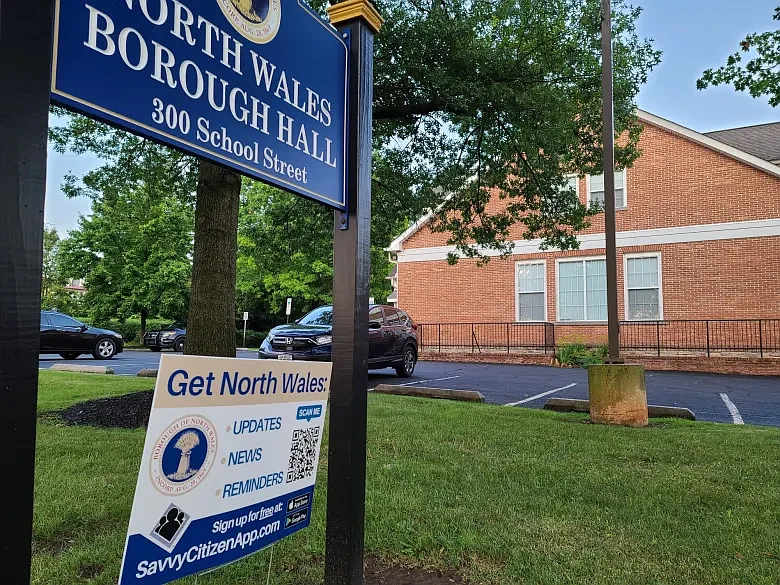
A sign indicating how to sign up for the “Savvy Citizen” app stands outside North Wales Borough Hall on Tuesday, July 25 2023. Photo by Dan Sokil | The Reporter.
One-mill hike could equal $150 for average resident
Another tax hike could be on the horizon in North Wales.
Council members voted unanimously this week to advance a roughly $150 tax increase they say is meant to address several needs.
“I have been agonizing over this budget. It’s been so heavy on my mind, especially at this specific time of year,” said council Vice President Wendy McClure.
In late 2023 council approved a $9.4 million budget for 2024, with a one-mill tax increase, yielding a tax bill just over $907 or $75 a month for the town’s average resident with a property assessed at just over $129,000. The 2025 budget kept those tax levels and balanced revenues and expenses at roughly $8.6 million due to a reduction in grant-funded work from the year before.
During October talks for the 2026 budget, borough Manager Christine Hart warned of dropping revenues from real estate transfer taxes and interest earnings. The first draft of the budget was based on a real estate tax millage rate of 7.0 mills, which was last raised in late 2023 for 2024.
New news for 2026 budget
Since those October presentations, Hart told council on Nov. 18, she’s continued talks with the town’s finance committee and various department heads, and those talks have centered around several possible cost increases for council to consider. Earlier this month the town received word from their outside energy advisor on the borough’s electric contract, currently scheduled to expire at the end of the year, with warnings of higher costs coming soon.
“In this market, we aren’t getting that (rate) anymore,” Hart said, and rates for the next contract to power facilities including the municipal building, borough-owned arts center on Main Street, and public works facilities could as much as double the roughly $20,000 line item for electricity for the current year.
Other news since the last round of talks include word of possible police retirements coming in 2026, which could come with retirement payouts for departing officers as well as hiring and outfitting costs for any new ones. A new assistant manager has been hired to fill a position vacant since June, the manager added, and staff and council are currently discussing whether a vacant full time public works supervisor position could be replaced with added responsibilities for remaining staff.
Hatfield-based ambulance corps VMSC-EMS has approached several municipalities they cover about securing a regular funding stream from those towns. The borough’s budget included a $20,000 contribution in 2024, but that number was cut to $10,000 for 2025, the manager said.
“I think a lot of times, people don’t realize that ambulance service is not guaranteed, and the state does not mandate coverage, as they do fire. We are very fortunate to live in a community where we call 911 and an ambulance comes. Unfortunately, there’s a cost to that,” Hart said.
Thus, a request from the finance committee to vet and discuss two versions of the budget, one with current millage levels and one with an increase from 7.0 to 8.0 mills.
Of the town’s annual revenues, roughly half come from that tax millage, with another $625,000 projected from earned income taxes, $58,000 in local services tax, and $55,000 in transfer taxes. On the expense side, costs for the town’s police department are projected to be just under $927,000, with an additional $452,000 for administration and engineering, $210,000 for public works, and a $9,000 line item for legislative costs including council stipends, the manager said — “Very important, but you’re not getting paid very much to do it.”
Ambulance corps could secure funding
Adding roughly $100,000 in new revenue via the one-mill tax increase could allow the town to establish a new “ambulance service” fund for VMSC with a roughly $20,000 allocation per year, according to the manager, while adding just over $20,000 to the town’s streetlight fund for added electric costs there.
“One of the problems we’re going to be facing, as a municipality, is that our municipal electric costs could skyrocket. By increasing our millage for street lighting, that’s going to help us cover some of those costs,” said council President Mark Tarlecki. “Right now we don’t know what they’re going to look like, but we want to be ready.”
The tax increase would also fund an increase from $45,000 to just over $50,000 to the town’s contribution to the North Penn Volunteer Fire Company, roughly $2,000 more to the North Wales Area Library, and smaller increases elsewhere in the budget. The proposed one-mill tax increase would be based on a property’s assessed value, the manager said, with the average assessed property value of $129,800 seeing an increase in their annual tax bill from $885 to $1,038, a hike of $153 for the year or just under $13 per month.
“Mathematically, for every $100,000 you’re assessed, it’s $100 a year. So if you’re assessed for $300,000 this increase would cost you $300 a year,” Hart said.
Without that increase, the town’s general fund would yield a projected deficit of roughly $14,000, which likely could be made up from interest earnings on reserves, the manager said — but the tax increase would more than make up for that deficit, plus allow the increases elsewhere.
“It’s a decision that council needs to make,” Hart said.
Hart said a vote to advertise the budget on Nov. 18 would allow the town to adopt the budget on Dec. 9, and an updated tax ordinance with the new rate could then be approved at their final meeting of the year on Dec. 23.
North Wales borough council next meets at 7 p.m. on Nov. 25 at the borough municipal building, 300 School Street; for more information, visit www.NorthWalesBorough.org.
This article appears courtesy of a content share agreement between North Penn Now and The Reporter. To read more stories like this, visit https://www.thereporteronline.com