Residents sound off for hours for and against work force housing apartments
Two years after a first round of debate, Upper Gwynedd officials have approved a controversial project for 60 apartments on Pennbrook Parkway.
“What we find attractive about the community is that it’s walkable to the train station. Upper Gwynedd is a very nice town. That land is not easy to find,” said Ed Speitel, vice president of land development for New Jersey-based developer The Walters Group.
The approval was a long time in coming, as the project proposal became a hotbed of opinions about housing in the region.
The Walters Group proposal included what the developer termed “workforce housing,” meant for residents who meet certain low-income qualifications. In the months between the first presentation and the vote before an overflow crowd that August to approve a needed zoning change, residents questioned the need for, and motivation behind the project, while the developer, county officials, and even elected officials from nearby municipalities argued that the project would help address housing needs in the county.
The project, which was named the ‘Cornerstone at Upper Gwynedd,’ received a MontcoForward low-interest loan as part of an incentivizing program to increase affordable housing options in the county.
Decision time
During a packed commissioners meeting on Monday night, Speitel and attorney Joe Clement led a team of consultants in detailing the plans before dozens of residents and housing advocates spoke in protest and support. Several residents opposed to the project sought to have formal party status during the hearing, making them eligible to provide their own witness testimony and cross-examine the consultants.
After a lengthy back-and-forth about their qualifications to do so, township solicitor Lauren Gallagher recommended and the board granted that party status to residents Teresa Price, Hilary Devlin, Fred Hencken, Martin Benedetto and Justin Griffith, while denying it to residents Carl and Linda Smith, Viraf Jacob; all subsequently spoke on the project during the public comment portion of the hearing, and attorney Christopher Papa represented Price, Smith and Hencken during their questioning.
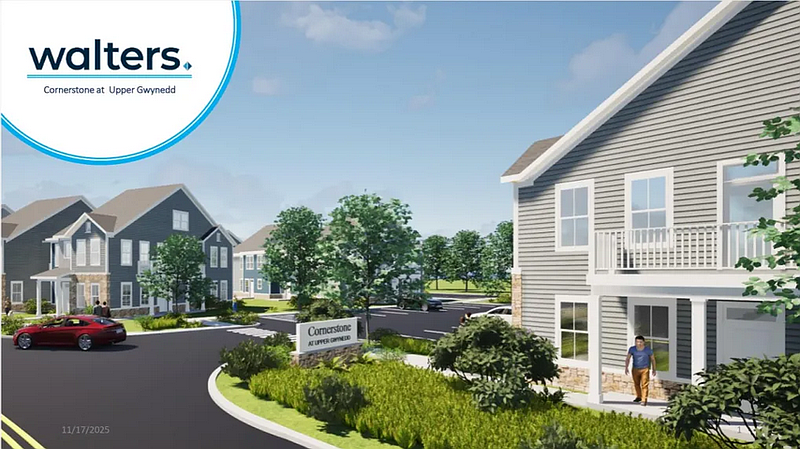
Walters currently operates roughly 2,000 workforce housing units, largely in New Jersey, and chose the Pennbrook site for several reasons, Speitel told the board. The plans up for discussion include a total of 60 units in a total of six buildings, in a mix of 27 one-bedroom, 20 two-bedroom and 13 three-bedroom units, with 117 total parking spaces on the 5.6-acre site.

As he spoke, Speitel showed photos of similar amenities, interior layouts and furnishings at other Walters developments, along with a series of overhead site and floor plans and street view renderings of the complex. “Of importance to note is the bathroom locations, the nice living areas, kitchen sizes, and every unit has a porch or a patio,” Speitel said.
Walters would own and manage the site, with an onsite manager and 24/7 emergency line, Speitel said.
“We have a lease agreement that spells out … rules. For example, one of those is: the porches and balconies that we incorporate, they’re a nice feature, but they can look really unsightly when someone has their bikes hanging out on them, or towels hanging over them. So these are the types of things we put into our lease and tightly manage,” Speitel said.
In response to questions, Speitel said the owners would conduct criminal background checks on potential tenants plus checks for Megan’s Law, and those “with a criminal background, within a certain amount of time, are not allowed to live here.”
‘The American dream’
Residents from both within and outside Upper Gwynedd spoke in favor of the project, including Joanne Mahoney, who said she’s lived in the township since 2014, after living in a “starter house” in Lansdale not far from a similar industrial area, then sold that house to move to a larger one in Hatfield.
“Because the house was affordable, we could save. And that type of situation does not exist now. We need to give more people that opportunity to ‘live the American dream,’ because that’s what it is — the ability to move up, to buy that additional house five years later, that’s the definition of the American dream,” she said.
Mike Hays, director of the Montco 30 Percent Project which held a rally in support of the project last week, said he’s now a resident of Pottstown and has seen residents across the county move up the housing scale, including his own parents who recently moved into a similar community after moving out of a mobile home community in Hatfield.
“This development has the potential to transform the lives of 60 individuals and families,” he said. “Housing is a public good, in my opinion, that may be best delivered through our collective efforts, just like this. North Penn is a wonderful, welcoming community, and I hope more people get to experience that.”
Kristyn DiDominick, executive director of the Bucks-Mont Collaborative nonprofit that advocates for affordable housing, said she lived and worked in nearby Lansdale for a decade and saw the need for such housing up close.
“For me, it’s not about abstract units. It’s about folks who could be our neighbors: the preschool aide who knows every child’s name. The night shift nurse, who when you show up, gets you through the worst hours. The firefighter who shows up when seconds matter. They should be able to live where they serve,” she said.
“Right now, 46 percent of renters in Upper Gwynedd, and nearly half across Montgomery County, are paying 30 percent of their income just on rent. Those are cost- burdened. And imagine what families could invest in: childcare, local businesses, if they weren’t forced to spend so much to put a roof over their head,” DiDominick said.

Nancy Raabe of Hatfield said she thought the fears from opponents were “completely understandable,” before asking the board to take a different view.
“I want you to consider what it is like to not have a home to come home to. What it is like to not be able to say, ‘I’m going home,’ because you have no home. That is the situation that many people facing these high rents are in the predicament of having to consider,” she said. “These kinds of projects bring hope — hope for the future, hope for communities, hope for all those who didn’t have that to grab onto beforehand.”
Charlene Flaherty said she works within Montgomery County’s office of housing and community development, which has pledged to back the project with roughly $2.6 million via federal and county-administered funding streams: “We’re able to relieve the debt burden, which means the developer can bring the rents down. This is not public housing, there are no vouchers, but because of this investment of dollars from outside our community, we’re able to offer these lower rents.”
Housing security
Amy Ryan Faga said she taught at nearby North Wales Elementary School and saw a family fight for housing up close.
“I knew a family that was housing insecure for months, as they moved in with different family members and friends. They were unable to pay their rent, as the father was downsized and lost his job. As you can imagine, this was traumatic and difficult for the children. They didn’t want to leave their school and their friends,” she said.
“That family eventually moved away, in search of more affordable housing. I am advocating for the Cornerstone at Pennbrook to be built, to give families more affordable housing choices in the North Penn School District. Two working parents deserve a chance to live in a nice community, where they’re not overextended financially,” she said.
Dennis Wendt said he saw only benefits: “optimal location: it’s near mass transit, and I see a need for new housing. You can’t turn on the news and not see a story about housing affordability. You see it every day you turn on the news, and I see a proposed solution.”
And Mark Connelly said he moved to the township in 2017 at a price level that’s all but unattainable now, and thought the new plan and updated zoning both comply with the town’s latest updates to both, and asked what would happen to the community if the project did not advance.
“You’re going to see a whole generation of people who aren’t going to be able to afford to live in the township. If I were to sell today, I’d probably $100,000 more than I paid — these are just staggering numbers,” he said.
Plenty of concerns
Several residents spoke out against the project too, starting with Teresa Price, who said she’s lived in the township for ten years, “maybe 50 or 75 feet” from the rail lines bordering the site, and had plenty of concerns, particularly with rental units near her that don’t mow lawns or take care of their properties: “I like Upper Gwynedd, it is a very nice neighborhood, and I would like it to stay that way.”
“Having past experience, of being a Norristown resident, I think it will be a negative effect. I’ve seen it, I’ve gone through it. Norristown now is probably 75 percent rentals; I had a house there, and I had to do a short sale to get rid of it, because the property values plummeted,” she said.
Price said she was also concerned about homeless who camp in in the nearby woods and possible crime increases from new residents there. Township Commissioner Greg Moll answered by asking if Price recalled the 2023 hearing when police Chief Dave Duffy said he had contacted his counterparts in several communities with similar developments who saw no such increase in crime.
“Housing values, and crime: I know those are concerns, not only of yourself, but of some of the people in the room, and frankly some of the commissioners. Those concerns were assuaged for this commissioner, when the chief did a lot of due diligence,” Moll said.
Papa then triggered a lengthy round of sparring by calling Hencken as an expert in property values, citing his 40 years as a resident and 15 as a local real estate agent as qualifications for being an expert, then asked what he thought such a development would do to surrounding property values.
“In my professional opinion, this type of project, being close to other residential properties, would deflate those property values to some extent. Depending on market demand, and some other factors you don’t have control over,” Hencken said.
Papa summarized the arguments from residents opposing the project, saying they felt the board had approved “spot zoning” for one specific project on one parcel in 2023, going against the community’s prior plans for the site as spelled out in the industrial zoning, and said they had concerns about traffic, noise and light pollution, and worries about those who would live there.
“This community has eight residential zones. I don’t believe there is a great need for more residential zones. And when the community was crafted, this was industrial,” Papa said. “We think that sort of, kind of, not really but does make the current zoning scheme completely incoherent and nonsensical.”
Carl Smith said he had “zero interest, motivation, or desire, to be complicit in this illegal and unconstitutional spot zoning,” and said he thought the plan was part of “a push to urbanize the suburbs.” Tom Price said he was unclear on how more residents in new units would be any benefit to those already living nearby, and asked if the township and taxpayers would be responsible for any infrastructure needed for the development.
Devlin said she didn’t oppose the project in concept, but on that site, and said she had seen property damaged in her community near Jackson Street from renters who lived nearby.
“I question the effectiveness, the efficiency, and the equitability of it. This is being put on ground that is open space, when I see empty commercial buildings everywhere, for lease. I would like to see repurposing of buildings that already exist: I really would like to see that more than using open land here,” she said.
Too much, too fast
Catherine Craig said she’s lived in the community for 15 years, and seen traffic and development increase, faster than the area can handle: “I can’t imagine adding more fuel to the fire, with more traffic congestion. Housing is good, but open spaces are good too,” Craig said.
Her brother worked as a manager of a similar property in Norristown, and “was there 24/7 to take care of what needed to be taken care of,” Craig added, before adding concerns about the impact to schools and wildlife from the new residents.
Jason Lanier of Lansdale said he saw other reasons for increasing costs, citing the ongoing renovations to North Penn High School, and accompanying tax increases by that school board, plus a recently discussed county tax increase, as main drivers.
“All this means that everyone who lives in this area, the North Penn area, will see their taxes increase indefinitely, to pay for the debt load we are going to take on,” Lanier said. “The county is saying they’re going to subsidize this. With what money? The county doesn’t have money, it takes our money, and redistributes it…You want to reduce the price of housing? Reduce taxes! It’s gonna make housing affordable for 60 residents? OK – the rest of us get screwed.”
Deborah Worstell said she’s lived in the area 35 years, has sold property across the region, and has a friend and a child who have seen crimes including theft and vandalism in similar apartment complexes in other towns. And Michael Bencosky said he’s lived in the area since 1979, and in that time has seen numerous empty properties developed into townhomes with high price tags: “I love this town. I just don’t want it to go to pot. Subsidized housing is just not for this town.”
Final vote
Following roughly four hours of testimony and comments, the commissioners then closed the public hearing, and voted unanimously to approve the conditional use request from Walters, with no further comments. Several minutes later, the board took up talks on the formal land development plans, and Speitel addressed the question of how the developer would work with police, township staff, and county agencies or local nonprofits to help the homeless living in the woods near the site now.
“I know the county has certain resources, as does Access Services, and we have had some preliminary conversations with them months ago. It would look like us reaching out to Access, to try to help them find suitable alternatives of some sort, to get them off of this property and out of the immediate area,” he said.
The commissioners voted unanimously to grant the land development plan approval, subject to the terms and conditions spelled out.
Speitel said afterward that his firm plans to finalize financing and start construction “around March 2026,” and that work could take roughly 18 months.
“Since there are multiple buildings, we expect to have the clubhouse complete and start occupying some of the units about 14-15 months in,” he said.
Papa said Thursday he and the residents opposed to the project plan to file a land use appeal to the Montgomery Count Court of Common Pleas arguing that the project was spot zoning, and would likely do so by the end of the year.
“Creating an ordinance for the purpose of facilitating one particular development, that’s sort of the classic definition of spot zoning. I think that’s exactly what’s going on, and we are going to file an appeal,” he said.
Upper Gwynedd’s commissioners next meet at 7 p.m. on Dec. 1 at the township administration building, 1 Parkside Place. For more information visit www.UpperGwynedd.org.
This article appears courtesy of a content share agreement between North Penn Now and The Reporter. To read more stories like this, visit https://www.thereporteronline.com