Walk into almost any modern laboratory and you’ll probably picture rows of advanced machines humming away, building the clean technologies of tomorrow. The surprising truth? Some of the most useful tools aren’t machines at all—they’re microscopic enzymes pulled from soil, ocean water, or even the surface of a leaf. These natural catalysts are beginning to help industries reduce waste, handle materials more gently, and rely less on harsh chemical processes. In a world actively searching for cleaner, smarter ways to operate, researchers are discovering that nature has already done much of the work. The real challenge is learning how to uncover, understand, and apply what’s already out there.
Enzymes stand out because they do difficult work without demanding much in return. Many traditional industrial reactions require high heat or strong solvents, and they often generate unwanted byproducts. Enzymes, on the other hand, usually perform under mild, water-based conditions and target only the molecules they’re meant to act on. This precision makes them appealing to companies looking to reduce emissions, improve efficiency, or simply use fewer chemicals overall.
But although enzymes are everywhere in nature, finding the right one is rarely straightforward. There are countless varieties, most of which have never been isolated or studied. Because of this, many scientists turn to professional Enzyme Discovery Services to help identify promising candidates that could support more sustainable innovation.
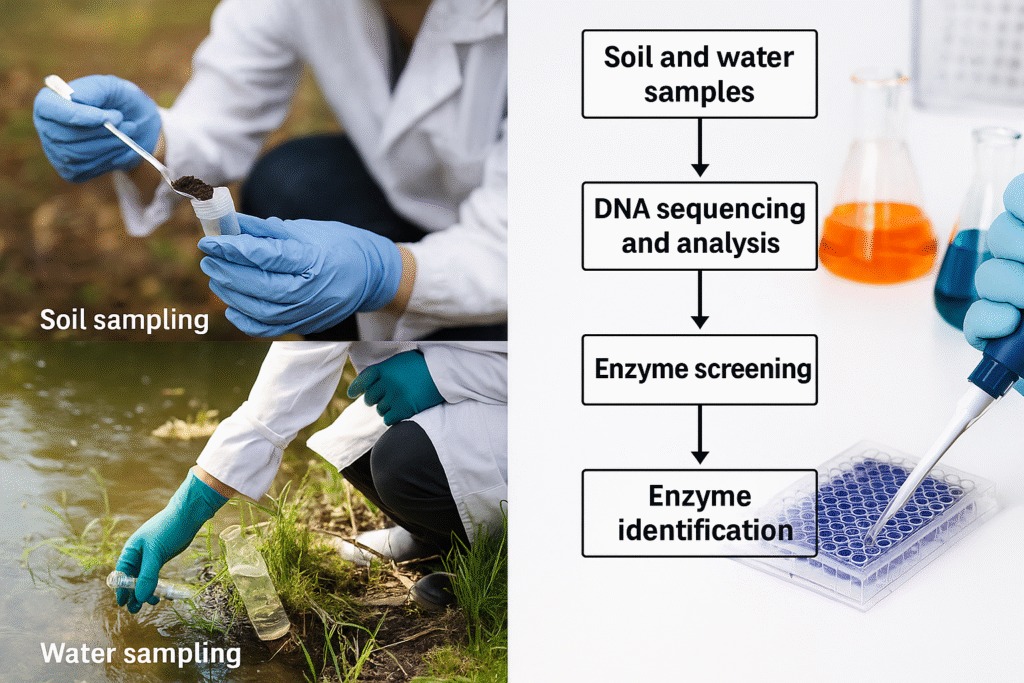
The search for new enzymes doesn’t follow a single path. Some researchers literally go outdoors—collecting small samples of soil, water, or plant microbiomes and studying the organisms within them. Every sample contains a mix of genetic material that might lead to a useful enzyme.
Others start their work inside giant digital libraries. With genome mining and metagenomic tools, scientists scan millions of gene sequences looking for features that hint at helpful catalytic behavior. This approach widens the search dramatically, allowing researchers to find potential enzymes that they may never have encountered in nature.
Of course, identifying a promising sequence or isolating a new enzyme is only the beginning. To determine whether an enzyme can be used in real processes, scientists typically rely on advanced Enzyme Screening Services that test performance under different temperatures, pH levels, and processing conditions. Screening is what reveals which enzymes hold up, which fall apart, and which show enough promise to move forward.
An enzyme that behaves beautifully in an isolated experiment may react very differently when placed into a fast-moving industrial workflow. Real-world environments expose enzymes to heat, pressure, fluctuating conditions, and sometimes harsh ingredients. Without careful screening, it’s impossible to know whether a newly discovered enzyme can deliver consistent, reliable performance.
This evaluation step narrows a crowded field of possibilities into a focused set of practical options. The enzymes that make it through screening tend to be the ones capable of supporting cleaner manufacturing, reducing chemical waste, or improving specific product processes. In this way, screening turns theoretical discovery into usable, real-world technology.
Although enzymes operate invisibly at the molecular level, the effects of enzyme-powered innovation are increasingly visible in daily life and across major industries.
In fields like textiles, paper, and specialty chemicals, certain steps traditionally require high temperatures or aggressive solvents. Enzyme-based approaches can replace some of these methods, lowering water and energy use while reducing unwanted byproducts. Manufacturers maintain performance while operating more responsibly.
Food producers use enzymes to simplify and improve production. They help generate plant-based proteins with better textures, support lactose-free dairy, and reduce dependence on certain additives. Because enzymes work at low temperatures, ingredients stay closer to their natural state—leading to cleaner labels and fewer intensive processing steps.
In healthcare, enzymes are essential behind the scenes. Techniques like PCR rely on enzymes to amplify DNA quickly and accurately. Enzymes also play roles in precision therapies and other diagnostic platforms where specificity matters. These applications reflect widely known scientific principles and continue to expand as medical technology evolves.
Enzymes are also used in environmental applications. Certain scientifically engineered enzymes can break down specific types of persistent compounds. Others help treat wastewater by degrading pollutants that chemical methods may struggle with. Because these approaches align with natural processes, they offer sustainable paths for environmental management.
As industries work to reduce emissions and energy consumption, enzyme-based technologies offer a compelling alternative. Their ability to function under mild conditions naturally supports lower-carbon operations. Enzymes also integrate well with biological and circular-economy systems, allowing processes to echo natural cycles rather than rely on resource-heavy chemical reactions.
With ongoing progress in enzyme discovery and screening, researchers are steadily expanding the list of challenges enzymes can help solve—whether in manufacturing, environmental protection, or materials innovation. What once seemed like a niche area of biotechnology is gradually becoming a key part of sustainable development.
Clean technology isn’t driven only by large machines or sweeping infrastructure changes. It’s also being shaped at a microscopic level by enzymes that have been part of natural systems since long before humans began studying them. By discovering, testing, and applying these biological catalysts, scientists are opening the door to solutions that are efficient, scalable, and aligned with long-term environmental goals. Enzymes offer a reminder that sometimes the most meaningful innovations come from paying close attention to what nature has already mastered. As applications continue to grow, enzyme-based technologies are set to play an increasingly important role in building a more sustainable future.