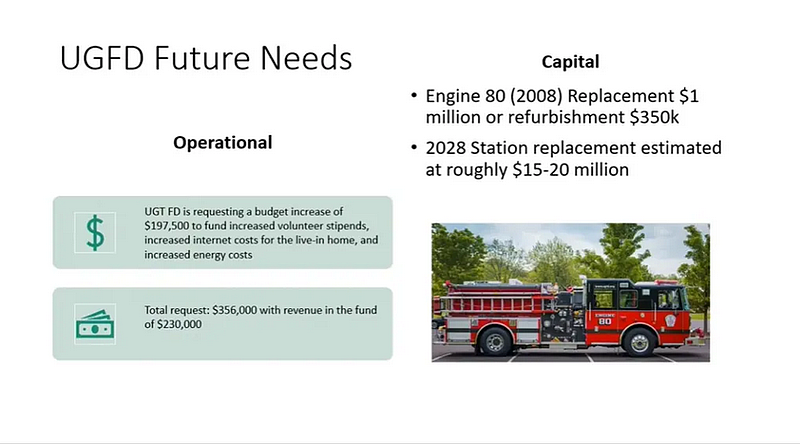
Slide showing Upper Gwynedd Township’s fire capital needs that could be funded in 2026 from a proposed fire tax increase, as shown to township commissioners on Monday, Nov. 10, 2025. (Screenshot of meeting video)
Staff cite future fire station as main driver of fire tax hike
For the first time in nearly a decade, a tax increase could soon be on the books in Upper Gwynedd.
Township staff made the case last week for an increase to the town’s fire tax, citing a long to-do list of projects that tax increase would help fund.
“Here’s what you have all been waiting for: the fire fund proposed tax increase is coming in at 0.63 mills, or about $100 per average assessed property,” said township Manager Sandra Brookley Zadell.
“We last raised taxes in 2017, in 2025 we did a small reallocation of the millage, and in 2026 we’re proposing the increase,” she said.

Each year the manager leads a series of public budget discussions in the fall where staff, the board of commissioners, and residents debate and discuss their planned projects for the upcoming year, before the board votes to advertise a preliminary budget and tax ordinance in November and finalize both in December. During the Nov. 10 meeting the manager outlined those talks so far, citing two major capital needs in the coming year as reasons for the proposed tax increase.
“We have an all-volunteer fire department, and they operate in (West Point) village, on Garfield (Avenue). The building is quite outdated, and small for the needs of a modern fire department, so it has been on our capital plan to replace that building,” the manager said.
In recent years the board has discussed options for renovating that building or examining sites elsewhere in the township, and has also voted ahead a study to look at whether regionalizing fire services with neighboring municipalities could be an option. No decision has been made yet, the manager told the commissioners, but the township’s fire tax allocation that covers annual operating expenses for the fire company could also be tapped for that effort.
“This funds only fire operations: totally fine in 2025, but in 2026 based on the operating expenses and planned capital expenditures, we start to not have enough funding, to fund the capital plan. And that situation just gets worse as we move forward,” she said.
“We have joined forces with Lower Gwynedd, Ambler, and North Wales to investigate all of the fire departments that serve those towns, to see if there’s some overlap in operations, and ways that we could work together to reduce duplication of apparatus, duplication of staff, and duplication of facilities,” she said.
That fire fund currently contains a balance of roughly $598,000 and operational expenses for 2026 are projected at just shy of $400,000, but the long-term capital budget also includes $500,000 toward the new station project, and a placeholder figure of $20 million in expenses for “building replacement” and an $8 million bond borrowing tentatively scheduled for 2028 for that project.
“As that (regionalization) study is happening, we still have aging fire equipment and operations of the Upper Gwynedd Fire Department that we need to plan and be ready for,” she said.
Smaller capital needs for the township fire marshal’s office in 2026 include a new vehicle and new stationary gates meant to barricade drivers from flood-prone areas during heavy storms, per the manager, while the fire department’s budget also includes $350,000 toward upgrades to Engine 80, currently the oldest firetruck still in service.
“That is a 2008 vehicle. These days, replacing a firetruck costs between $1 million and $2 million, depending on the piece of apparatus, which is outrageously expensive,” she said.
“One thing we’re looking at for next year is, rather than replacing the engine, looking at a potential refurbishment. That’s something the fire department is working on,” Zadell said, and could need board approval since the township owns the vehicle.
Annual expenses
For the upcoming year, the fire department has asked for just under $200,000 more in revenue to cover operational expenses, largely for firefighter stipends and utilities for a house owned by the department where firefighters live and work at minimal cost to stay near the station in case of emergencies.
“One of the ways we bolster our department is our live-in program where, mostly young people, live for free in a house that the fire department owns, in exchange for hours of service they provide to the fire department. It’s very creative,” Zadell said.

The fire company’s capital reserves have hovered around $500,000 ever since purchasing two vehicles in 2021, but the refurbishment to Engine 80 could nearly deplete that fund, thus the tax increase that could generate roughly $900,000 in new revenue for that fund each year.
“The question may be, ‘Sandra, why do you want to have such a huge surplus in that fund?’ My answer is, fire trucks cost one to two million dollars, and the fire station is going to cost $15 million. So if we go down that path, we need to be able to pay for it,” she said.
Long-term budget breakdown
So far for 2025, revenues and expenses are tracking to yield a roughly $700,000 surplus, and staff have suggested that surplus could be transferred into reserve to tackle future capital projects. Staff have identified a long-term capital project list of roughly $64 million in infrastructure needs the board will need to address in the long-term, the manager added, and an $8 million transfer from reserves this year could help tackle much of that to-do list, plus relatively low debt loads now could mean a bond borrowing in the near future to tackle more of those needs.
“When we’re planning a project, and making a 30-year investment into our community, we don’t want the taxpayers of today to pay for that 30-year cost. We want to spread that cost over 30 years, so the taxpayers of today and of tomorrow are helping to fund that cost,” Zadell said.
The separate sewer capital fund, meant to cover expenses and projects at the township wastewater treatment plant, “is doing really well” and currently sits at roughly $5.6 million in available funds, with several projects slated for the next three years that could draw down that fund by the end of the decade.
“I don’t get too worried about that, because between now and 2029 probably a lot will change with our plan,” Zadell said, including grant funding for certain projects that could help that fund stretch further.
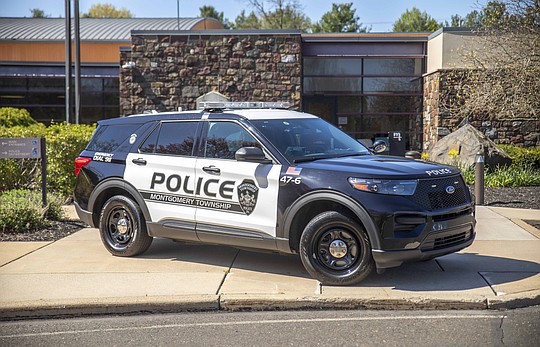
Smaller capital projects included in the budget include HVAC and safety upgrades to the administration building, a new police vehicle, a new pole barn and pickleball court for parks and recreation, a public works dump truck to replace a 2000 model year truck still in use, and $4.5 million for replacement of a bridge on Sumneytown Pike and relocation of an adjacent pedestrian bridge, plus just under $1 million in annual road paving.

Of the township’s total tax millage, in 2025 the 2.0410 mills are allocated to give roughly 60 percent or 1.584 mills to the general fund, 29 percent or 0.139 mills to the fire fund, 11 percent or 0.29 mills to debt service, and one percent or 0.028 mills to the fire hydrant and water district. With the proposed increase, the fire tax millage would jump to 0.7690 mills and total township millage to 2.6710, with details provided in the township’s budget presentation and documents, the manager said, before showing a chart of several communities in the township, their assessed values, and the corresponding township tax bill.
“Your home might be worth $500K, but the assessed value is frozen from the 1990s, so we did a sample of neighborhoods, and you can see the average tax bill changes, depending on the neighborhood,” she said.
Commissioner Greg Moll thanked the manager and staff for “going over proposed budgets, refined budgets, sharpening the pencil in a lot of different departments.” Commissioner Liz McNaney said budget talks were “different this year, in a good way,” with added transparency and capital funds broken out to better track long-term expenses. and commissioner Denise Hull led a round of applause for Zadell, who she called “the maestro” of the budget process, and the rest of staff for their input.
The five commissioners voted unanimously to advertise the budget and tax ordinance for public input before formal adoption in December.
For more information visit www.UpperGwynedd.org.
This article appears courtesy of a content share agreement between North Penn Now and The Reporter. To read more stories like this, visit https://www.thereporteronline.com