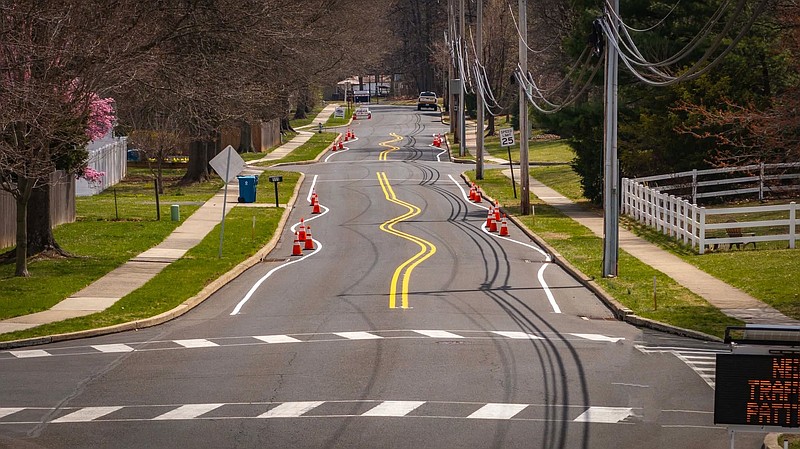
Chicanes on Grays Lane in Montgomery Township Photo by James Short.
After nearly an hour discussion Monday night, supervisors believed it best to remove the traffic calming measures implemented a month ago
The Montgomery Township Public Works Department has been tasked by the board of supervisors Monday night to schedule the removal of chicane delineators and grinding off of associated line striping from Grays Lane, after the traffic calming measure has been in place for one month.
Township Manager Carolyn McCreary, in her township manager report near the end of the supervisors meeting Monday night, said staff and traffic engineer Gilmore & Associates discussed the issues residents expressed with the traffic calming measures and recommended that supervisors keep the installation in place for six months, allowing the public to adjust to it and the police’s Highway Safety Unit and traffic engineers to monitor the speed to determine its effectiveness.
“The Highway Safety Unit will conduct directed speed enforcement of this area with zero tolerance, that means there will not be warnings given out if someone is found speeding thorough that area,” McCreary said. “They will be given a ticket, including any points that apply with it.”
Furthermore, McCreary recommended that supervisors hire a third-party engineering firm to analyze the entirety of Grays Lane, to determine if more traffic calming measures are warranted.
All reports and analyses would then be discussed and shared with the township Public Safety Committee and then shared with supervisors at a public meeting.
Montgomery Township Police Chief William Peoples reported that there have been five different selective enforcements in one month on Grays Lane.
Out of more than 218 vehicles, there was one violation for driving at 38 mph.
“Besides that,” Peoples said, “the highest speed was 33 mph.”
The Board of Supervisors approved the $7,578 purchase and installation of 108 Pexco-brand posts, anchor bolts, and signage, and line striping contract on Feb. 26, 2024 in a 4-0 vote, with then Chairwoman Candyce Chimera absent from the meeting.
Supervisors Chairman Audrey Ware-Jones said the topic needs to be discussed a little bit more, especially in the wake of public comment on the issue from two weeks prior.
“I too felt like, let’s give it some time, just to be quite honest, to see if it is an effective calming method, so that we have it in I’ll say in our back pocket, for a lack of a better term, to be considered elsewhere or whatever the case may be,” Ware-Jones said. “I will say this: after all of the residents that came and shared their thoughts and didn’t like it, didn’t like what we did, I definitely feel, and I will be very honest, if I lived there, I too would want it to come out.”
Ware said the township could perhaps take the data and use it to possibly apply the traffic calming measure somewhere else in the township.
Supervisor Tanya Bamford, a resident of the neighborhood on Twining Road, weighed the feedback against the needs of the community. She did not think the township should throw the baby out with the bathwater.
“We did this because we needed to do it. It was justified in terms of the data, and we’re doing it for a public safety reason,” she said. “I travel along that road, and I don’t find it difficult to navigate the chicanes. I don’t find it to be particularly embarrassing myself.”
Bamford said residents gave compelling testimony regarding safety of pedestrians on sidewalks along the route, as some vehicles have veered toward sidewalks when navigating the unique roadway.
“I think it does bear further study, so I’m in support of taking a closer look at this and seeing it with fresh eyes, especially to see if there isn’t another way that we could calm the traffic there effectively,” Bamford said. “I do think taking the action was justified, it needs to be done.”
Bamford said monitoring the traffic for six months was the way to go; however, should her colleagues prefer to remove it, Bamford wanted a plan in place that would continue to address the speeding issues
“I think that monitoring this for another six months, potentially doing another study, is the smarter way to approach this to make sure that we’re doing what’s in the best long term interest for our community,” Bamford said.
Supervisor Beth Staab said the chicanes and roadway are impacting the homeowners’ property values and livelihoods and it cannot be ignored.
“Even saying six months, I don’t know if that’s a fair ask,” Staab said. “I’d like to actually have some sort of a community interaction with (residents).”
Staab also wanted to find out how this whole thing happened.
“I think that it was a sound study, I think it was warranted … but the big miss here was the communication aspect of it,” she said. “I know we have things in place, and we have systems of having different committees and I thought that this should have fallen into some of those committees.”
Staab suggested the Public Safety Committee could have had this issue as an ongoing monthly communication between the police department and the community.
“That was a miss because we didn’t have it into our committees and I want to make sure we do not ever, ever, ever repeat this kind of error again, because it is to me an almost unforgivable thing,” Staab said. “For that reason, we have to very much listen to the people that live in those Grays Lane residences that are adjacent to the chicanes themselves.”
Supervisors Vice Chair Annette Long said the chicane design in fact did come to Public Safety Committee, but “after it was a done deal already.”
“It wasn’t a, ‘What do you think? Can we investigate more? This was more of a ‘This is what the engineers have said, this is what they’ve come up with,’ and that’s when it came to public safety committee,” Long, of Canterbury Drive, said.
“I also listened to everybody intently because yes, we live there and we all live in Montgomery Township. This is our concern: to keep everyone safe in one way or another,” Long said. “However we can best do it, that’s what we want to do, that’s our heart, that’s why we basically volunteer to do this. I think I need people to understand that as well: we’re not just coming in and out of here. We love the community and we’re here to serve the community.”
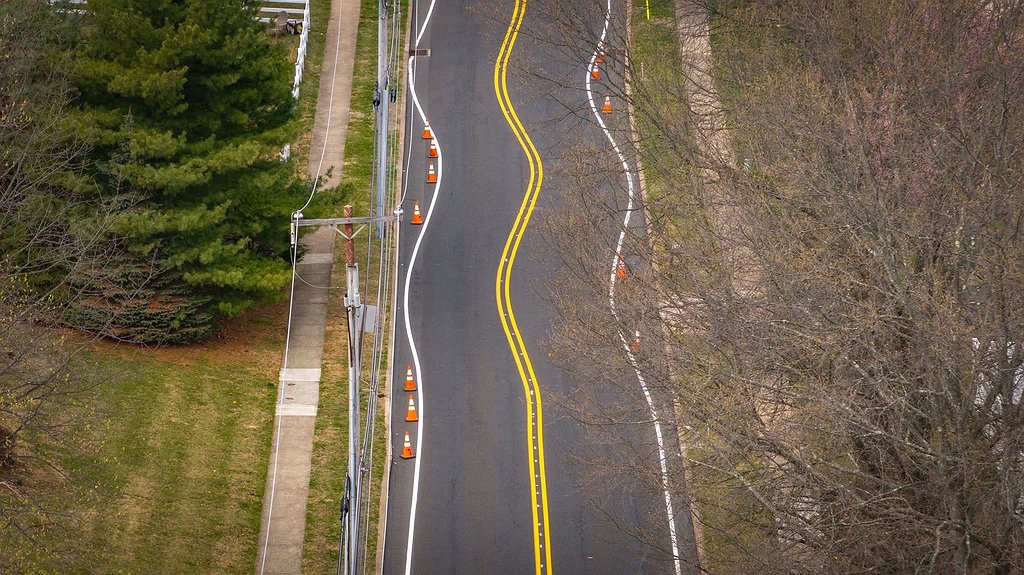 Chicanes on Grays Lane in Montgomery Township
Long questioned if speeds dropping by 5 mph was enough and pondered how she would feel if the chicanes were in front of her house.
“I don’t know if six months is too much, maybe we do need some time to evaluate, to assess, and again, this is what our engineers, the experts, have told us this was our ‘best’ idea that came forward,” Long said. “Is it best? I’m not a traffic engineer, but I did listen to our experts.
Long said there have been a handful of residents in support of the traffic calming measures.
“I really, really struggle with it and that’s why I think I would be more in line with maybe three months, maybe four months, and definitely another study has to be done,” she said. “Is there something that we maybe missed?”
Chimera said she talked to some residents who commented two weeks ago.
“I just asked them what they thought, had they seen any improvement? And all of them said ‘no.’ One person said the only improvement she has seen is when there are cars going both ways,” Chimera said. “So, on a regular time, when there’s only one car, they’re still flying down, they’re ignoring our attempt to slow them down.”
Chimera said the supervisors failed the public.
“There were mistakes, we didn’t get letters out, we never had a community meeting, all these things should have happened,” she said. “Had they, I believe everyone in the room would have said ‘No, thank you.’ It’s been a speeding problem from the beginning of time, and we’d rather let it be. That’s what I’ve heard from people.”
Chimera said a month in her mind was long enough, and made a motion to authorize Public Works to take it down as soon as possible, within their timeframe.
“Second,” said a member of the audience.
However, Solicitor John Walko said the board was not allowed to take an official action at Monday’s meeting, since it was not advertised ahead of time for an agenda item. The board can discuss the topic and provide township staff with direction.
“It is something that visually may not be very appealing, but has been effective and before we pull it out we ought to have a plan in place for addressing the problem, the problem is still going to exist,” Bamford reiterated. “I feel like a knee-jerk reaction here is the wrong move. We should be measured and should also do a better job of communicating what those next steps look like.”
Staab said the community needs to be included in future discussions.
“We need to make sure that they are part of at least the discussions for that because the impact on their exact property (on-street parking, snow removal) is to me paramount to their livelihood,” she said. “Just saying ‘Let’s leave it in place and do more studies,’ to me, that’s delaying the inevitable. I think if people want it out, we should find that out for sure.”
Bamford argued that the chicanes would not affect property values.
“The crosswalks that went in that some referred to as ‘the helicopter pad,’ that had no impact on property values and we don’t really know for a fact that it’s going to have a negative impact on property values,” Bamford said. “Those values are driven largely by supply and demand, and we live in a really desirable community and you can’t say definitively that this is going to have an impact on property value.”
Chimera, a real estate agent, read aloud from a U.S. News & World Report article from May 4, 2023 that she found on the internet on her phone. She said the report stated that traffic lines and patterns that indicate a higher traffic volume can negatively impact property value.
“Location, location, location for a reason can impact value and how long it will take to find a buyer,” Chimera said. “It’s not me making this up. We had 16 people at the meeting two weeks ago who came and made comment and they all said to remove it. I think we’ve heard from the community.”
Bamford said she has heard from people in the neighborhood who are really happy that the supervisors implemented the chicanes.
“I even had one of our sewer authority members comment. He drives a Tesla, and he noted that his Tesla automatically navigates that curve and slows down too to do so,” Bamford said. “Anyway, you don’t hear me as saying I love this solution and I think it should be permanent. That’s not what I’m saying. I think that we should have a measured response here, take time to analyze this and come up with a better plan.”
Resident Dave Sherman, of Forest Trail Drive, criticized the township for its communication and involving the community in that communication.
“I think we’re perpetuating that problem this evening with the township manager burying the report in Page 103 of a document that nobody’s read,” Sherman said. “Five of us show up for a meeting tonight, and there’s a recommendation to extend this study for six months. I can tell you, after 30 days, it doesn’t work.”
Sherman said so what if speeding went down 5 mph? There are drivers still going straight up the street, and some get scared about head-on collisions. He offered to show supervisors a picture of a moving truck driving on Grays Lane.
“A trash truck or moving truck cannot slow down as fast as a car can,” Sherman said. “If you are approaching a vehicle, that car gets squeezed over the road and you’re going to get in an accident.”
“If you’re going 25 mph, you shouldn’t get squeezed off the road,” Long said.
“A tractor trailer cannot stop in time for a car to squeeze by. There will be a car accident. It’s physics,” Sherman replied, adding that chicanes have already been hit and damaged.
“My real point here is for 35 years we’ve had these conditions in this neighborhood and my suggestion at the last meeting was to put some police monitoring the situation,” he said. “We don’t need any more studies. Put a few policemen in the neighborhood periodically measuring speed and ticketing people, I guarantee you it will stop speeding.”
“The study should be bring the police in and see how many tickets they can hand out and generate revenue for township,” Sherman said.
McCreary clarified some items for the public and supervisors. First, she said Gilmore & Associates did a study in 2021, which resulted in the installation of crosswalks. The speeding on Grays Lane, she said, was discussed three times at Public Safety Committee meetings in 2023.
The reason for the third-party engineering suggestion, she said, was due to Gilmore & Associates’ study being discounted by the public.
“We didn’t want Gilmore to do another study and then say, ‘Well of course Gilmore is going to say this because they’re the ones who recommend it,’” she said.
The six month suggestion, she said, was not to imply it should remain for nine to 12 months. It was meant to allow police to get more traffic counts.
“If the majority of the Board says they should come out, then Public Works will work on getting that done,” she said.
“I’m willing to take it out,” Chimera said. “Supervisor Staab is willing to take it out, Ware-Jones is willing.”
“You’ve convinced me,” said Long. “Let’s take them out.”
Public Works Director said his department would contact the company Guidemark to schedule grinding off of the paint on the roadway.
A chicane is a manmade serpentine curve in a roadway, which are meant to force drivers to make extra turns, in order to slow traffic for safety. With a driver turning slightly left and right, it requires them to reduce their speed to properly continue on the roadway.
Chicanes are constructed either as single-line chicanes, with staggered build-outs, forcing traffic in one direction to give the right-of-way to the other direction. There are also two-way chicanes, which also use build-outs, but separate lanes with islands or road markings.
A similar chicane traffic calming measure was in place for years on Walnut Street in the Colmar section of Hatfield Township, but has since been removed.