Autonomous vehicles (AVs) stand out as one of the most transformative innovations of the 21st century. With the promise of safer roads, reduced congestion, and increased mobility, self-driving cars are reshaping how we think about travel. However, bringing AVs from concept to reality involves navigating a maze of technical, ethical, and infrastructural challenges. One of the most critical tools enabling this transformation is traffic simulation.
Traffic simulations and autonomous vehicles share a dynamic, symbiotic relationship. On one hand, simulations are instrumental in training AVs to handle the complexities of real-world driving. On the other, AVs themselves generate massive troves of real-time traffic data, often collected and transmitted through GPS networking, that enhance the accuracy and responsiveness of these simulations. This feedback loop is accelerating advancements in both fields and reshaping the future of intelligent transportation systems.
The real world is messy. Human drivers make unpredictable decisions, pedestrians behave erratically, weather conditions change rapidly, and infrastructure can vary widely from one region to another. Training autonomous vehicles to operate safely and efficiently in such environments demands a vast amount of testing that is impractical, and often unsafe, to perform solely on public roads.
Simulation platforms like CARLA, LGSVL, and NVIDIA DRIVE Sim provide realistic virtual environments where AVs can be subjected to millions of driving scenarios. These platforms simulate not just the road infrastructure and traffic conditions but also weather, lighting, sensor noise, and vehicle dynamics. This allows engineers to expose AV algorithms to edge cases like a child running into the street or a truck jackknifing on an icy road without risking lives.
In simulation, developers can perform scenario-based testing, where AVs are repeatedly exposed to specific driving situations. This is critical for evaluating their ability to respond appropriately under stress or in non-ideal circumstances. Moreover, machine learning techniques like reinforcement learning benefit from simulation because AV algorithms can learn optimal behaviors by receiving rewards or penalties for their decisions.
Simulators also help AV developers test the perception systems, such as lidar, radar, and computer vision that allow vehicles to “see” their environment. These systems are vulnerable to occlusions, lighting glare, or sensor fusion errors. By modeling these conditions virtually, developers can refine how AVs interpret their surroundings.
While simulations are indispensable for training AVs, autonomous vehicles in operation become powerful data engines that feed back into those very simulations. As they drive through urban and rural landscapes, AVs constantly collect real-time data, including:
This data is invaluable for improving the fidelity and accuracy of traffic simulations, allowing them to reflect real-world dynamics more closely than ever before.
Traditional traffic simulation tools such as SUMO (Simulation of Urban Mobility), VISSIM, and AIMSUN historically relied on average flow assumptions and macroscopic models that lacked granular behavioral data. With AV-generated data, these tools can now incorporate microscopic and mesoscopic behaviors, modeling individual vehicle decisions and interactions with a much finer resolution.
For example, AVs equipped with advanced sensors can record how a car merges into dense traffic, yielding insights into driver gap acceptance, hesitation, and lane-change timing. Feeding this back into simulation models improves predictive power, which is vital for infrastructure planning, signal optimization, and congestion management.
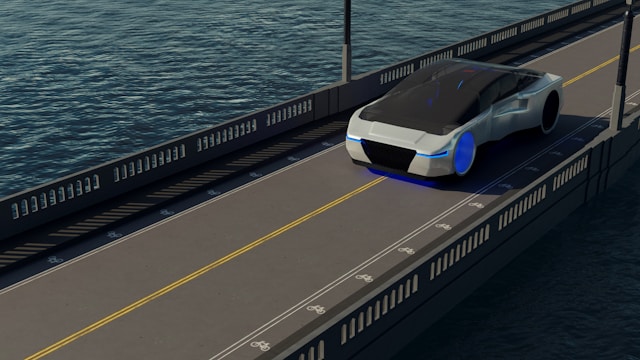
In smart cities, real-time AV data can help traffic control centers respond dynamically to changing road conditions. For instance, if a cluster of AVs reports unexpected congestion or a road hazard, the city can use simulation tools to model potential rerouting strategies or adaptive signal timings before applying them on the ground.
This data-simulation synergy makes the transportation system not only more efficient but also more resilient and responsive to disruption.
The relationship between AVs and traffic simulation can best be understood as a closed-loop feedback system:
This loop has profound implications for the scalability and safety of autonomous vehicle deployments. With each iteration, AVs become better drivers, and simulations become better predictors.
The AV-simulation feedback loop doesn't just benefit vehicle development - it also transforms urban planning and public policy.
City planners can use AV data-enhanced simulations to test the effectiveness of new road designs, bus lanes, or bike paths before breaking ground. By modeling how AVs interact with proposed changes, planners can minimize negative impacts on traffic flow and safety.
As AVs become more prevalent, simulations can help cities understand how to best accommodate autonomous traffic, whether through designated drop-off zones, AV-only lanes, or new signalization systems that communicate directly with vehicles.
Simulations can also support policy testing. What would happen if a city restricted certain AVs from high-traffic zones during rush hour? How would a toll road affect AV route choice behavior? Before implementing such policies, simulations enhanced with real-world AV data provide a test bed to evaluate outcomes.
While the synergy between AVs and traffic simulation is powerful, several challenges remain:
Sharing AV data across manufacturers, municipalities, and simulation developers raises questions about privacy, security, and standardization. Developing common frameworks and anonymization protocols is essential to ensure ethical and effective data use.
Even the best simulations are only as good as their models. If training simulations don't accurately reflect diverse environments, such as poorly marked roads, extreme weather, or varied driver behavior, the AVs trained on them may underperform in the real world. Continuous feedback from real-world AV data is key to mitigating these biases.
As cities become more connected, the challenge will be scaling simulation capabilities to handle vast streams of AV data in real time. Emerging technologies like edge computing, 5G networks, and digital twins - virtual replicas of physical infrastructure - will play a vital role.
The relationship between autonomous vehicles and traffic simulation is a compelling example of technological symbiosis. Simulations are the training grounds where AVs learn to drive, and AVs are the scouts that bring back real-world intelligence to make those simulations smarter. This two-way relationship creates a feedback loop that is accelerating innovation, enhancing safety, and optimizing transportation systems for a future driven by autonomy and data.
As this feedback loop strengthens and expands, we can expect not only smarter vehicles but also smarter cities, where human mobility is more efficient, equitable, and sustainable than ever before.