Have you ever watched your team “save time” with a free AI deck tool… and somehow the week still ends with everyone stressed, the slides still kinda off, and you quietly wondering if you’re the problem? 🙂
Free AI presentation tools often create hidden costs that hit teams harder than individuals—data privacy exposure, intellectual property (IP) leakage through prompts and uploads, and a compounding time cost from rework, brand fixes, and workflow friction; I recently read a comparison of seven free AI presentation platforms that maps to these exact failure modes.
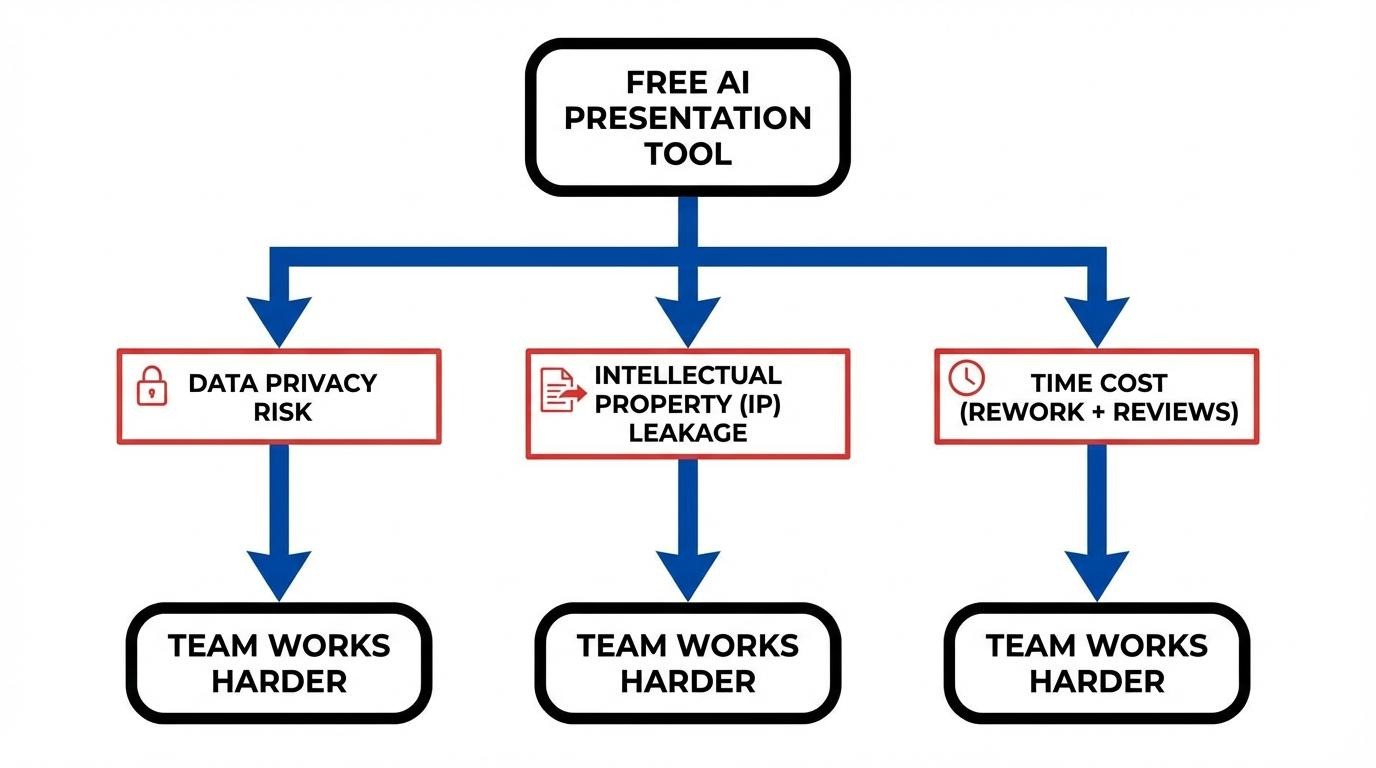
Image 1 (Flowchart): “Free tool” → where the hidden costs actually land
Data privacy is a hidden cost because prompts, uploads, and generated slides can contain confidential information that becomes exposed through vendor storage, model training policies, or user mishandling. For teams, the risk scales with every employee using the tool.
When people say “data privacy,” half the room hears “security team problem,” and the other half hears “that thing we sign a policy for and then ignore.”
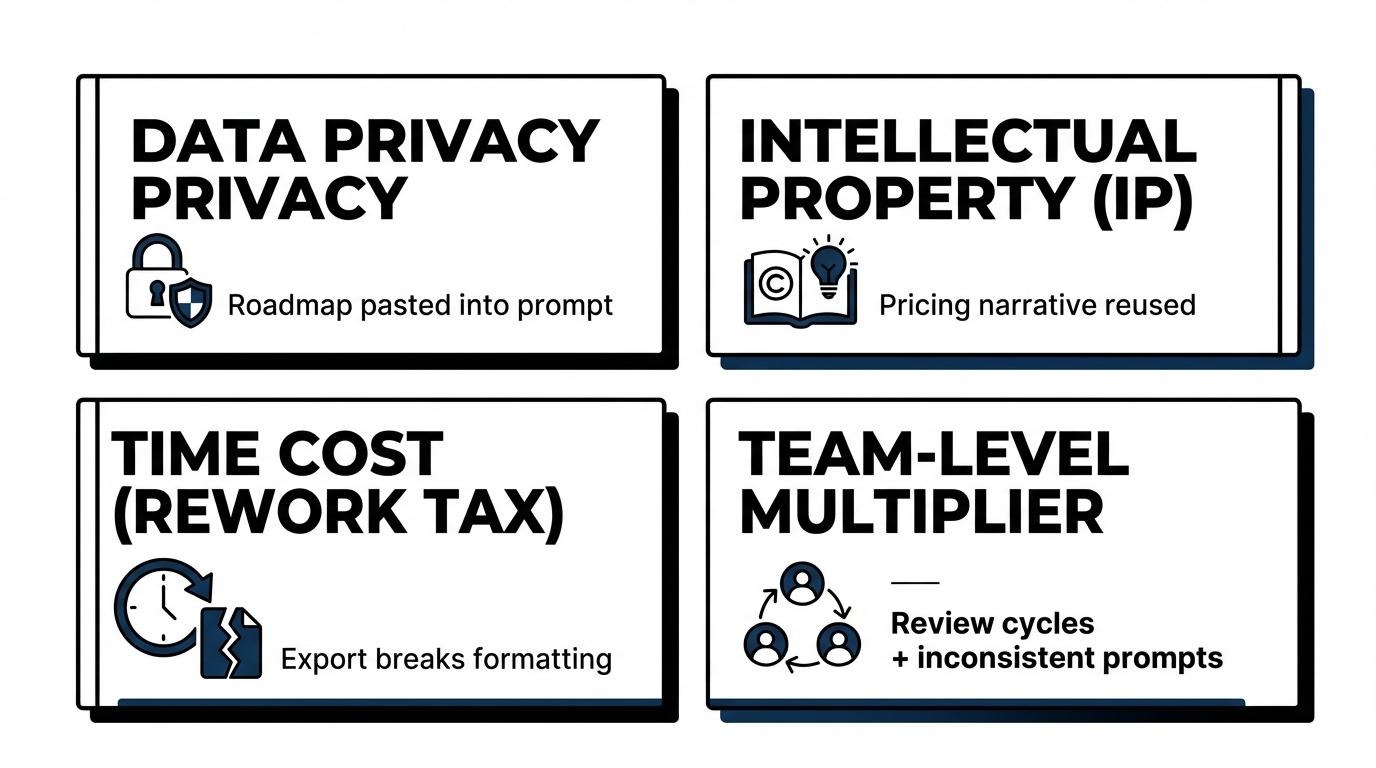
But presentations are basically concentrated secrets. Roadmaps. Pricing moves. Org charts. M&A “what-ifs.” Client churn explanations. The stuff you’d never paste into a public forum… but you might paste into a prompt because you’re tired and it’s 11:48pm.
And the free tier experience nudges people into sloppy behavior. No SSO. No admin console. No clear retention controls. Sometimes no real contract language you can lean on. It’s all vibes.
Random thought: the moment your team starts uploading decks, you’ve created a shadow document system. It’s not SharePoint. It’s not Google Drive. It’s… whatever that tool’s backend is. And if you don’t know what that backend is, congrats, now you have a mystery box full of sensitive slides.
US reality check (not legal advice): depending on your industry, “confidential” isn’t just a cultural label. Health, finance, education, even some adtech workflows—there are regulatory expectations. HIPAA (health). GLBA (financial). FERPA (student data). State privacy laws like California’s CPRA. I’m not saying your deck is regulated; I’m saying your inputs might be.
And even outside regulated data… client trust is its own law. The unwritten kind. The one that ends relationships.
What I’ve seen teams do (not “advice,” just… what happened): they start by banning uploads. Then they realize prompts can still leak content. Then they end up with a “safe prompt library” and an internal redaction checklist. And suddenly, wow, look, the “free” tool created a whole governance mini-project.
Small sentence. Big mess.
Intellectual property (IP) is a hidden cost when your strategy language, positioning, and unique structure gets embedded in prompts, templates, or vendor systems, creating risk of reuse, unintended disclosure, or loss of control. Teams amplify this risk through repeated use and shared prompt habits.
People hear “IP” and think patents. Like you need a lab coat for it to count.
Nope. IP can be the way your company tells its story. The way you frame the market. The internal model that makes your go-to-market not stupid. The pricing rationale you don’t publish. The customer segmentation that took six months of painful meetings to agree on.
And here’s the gross part: the tool encourages you to pour that into the prompt because it works. You get better slides. More tailored talk tracks. Cleaner structure. You feel smart again. 😅
But if the free tier terms allow training or broad reuse (varies by vendor; often unclear unless you read the policy), your “secret sauce” starts living outside your control. Even if it’s not literally training data, it can be stored, logged, or reviewed for “quality.”
Also: internal leakage is real too. One person makes a killer prompt. Shares it in Slack. Now twenty people paste in sensitive details to “fill the blanks.” The prompt becomes a funnel for secrets. Nobody meant to. That’s what makes it dangerous.
When a deck gets easier to generate, it also gets easier to overshare.
And yeah, sometimes the IP problem isn’t the vendor. It’s the team’s muscle memory. “Just paste the doc.” “Just upload the notes.” “Just include the customer name so it’s more accurate.”
It’s not evil. It’s fatigue.
The time cost of free AI presentation tools comes from rework: fixing factual errors, aligning brand and voice, reformatting charts, and reconciling inconsistent outputs across teammates. In teams, this expands into extra review loops, stakeholder alignment, and version-control friction.
This is the one that sneaks up like… quietly. No alarms. Just more meetings.
The first draft looks done. That’s the trap. Because “looks done” triggers stakeholder behavior: people start nitpicking surface stuff while the underlying story is still mushy.
And the AI deck output tends to be confidently generic. The story arc is fine. The slide titles are fine. Everything is… fine. Which is a problem if you’re trying to win a deal or defend a budget.
What I keep seeing:
Speaking of “final”: the word final has no meaning in slide culture. None. It’s just a prayer people say before they send v17.
And here’s the part that hits managers: the time cost doesn’t sit with the person who generated the deck. It shifts to reviewers, approvers, and the one poor soul who has to unify 14 slides from 5 people into one coherent narrative.
Short sentence. That person hates you.
Is it safe to upload confidential company data to an AI presentation maker? It depends on the vendor’s data handling terms, retention controls, and whether the tool offers enterprise security features like SSO and audit logs. For most teams, confidential decks (roadmaps, pricing, client strategy) create a high data privacy risk on free tiers because controls and contractual protections are usually limited.
Do free AI presentation tools use my content for training? Some tools may use prompts or uploaded content to improve their models or services, depending on their terms and settings. The practical IP concern is that strategy language and proprietary structure can be stored or reused outside your control unless the vendor clearly provides opt-out and enterprise-grade contractual protections.
What are the limitations of free AI presentation tools compared to paid ones? Free tiers commonly limit exports, branding customization, collaboration controls, admin features, and support. The operational consequence is higher time cost from rework and more risk around data privacy and IP, because teams lack governance features that usually appear in paid or enterprise plans.
What’s a “safe” way teams use these tools without chaos? I’ve seen teams keep AI use to non-sensitive drafts: structure, slide titles, generic visuals, and placeholder language—then manually insert confidential specifics in their controlled slide system. That keeps the productivity upside while lowering the chance of privacy/IP leakage.
Free AI presentation tools can create hidden costs by making teams prematurely commit to a narrative that “looks complete” before the underlying thinking is correct. This leads to misalignment, extra reviews, and slower decisions even if slide production is faster.
Okay. This is the part where I sound like a grump.
When decks become easy, people make more decks. And when people make more decks, they sometimes stop doing the hard part: deciding what they believe.
The AI can’t pick your tradeoffs. It can’t decide what you’re willing to lose. It can’t look your CFO in the eyes and say, “we’re doing this and not that.”
So the deck becomes a fog machine. Lots of slides. Low clarity. Everyone “aligns” without aligning.
And then leadership thinks the team is slow. But the team isn’t slow. The team is trapped in presentation-as-thinking. Which is… honestly a little tragic.
Anyway.
Key takeaway: Free AI presentation tools are rarely free for teams because hidden costs show up as data privacy exposure, IP leakage, and time cost from rework and review cycles.
Key takeaway: The fastest path to a deck is not always the fastest path to a decision, especially when “almost done” slides trigger extra stakeholder loops.
Image 2 (Infocard): The 3 hidden costs, in one glance
Also—real talk—if your org has ever had a “deck emergency” because someone used a free tool and then export got paywalled, or a client noticed inconsistent branding, or security showed up asking uncomfortable questions…
Tell me your most painful slide-deck war story. Like, truly. I want the full chaos. Who broke what, how late it got fixed, and what it cost you (sleep counts). Let’s do a little professional misery Olympics.