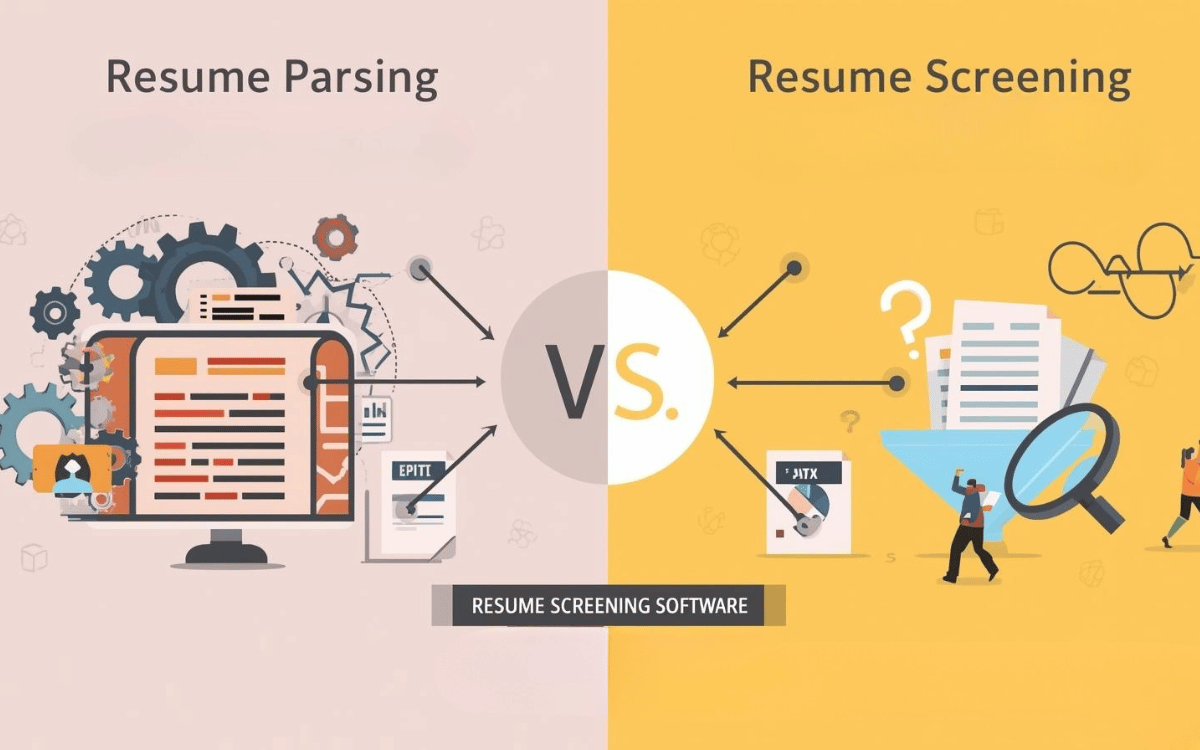
Hiring teams deal with volume. Real volume. One role can pull in 300 resumes before lunch. No recruiter wants to read all of them line by line, and no business should expect that. This is where automation steps in, but confusion starts right here.
Many teams use resume parsing and resume screening as if both mean the same thing. They don’t. The tools solve different problems. Mix them up, and hiring slows down in quiet but costly ways.
This blog breaks down resume parsing vs resume screening, explains the difference between resume parsing and resume screening, and helps you decide what fits your hiring setup.
Let’s start with a familiar scene.
An HR manager opens the ATS on Monday morning. 412 new resumes. Some are PDFs. Some are Word files. A few look like they were scanned in 2009. Names, skills, job titles, dates, all sitting in random spots.
Before any screening logic can work, that data needs structure. Clean fields. Searchable text. That first step decides whether the rest of the hiring flow moves or stalls.
This is where parsing and screening split paths.
Resume parsing software reads resumes and turns unstructured content into structured data. Think of it as a translator.
It scans a resume and pulls out:
The output lands in neat fields inside your ATS or HR system. Recruiters can filter, search, and sort without scrolling through raw files.
Parsing shines when volume grows or formats vary.
A staffing firm hiring sales reps across regions sees resumes in dozens of layouts. Parsing removes format chaos. A tech startup hiring engineers wants skill tags ready for search. Parsing does that.
Most modern ATS platforms use parsing by default. Vendors like Sovren, RChilli, and HireAbility focus heavily on parsing accuracy. According to a 2024 report from Capterra, parsing accuracy still ranges between 85 to 95 percent, depending on resume format and language.
Parsing does not judge candidates. It does not rank them. It does not decide fit.
If a resume lists Java once in a skills section, parsing records it. It does not ask if Java matters for the role. That decision comes later.
Resume screening software evaluates candidates against role criteria. It works on top of parsed data.
Screening answers questions like:
Screening tools use rules, scoring models, or AI models trained on job data. Many fall under automated resume screening software within broader AI recruitment software platforms.
Picture a company hiring 20 support agents in two weeks. Screening software filters candidates with customer support experience, language skills, and shift availability. Recruiters review the top 40 instead of all 400.
Large enterprises rely on screening for consistency. SMBs rely on it for speed.
LinkedIn’s Global Talent Trends report notes that teams using automated screening reduce time-to-shortlist by up to 35 percent. That time matters when hiring competes with business deadlines.
Screening depends on rules and data quality. Bad input leads to bad output.
Overly strict filters can reject strong candidates. Bias can creep in if historical hiring data favors certain profiles. Ethical use demands regular review and transparency.
Good screening tools offer override options and audit trails. If a tool hides its logic, that’s a red flag.
Here’s a simple resume parsing vs screening comparison without tech jargon.
Parsing structures resume data. Screening evaluates candidates.
Parsing happens first. Screening comes after.
Parsing creates searchable fields. Screening creates rankings or shortlists.
Parsing does not decide. Screening influences hiring decisions.
Screening depends on parsed data. Parsing works alone.
This distinction matters. Teams that buy screening tools without solid parsing often face messy data and missed talent.
Marketing language causes part of the confusion. Many vendors bundle both under one label. Demos focus on flashy dashboards instead of fundamentals.
Another reason is pressure. Hiring managers want faster results. They skip clarity and jump to automation.
Yet skipping parsing accuracy hurts screening quality. It’s like judging candidates with half-filled profiles.
This depends on hiring scale and maturity.
Start with strong parsing. Clean data supports growth. Manual review still works at low volume.
Add screening once volume rises. Rule based filters help recruiters focus.
Use both. Parsing for data hygiene. Screening for speed and consistency. Review logic often to avoid blind spots.
If you plan to scale, it’s smarter to choose the best automated resume parsing software before adding heavy screening layers.
Modern AI recruitment software uses machine learning to score resumes. This brings speed but also responsibility.
Regulators now question black box hiring tools. The EU AI Act and similar frameworks push for explainability. Hiring teams must know why a candidate ranks high or low.
Transparency builds trust with candidates and protects employers. Tools that offer bias checks and editable criteria deserve priority.
There’s no universal winner, but strong tools share traits:
Popular platforms like HireVue, Pymetrics, and iCIMS blend parsing and screening with compliance features. Still, fit depends on role types and hiring goals.
The difference between resume parsing and resume screening is simple but often ignored. Parsing organizes information. Screening evaluates people.
One prepares data. The other shapes decisions.
Teams that respect this order hire faster with fewer mistakes. Teams that skip it face quiet delays and missed talent.
Before buying tools or adding automation, pause and review your hiring flow. Fix the foundation first. Everything else works better after that.
If your roadmap includes smarter hiring, stronger data, and fewer wasted hours, the choice becomes clearer.
Author Bio –
Taufiq Shaikh, Head of Product at BizHire, specializes in AI-driven product strategy and user-centric UI/UX design. His work centers on creating smart, human-first recruitment technology.