New council could adopt recommendations in 2026
After hitting one major milestone in 2025, North Wales officials are looking ahead to their goals for 2026 and beyond.
Council members recently heard an update on the ‘North Wales 2040’ town comprehensive plan adopted nearly a decade ago, and revisions that could shape the town’s goals for the next two decades.
“The borough has done an amazing job of implementing this plan,” said Tim Konetchy, the borough’s liaison to Montgomery County Planning Commission.
“One of the things we see with comprehensive plans is they usually just sit on the shelf. That’s definitely not the case for North Wales,” he said.
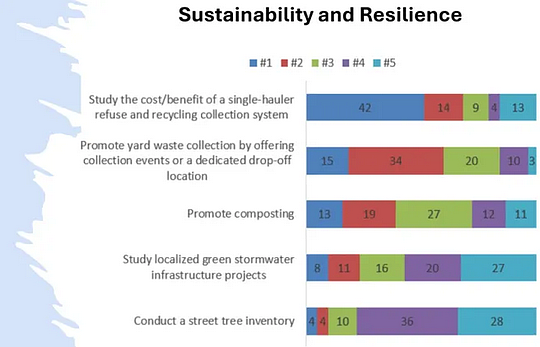
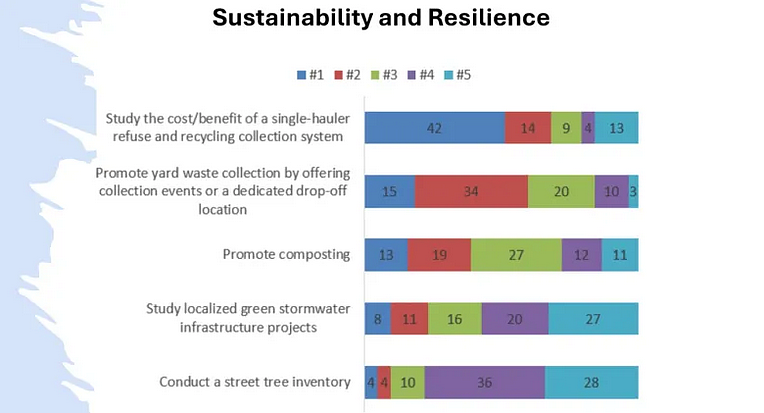
In fall 2024 council and its planning commission sent out a resident survey asking for feedback on an update to the ‘North Wales 2040’ comprehensive plan adopted in 2018 after a series of public input meetings over the prior two years. Since the 2040 plan was finalized, the council and the planning commission have taken up several of its recommendations, and in February council discussed those survey results, hearing that a look at a single trash hauler was among the top priorities from residents who ranked their sustainability goals.
Since that update began last year, Konetchy told the council, he’s been working with the borough planning commission to review the document and find where it needs to be updated or revised.
“We’re kind of just saying, have we gotten through these projects? What’s done, what’s left to do? And is there anything that’s fallen off of our radar as a priority?” he said.
That plan was drafted and adopted before the pandemic that began in spring 2020, so an update for a post-pandemic era could carry more emphasis on parks and outdoor spaces and less on offices and indoor businesses, the planner told the council.
“Covid really changed our perspectives on a lot of things: open space, parks, trails, sidewalks, they all became a lot more important to people. They’re well-utilized, and now we have a different view on some of these things,” Konetchy said.
Survey data gathered from residents starting in August 2024 through January of this year drew just over 120 responses, roughly ten percent of the 1,300 households in town, a sample size the planner called “definitely a good showing,” and more feedback could be fielded from the public as specific projects are tackled. In that survey, residents were asked to rank their priorities of the projects not yet completed from the earlier draft of the plan, and were grouped under themes of community character, economic development, transportation, and sustainability and resiliency, with the survey outlining the average rankings and shifting priorities.
“We looked at the one-through-five ranking, but also the average ranking, what jumped off the list, what might have been a lower priority than it was in 2016-17-18 when the plan was being drafted. That’s ultimately what informed the future projects,” Konetchy said.
Survey says
Under the ‘community character’ category, top-ranked by residents was to prepare maintenance and stewardship plans for borough parks, followed by conducting a park tree inventory, then lower priorities included enhanced recreational programming like classes or events, promoting state or county programs, creating and promoting a community garden, and accessibility audits for each park.
For the economic development grouping, the top priority ranked by residents was to ‘Study the Main Street streetscape and prepare streetscape design standards, regulations and guidelines’ for a unified look in that part of town. Lower-ranked priorities included collaborating with the business community — a revived ‘Main Street North Wales’ business association has already started doing so — then creating wayfinding signs, with the lowest priority being to study the costs and benefits of installing parking meters on Main Street.
Rankings for the transportation category put the town’s top priority as ‘Continue to implement the walkability audit by making targeted sidewalk improvements,’ followed by conducting a traffic study and implementing traffic calming measures, then drafting a town bicycle plan and create a formal bike route network, followed by a transit facility study that looks at all transit facilities such as bus stops and train stations in town and spell out future goals.
And for the sustainability and resilience category, the top ranked suggestion will draw debate: “Study the cost/benefit of a single hauler refuse and recycling collection system” was ranked a top priority by more than half of those who responded, followed by promoting yard waste collection, promoting composting, studying local stormwater infrastructure projects, and conducting a street tree inventory — similar to a survey done in one of the town’s three wards by a local Eagle Scout last year — from top to lowest priority.
In the 2018 version of the plan, Konetchy said, planners included a chart detailing every goal spelled out in the plan, how it ranked, and possible funding sources; a 2025 update would remove those projects already done, and reorder those left based on the survey data.
“At the end is this big spreadsheet that has a lot of columns, a lot of rows, it says ‘This is the goal, this is who funds it,’ and so forth. What we did is tacked on a column to the far right, and said ‘This is the 2025 update,'” he said.
Completed projects highlighted in the plan update include the arts and cultural center that formally opened in June, and includes photos from the ribbon cutting ceremony alongside the 2018-era goal to tackle that project and create a destination for its own.
“I can tell you, I’m getting lots of questions from other community planners, for other communities, saying, ‘How can we do this?’ Obviously, it’s beautiful,” he said.
Other projects tackled since the 2018 plan was adopted: a town-wide zoning ordinance update formalized in 2023, a sidewalk study Konetchy presented to council in 2021, and a Center Street sidewalk project that started in spring 2022 and finished later that fall, with an expansion round slated to start next year.
“We walked every sidewalk, every intersection, with a list of criteria, and we graded all of those. We have a map showing all of those grades: basically, we were looking for where the greatest needs were in the community, and I know Christine has been working down the list — Center Street was one of the bigger ones,” Konetchy said.
The 2018 plan also called for upgrades to Ninth Street Park to help improve stormwater management and reduce runoff and flooding, and a path paving project was done there in 2024, while a second phase of streambank restoration work there is slated for early 2026, he said.
“Redoing that trail, taking gravel and grass and resurfacing that with an ADA-compliant surface, making it so people with strollers, wheelchairs, anybody who has any trouble walking at all can walk there now and enjoy it, whereas before it really was a barrier,” Konetchy said.
Talks are slated for the town’s planning commission in early 2026 on which projects should be reduced in priority and which upgraded, with those new priorities identified so far ranked by stars in the chart. Top priorities based on those talks so far include creating the park maintenance plan with monthly and yearly goals, which the town’s volunteer parks board could help fill in specifics.
“They would have recommendations for stewardship and maintenance: whether that’s invasive species management, habitat improvements, if any specific hazards could rear their head, like ‘I’m worried that tree in five years is going to need some trimming.’ Just so it’s on paper, so we have short, medium and long-term goals for each park,” Konetchy said.
The top economic development project, the Main Street streetscape study, could include an inventory of existing furnishings like benches, streetlights and banners, a plan with short- and long-term goals to update those, and design guidelines for any new public infrastructure, such as sidewalks, and for façade work done by private participants like new business owners who move into any vacant storefronts.

“That’s generally something we could do: just general goals, like ‘For this type of architecture, this is the color palette,'” Konetchy said, and those specifics in the plan could be developed with the town’s Historical Architecture Review Board that already vets any such projects.
For the traffic calming study, Konetchy added, North Wales could emulate a recent effort in Lansdale that studied specific streets, intersections, and bypass routes instead of the whole town, and having the study spelled out in the 2040 plan update could help seek grant funding from outside agencies.
“It is something that can be piecemealed; we could take bite-sized chunks out of it. And we’d be looking to start off with a traffic observation study, just to know what the counts are, where the issue areas might be,” Konetchy said.
The single trash hauler study could also use outside help: the town could issue a request for proposals or qualifications seeking an outside consultant to steer that process, and MCPC has a recycling division that “would be happy to help” if needed.
“The idea would be doing a cost-benefit analysis: does this make sense for the borough? Does it save the community, writ large, money? Does it make financial sense to switch?” Konetchy said.
The original 2018 version also includes a look at North Wales Elementary School, and parents there have already begun a series of upgrades to the playground area, with a mosaic mural and sensory garden on a wall of the school dedicated this fall. The 2025 draft would note what has already been done there and list any future goals being planned by the home and school parents there.
“From the borough standpoint, just offering what support we can: if there’s any opportunity to partner on a grant application, or get creative to really leverage that as a shared space,” Konetchy said.
Next steps
Adopting the plan update could include a formal adoption and review as an update to the 2018 plan, which would require public notice and hearings, or a vote to adopt the update by resolution: “I could flip a coin, either way, but ultimately it’s up to borough council,” Konetchy said.
Borough Manager Christine Hart added that when she and an outside consultant were seeking the roughly $2 million in grants for the arts and cultural center, having the goals in writing may have made a difference.
“The comp plan was one of the most highly-used documents in both of those applications,” she said.
The manager then asked if there was any difference to future grant applications by adopting the 2025 update via resolution or ordinance, and Konetchy said the formal review process could take three to four months to finalize, including vetting by MCPC. Council President Mark Tarlecki asked if that vetting process for the 2025 update could impact the planned work at Ninth Street Park slated for 2026, and Konetchy said it would not.
“I just want to make sure that whatever we do (to review the plan), doesn’t hold us up,” Tarlecki said.

Councilwoman Star Little, who sat on the planning commission during much of the talks on the plan update, said she’d prefer more time for public feedback and vetting of the update, and asked if the council would need to read and vet the full formal audit documents before any vote.
“It’s not anything new, this is all stuff that’s already in the comp plan, it’s just pointing out things that have been completed, and what we’re prioritizing for the next five years. It’s just restating where we’re at,” Little said.
Councilwoman Candace Anderson added that she had suggestions for Konetchy to change the formatting of the charts to increase clarity and better indicate high against low priorities, and to clarify the ratings versus rankings in each category.
“Sometimes it’s not obvious what’s a good number and a bad number,” she said.
Council VP Wendy McClure added thanks to all who answered the survey and shared their thoughts, and asked if Konetchy and MCPC could develop a summary of the updates for residents to review.
“The folks who took the time to take the survey, obviously, these things matter to them. We don’t always have a full audience here, so I just want to make sure the public is really aware that the update is in progress,” she said.
Councilwoman Sarah Whelan asked for specifics on the traffic study, and whether the county or a consultant would look at the entire town first or specific areas, and Konetchy said that’s up to the council; Hart added that she and borough police already have several areas in mind.
“If the chief or I are receiving complaints about speeding, or people running stop signs, council would then make a decision to have the (traffic) engineer look into that,” Hart said.
“In order to actually install a traffic calming measure, like a stop sign or a bump out, we would need a traffic study from the engineer, and council would have to approve the expense for that traffic study, and then whatever results, we would decide on how to implement it.”
Tarlecki added that those changes could be brought back to MCPC for updates before a final vote, and that summary could be posted on the town’s website and social media channels before the final vote.
“We don’t need to overthink this, but we want to make sure people are aware,” Tarlecki said.
Council then voted to table any formal action on the comp plan update until the modifications were made and a summary developed, and Hart said she would proceed with legal advertisements toward adopting the plan update in early 2026, and post the summary on the town’s website for vetting by the public and incoming council members.
North Wales borough council next meets at 7 p.m. on Dec. 23 and Jan. 13 at the borough municipal building, 300 School Street. For more information, visit www.NorthWalesBorough.org.
This article appears courtesy of a content share agreement between North Penn Now and The Reporter. To read more stories like this, visit https://www.thereporteronline.com