No vote yet on zoning change for Old Forty Foot Road site
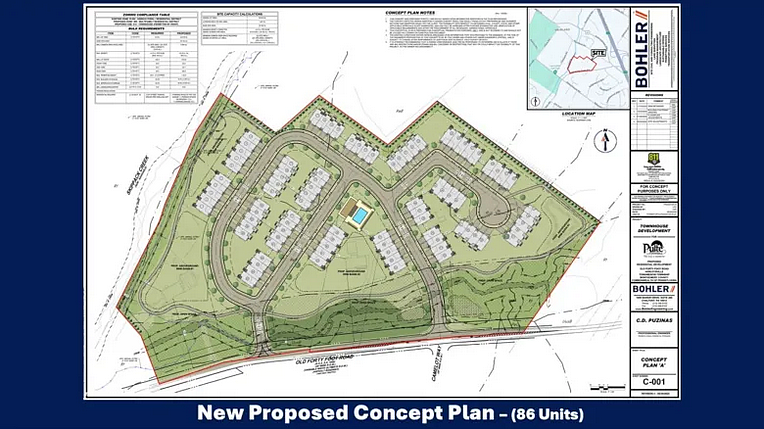
Plans for a complex of 86 townhomes on Old Forty Foot Road in Towamencin are staying on the drawing board for now.
Township officials continued talks on those plans last week, with the developer giving an update on where those plans now stand, and the supervisors sounding off on what they’d need to see before voting it ahead.
“I will say this: it is definitely, for me, all about the stormwater. I just cannot imagine managing that flood zone, with townhomes on it,” said supervisors’ Chairwoman Joyce Snyder.
In August 2024, a team from Pulte presented plans to the board for a complex of 96 townhouses, with no more than five attached, dubbed “carriage homes” by the developer, on roughly 24 acres at the eastern end of the township, south of Mainland Road and across from a development at Camelot Way, near Towamencin’s border with Upper Salford Township.
At that time the developer asked the board to consider changing the zoning there from R-200 residential to MR-multifamily residential, and at the time the developer touted the open space that would be preserved with the plan, while supervisors voiced concerns about traffic and flooding, while saying they preferred that plan to an earlier proposal for that site that sought to build several high-rise apartments totaling roughly 400 units there instead.
This past July, the developer gave an update, saying the number of units had been downsized to 86 and the configuration changed to reduce the impact on the floodplains, increase stormwater absorption, and reduce runoff, while residents said they were still worried about runoff and traffic. On Dec. 10, the developer gave another update, with attorney Gregg Adelman and Pulte Vice President of Land Development Sam Carlo reviewing the latest revisions.
“We’re not seeking the board to take any action this evening, yea or nay, on the zoning map change. All we’re asking for is the process to continue,” Adelman said.
Next steps would be to hold a public hearing on the plan to field public comments, both for and against, and a vote on the zoning map change to allow the multifamily residential use would be needed before any plan approval.
“Then the board can decide what to do, at that time,” Adelman said.
As he spoke, the attorney showed an overhead map with the property in question outlined, and the various types of residential zoning, including both R-200 and MR-multifamily residential on adjacent sites, and a branch of the Skippack Creek along the west side of the site.

“There is a large MRC development, as well as MR – The R-200 that’s located adjacent to the property is actually along the Skippack Creek corridor, where nothing will be developed, because that’s the floodway, which was some of the pictures that neighbors had shown,” Adelman said.
The most recent township comprehensive plan update designates that area as one with growth potential, the attorney added. Stormwater management features would be designed to meet all township regulations and the proposed density of 3.8 units per acre falls below the four-per-acre maximum listed in township and county plans as highly dense.
“It is not considered highly dense — it’s considered less dense, in accordance with the 2040 Montco plan,” Adelman said.
Their request is for the township to consider “this type of development, which we believe is consistent with your long-term, long-range planning,” with a hearing and vote on the zoning necessary before plans are refined and vetted by township consultants.
“In a nutshell, that’s what we’ve been asking for. Clearly, there are land development issues that will need to be sorted out: stormwater, traffic,” Adelman said, before asking the board to consider scheduling a hearing on the map change.
Board sound off
Township solicitor Bob Iannozzi then clarified that “there is no deadline” for the board to act on that request, before the supervisors began grilling the developer on specifics. Supervisor Kofi Osei asked if the developer had talked with a nearby church about an easement needed for emergency access, and Carlo said those talks began, but have “stalled — it hasn’t gone as we’ve wanted to. At this point, it’s stalled,” and Adelman said the church had sought “a very, very, very high price” for that easement.
“Without that easement, I really am not in favor of even considering this, at the moment. If you come back with that easement, I’d be willing to talk about it, but without that, I think we are increasing the danger to these new residents,” Osei said.
Adelman asked what specifically the board was concerned about, and Osei and supervisor Kristin Warner said they were worried about drivers making left turns from the site onto Old Forty Foot, and that large emergency vehicles such as firetrucks could navigate the site.
“Your definition of high density or low density is way different than mine. Of all the properties in our township, this is one of the most prone to flooding,” Warner said, before saying she’d oppose voting ahead of the zoning change for now.
“If you come in with something that’s a little more in line with what our current zoning is there — there’s a reason we have zoning in different areas of the township. That’s been a farm for…ever,” Warner said.
She then asked if the developer had considered larger lot sizes, with less residential density but possibly higher price tags.
“Have you thought about selling off larger acreage as homesteads? That seems to be a real popular idea today. I know two families that both moved south, because land is cheaper there, but they’re young families that are buying five or six acres and homesteading on it. I would imagine there’s demand for that in this area,” Warner said.
Carlo answered that Pulte has seen a different trend: buyers who want smaller lots, with joint maintenance through homeowners associations like the proposed development would have.
“They’re looking for smaller homes, less maintenance for the homeowner themselves,” he said. “It gives them a little more freedom to enjoy things on the weekends, rather than chores around the house.”

Supervisor Chuck Wilson added that he preferred the 86-unit plan to the original proposal with 400-plus apartments, but still saw flaws.
“I’ve kinda soured on this as I’ve gone through more detail on this. I think there’s potential stormwater problems, and the traffic is a real issue there,” he said. “I would say, we just can’t put that much more traffic on that road, so I’m going to be opposed,” and supervisor Amer Barghouth said he agreed.
Adelman then asked what the board would like to see in any revised plan, and Snyder said addressing the flooding was her main concern.
“I am certainly not a flood water expert, and I don’t claim to be, but it just doesn’t feel like putting more homes on that area, is going to address the consistent flooding in that area,” she said.
“I don’t have an answer for it: that’s why you guys get paid more than I do,” Snyder said, and Adelman answered: “The engineers do, and they would have to design that as part of your process, to your technical consultants’ satisfaction,” and would bring back an update at a future meeting.
Public reiterates concerns
Several residents also shared their thoughts, along the same lines: resident Joe Silverman said he thought any stormwater features, such as basins, would not be enough.
“You can have detention, retention: a basin just holds it for a short period of time, but when the basin fills up, the basin is worthless, the water just flows downstream. All that water has to go somewhere, and it’s going down that creek,” he said.
Patrick McNally said he thought that area was the most rural section of the township, asked if the roads had capacity for the new traffic it would add, and showed a series of photos of yards of nearby homes that flood now, before any new development. Vicky McNally said she’s also lived nearby for decades, and still had those concerns: “When it rains further up, that creek still rises. And all the impervious (cover) further up: the roads, the turnpike, the (309) connector route, what they’re building in Hatfield, that all comes down the creek, and that creek rises.”
Barry Kenyon said he thought the basins in the 86-unit plan were still not enough, and the number of units too high: “Most of them are two- or three-bedroom units, according to their little plan. Let’s just say one (kid) per unit, where are they going to play? Out on Forty Foot Road? Over in the creek? Almost all the green space is water retention basin,” he said.
The board then took no action on the proposed zoning change, and the developer said they would be back with revisions at future meetings.
Towamencin’s supervisors next meet at 6:45 p.m. on Jan. 5, 2026, at the township administration building, 1090 Troxel Road. For more information, visit www.Towamencin.org.
This article appears courtesy of a content share agreement between North Penn Now and The Reporter. To read more stories like this, visit https://www.thereporteronline.com