Across generations, people have been fascinated by the enormous predators that once dominated prehistoric oceans. Popular culture often refers to these giants as the biggest dinosaur in the sea, even though many were not dinosaurs at all. Still, the idea sparks curiosity: What did these creatures look like? How big were they? And how do we know? For many visitors, imagining something so massive—often longer than a school bus—is nearly impossible without a tangible representation.
Museums play a pivotal role in bridging that gap. Through accurate reconstructions, fossil-based modeling, and educational display design, they bring ancient marine worlds to life. These exhibits help visitors overcome common challenges, such as understanding the true scale of extinct animals or distinguishing scientifically accurate information from fictional portrayals. As museum technology advances, so does the ability to recreate these incredible sea reptiles with greater detail and scientific integrity.
Marine reptiles evolved long before humans ever walked the planet, adapting to Earth’s oceans in ways that made them formidable apex predators. Among the species that draw the most attention are mosasaurs, plesiosaurs, and ichthyosaurs—groups that dominated various prehistoric eras. Although none of these creatures are technically dinosaurs, the phrase “biggest dinosaur in the sea” persists as an accessible shorthand for describing them. Museums often use this misconception as an educational starting point, encouraging visitors to explore the differences between marine reptiles and their land-dwelling counterparts.
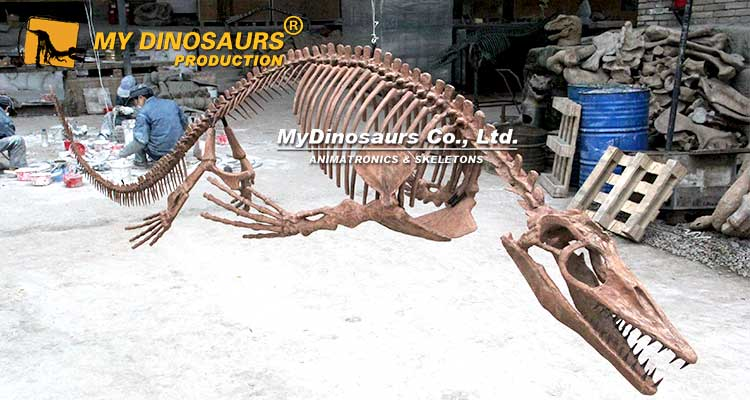
Understanding the scale of these animals is a major part of what makes them so compelling. Fossils indicate that some ichthyosaurs reached lengths of over 20 meters, while certain mosasaur species could rival that size. Without a physical reference, however, such measurements hold little meaning for the average visitor. A towering, fully reconstructed skeleton communicates scale in a way that text panels never could. For this reason, museums invest heavily in accurate, life-size recreations as central elements of their ancient ocean galleries.
Recreating the enormous marine reptiles often referred to as the biggest dinosaur in the sea requires a multi-stage approach grounded in paleontological science, digital modeling, and expert fabrication. Museums rely on accurate data and carefully structured workflows to ensure the resulting exhibits are both scientifically valid and visually compelling.
To ensure accuracy, museums begin by gathering a comprehensive dataset derived from fossils and academic research.
Once the data is collected, museums convert it into detailed digital models that serve as the blueprint for physical reconstruction.
With digital plans established, fabricators create large-scale physical replicas that bring the ancient creatures to life.
After construction, museums design immersive displays that communicate the creature’s environment, behavior, and scientific significance.
One of the most significant benefits of full-scale reconstructions is their ability to make science accessible. For many visitors, encountering a life-size marine reptile model provides a moment of awe that sparks curiosity. This emotional impact encourages deeper engagement with scientific concepts such as evolution, climate change, and extinction events.
Additionally, replicas offer practical advantages. True fossils of giant marine reptiles are rare and often too fragile to display publicly. Replicas allow museums to showcase accurate representations without risking priceless artifacts. They also enable institutions to create standardized educational programs, send traveling exhibits to schools or smaller museums, and share paleontological discoveries globally.
Moreover, reconstructions help clarify common misconceptions. By presenting accurate information alongside dramatic visual displays, museums teach visitors that marine reptiles are not dinosaurs, even if the phrase “biggest dinosaur in the sea” remains a popular cultural reference. This combination of visual impact and factual explanation contributes to a more scientifically informed public.
To understand how museums choose which reconstruction method to use, it helps to look at how various approaches differ:
Each method serves a different purpose. Full skeleton replicas remain the most impactful way to communicate scale, but digital experiences can supplement them by showing movement or environmental context. Many museums combine methods to create layered, immersive educational journeys.
A dedicated section focusing on the keyword phrase helps anchor its use in an educational context. Although the term is technically inaccurate, it captures public imagination, providing museums with an opportunity to explain what these animals truly were. Accurate reconstructions emphasize anatomical features—such as the streamlined bodies of ichthyosaurs or the powerful jaws of mosasaurs—that help visitors understand how these creatures survived in ancient oceans.
By presenting scientifically grounded models, museums foster a more nuanced appreciation for prehistoric marine life. Visitors learn how paleontologists estimate size from incomplete fossils, how marine reptiles adapted to their environments, and why some evolved massive proportions. This transforms the phrase “biggest dinosaur in the sea” from a misconception into a rich, teachable moment.
Recreating the ancient giants of Earth’s oceans is a multidisciplinary effort that blends paleontology, design, engineering, and education. Through carefully built replicas and scientifically informed displays, museums enable audiences to visualize the biggest dinosaur in the sea—or rather, the largest prehistoric marine reptiles—in vivid and meaningful ways. These exhibits connect visitors with a world that vanished millions of years ago, inspiring curiosity and fostering a deeper appreciation for our planet’s vast evolutionary history.
As reconstruction technologies continue to advance, museums will be able to bring ancient seas to life with even greater fidelity. The result is a more informed global audience, better prepared to understand the natural world and its remarkable past.