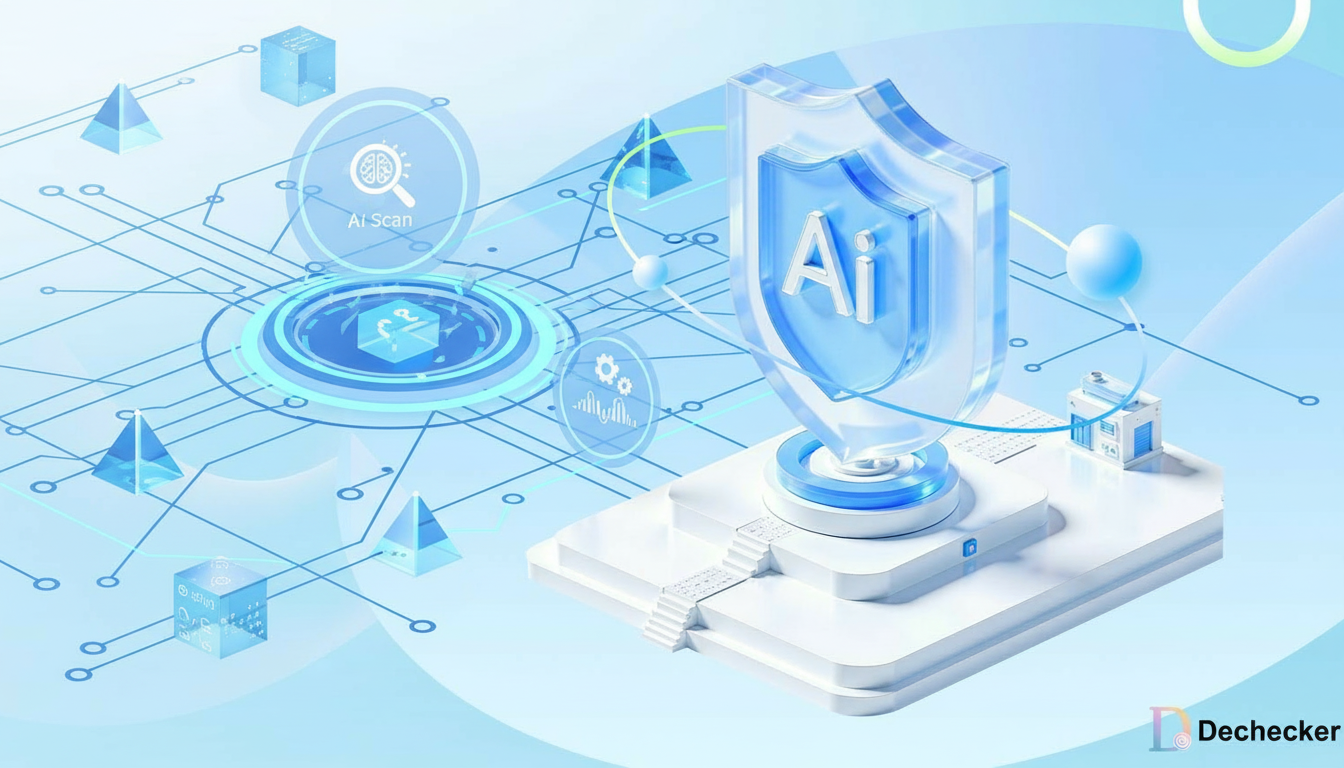
In the modern world where everything is connected, security of networks is not only a technical issue but also a matter of strategic plan. Companies are attacked with very advanced methods, which include among others, ransomware, phishing, and supply chain vulnerabilities. Application of Generative AI and machine learning is aimed at detection of anomalies, vulnerability prediction, and even automation of response strategies. Yet, as these AI systems generate analyses and threat reports, the challenge of verifying accuracy and maintaining human oversight becomes critical. Dechecker’s AI Checker offers a means to ensure that AI-assisted cybersecurity content remains readable, trustworthy, and actionable.
Conventional security tools depend on signature-based detection and established protocols. On the other hand, modern AI systems are capable of analyzing network traffic, log files, and system behaviors almost instantly, at the same time spotting the unusual patterns which might signal a breach. These algorithms can even foresee the attacks that will happen and give the security teams a proactive edge.
Nevertheless, AI models are very good at pattern recognition, but sometimes the outputs that they produce, such as threatening reports, alerts or summaries, may seem like they were written by a machine or lack depth of explanation. The AI Checker is a tool that assists the analysts in spotting these weaknesses, thus making it possible for the generated content to be communicated in a clear manner while still retaining contextual understanding.
There are a lot of advantages for AI in the field of cybersecurity namely: quicker spotting of threats, less manual monitoring, and the ability to analyze complex networks on a very large scale. However, the risks are also present. Relying too much on AI-produced reports can result in misunderstanding, failure to catch abnormalities, or false assurance in machine recommendations. It is very important to keep a human viewpoint; tools like AI Checker are helpful in this aspect by pointing out the parts of the text which might look too automated or similar.
Cybersecurity findings often contain dense technical jargon. Analysts must translate these findings into actionable recommendations for diverse audiences, including executives, developers, and compliance officers. AI Checker assists by identifying phrasing that may seem formulaic or AI-generated, allowing teams to refine content and maintain clarity without sacrificing precision.
Many security insights originate from multiple sources: system logs, threat intelligence feeds, and recorded briefings. Using an audio to text converter, teams can transcribe discussions, interviews, or incident reviews quickly. AI Checker enables editors to refine transcripts, preserving tone, context, and actionable insights, while ensuring that mechanical phrasing does not obscure critical details.
Cybersecurity teams often include various experts like threat analysts, network engineers, and compliance specialists. Reporting standardization is essential for coordinated responses. AI Checker provides a neutral perspective that helps in synchronizing the inputs of AI and human-created content, thus making the reports of different team members clear and consistent.
AI systems are capable of producing false positives, thereby identifying non-threatening activities as suspicious. Excess dependence on these alerts may result in alert fatigue or incorrect distribution of resources. The use of detection tools such as AI Checker adds an extra level of scrutiny, making sure that the written explanations of AI outputs are still precise, subtle, and understandable.
Cybersecurity threats undergo a very fast evolution, and AI models have to be constantly trained with new data to keep being effective. Likewise, the tools for detection must be updated along with the systems, having the capability to identify the patterns of AI-generated texts and aid in human review.
In many sectors, accurate reporting is not only a best practice but also a regulatory requirement. Misrepresentation or for example, ambiguous explanations of AI-generated security analyses could lead to legal consequences. AI Checker not only reinforces ethical standards but also ensures transparency and clarity that are compliance requirements.
Reports that are clear and trustworthy give security teams the power to make swift and smart moves. The AI Checker tool marks the machine or AI-like text so that the human experts are able to grasp the results correctly, rank the threats properly, and share the practical advice with certainty.
AI-created evaluations open the door to the learning process, especially the junior analysts. Through content marked for review, the teams can spot the fields where the reasoning of AI would need human intervention to be comprehended, thus deepening the understanding and growing the skills at the same time.
Detection tools promote the careful and thoughtful use of AI. Human analysts can utilize AI to a large extent but at the same time, they will be giving the human contribution in the form of insight, examples, and context. The method of human plus machine together leads to the adoption of technology in a responsible manner but still with the ability to use one's judgment and be clear.
The time of less sophisticated cybersecurity threats is long gone and very soon AI will be the main actor in this field. Still, the question of how much human intervention is needed together with automation is very important. For instance, Dechecker AI Checker will make sure that the content produced by AI is not only readable but also has the human point of view and insights.
Additionally, the use of multimodal data by the organizations, for example, logs, interviews, and real-time communications have drawn a clearer vision for using detection tools across formats. The Joint effort of AI support, transcription, and meticulous review enables the teams to handle the consequences of threats in the right way, with the right quality, and by being open about it.
Generative AI has been able to reshape the cybersecurity industry completely and have given it speed and prediction never before seen. Nevertheless, if not carefully examined, the AI analyses may be unintelligible, too mechanical, or even wrong. Dechecker’s AI Checker acts as an important layer of quality assurance, allowing teams to have the human aspect, trust, and clearness of action.
In the rapidly changing field of cybersecurity, it is vital to have a mix of AI effectiveness and human insight. Detection tools make sure that the companies are using AI in a good way and consequently, they are creating content that helps in making decisions, responding to threats and planning security strategies. The security teams that incorporate AI Checker into their operations will be able to reap the benefits of both speed and accuracy, and at the same time, the human judgment that is still the most important factor in effective cybersecurity practice will not be lost.