When people talk about Pennsylvania manufacturing, images of large factories and assembly lines often come to mind. However, the true drivers of technological innovation are often the local manufacturing forces hidden within communities, specializing in micron-level precision. This article will demystify how this "invisible" technology operates and explore why it is an incredibly valuable part of the Montgomery County business ecosystem.
The essence of modern local manufacturing has undergone a profound evolution. Its core value has shifted from large-scale, standardized production to high-value-added, high-tech fabrication of complex components and prototypes. This completely transcends the traditional perception of "local manufacturing as small workshops." In Pennsylvania, advanced precision CNC milling technology can produce critical parts for medical devices, aerospace components, and precision instruments. Its value lies in knowledge density and technical depth, not merely scale. This capability significantly strengthens the indispensable position of Pennsylvania manufacturing within the global high-end industrial chain.
This transformation also brings employment stability. According to data from the U.S. Bureau of Labor Statistics (BLS), the job market demand for technical positions related to precision manufacturing, such as CNC machine tool operators and programmers, shows a stable growth trend, proving this sector is a reliable stabilizer for the regional economy.
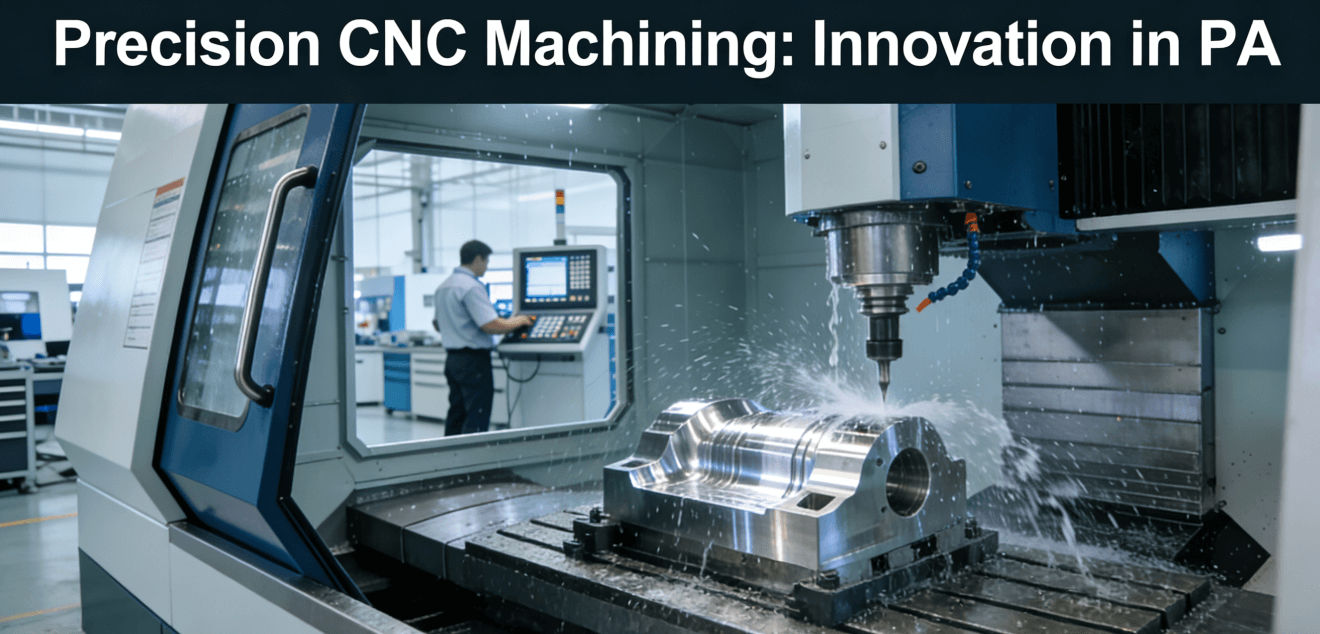
The entire process begins with a three-dimensional digital model (CAD) of the product. This model is programmed through specialized Computer-Aided Manufacturing (CAM) software, generating a series of precise instructions (G-code) that drive the high-speed cutting tools on a precision CNC milling machine.
Within an enclosed workspace, the tools cut metal, plastic, or other raw materials along pre-set paths, stripping away material layer by layer until a complex part identical to the digital blueprint is formed. This custom CNC milling approach makes small-batch production of highly complex parts both economical and efficient, perfectly suited for the agile needs of product development iteration and specialized equipment manufacturing. A high-performance CNC milling is, in essence, a tireless digital craftsman, turning innovative ideas into tangible, high-precision reality.
In today's globalized world, why are multinational companies willing to entrust their critical R&D and production tasks to local CNC milling services? The answer lies in a combination of three advantages: agility, quality, and trust.
Geographic proximity offers an unparalleled response speed. Engineers can communicate face-to-face with the manufacturing team, quickly resolve design issues, and receive physical prototypes for testing within days. This close collaboration significantly shortens product development cycles, a crucial strategic advantage for time-sensitive global enterprises.
Global cooperation is built on unified standards of trust. The quality assurance of high precision CNC milling relies not only on advanced equipment but also on an internationally recognized quality management system. This is precisely why manufacturers like JS Precision consider obtaining stringent certifications a cornerstone of their operations.
l ISO 9001:As the global benchmark for quality management systems, ISO 9001 certification ensures standardized, documented process control from order receipt to final delivery. It provides customers with confidence, proving the supplier can consistently deliver products that meet regulatory and customer requirements, forming the basis for long-term cooperative trust. This system focuses on process improvement and customer satisfaction, a key indicator of a mature and robust manufacturing enterprise.
l AS9100D:This is the gold standard in the aerospace field, far more stringent than ISO 9001. AS9100D emphasizes extreme requirements for product traceability, risk assessment, and deviation control. For instance, it requires detailed records for every critical component, from raw material source and processing history to the tools used, ensuring any quality issue can be traced back to its source quickly and accurately, thus meeting the aerospace industry's zero-tolerance attitude towards safety and reliability.
l IATF 16949 & ISO 14001: IATF 16949 is a mandatory quality threshold for the automotive industry, focusing specifically on defect prevention, reducing supply chain variation, and waste. The ISO 14001 Environmental Management System certification indicates a company's commitment to minimizing its environmental footprint, for example, by optimizing cutting fluid recycling systems, reducing energy consumption, and properly handling metal waste to achieve green manufacturing. The combination of these two certifications demonstrates a supplier's commitment to providing high-quality automotive components while fulfilling its social responsibility and sustainable development commitments.
These certifications are the "credentials of trust" for dialogue with global high-end industrial customers. To gain a deeper understanding of the breadth and depth of this technology, you can refer to this comprehensive guide on precision CNC milling.
figure 2: Rigorous international certifications, like those held by JS Precision, are the foundation of trust for global clients relying on local manufacturing partners.
In recent years, the fragility of global supply chains has prompted companies to reassess their strategies. Sourcing key component production locally or through nearshoring can effectively mitigate risks associated with long-distance transportation, geopolitical uncertainty, and inventory disruptions. Trusting precision manufacturing partners within the Montgomery County business ecosystem is a key part of building a more resilient and responsive supply chain.
The value of the precision machining industry extends beyond serving global clients, deeply benefiting the local community. Firstly, it creates a large number of high-skilled, well-paying jobs in programming, process engineering, equipment operation, and quality inspection, fostering a stable technical middle class for the region. Secondly, the industry significantly lowers the barrier to technological innovation.
Today, a powerful mini CNC milling machine can support local makers, vocational education programs, or small design studios, rapidly turning ideas into prototypes, thereby greatly stimulating the vitality and innovative spirit of the Montgomery County business ecosystem.
Looking ahead, local manufacturing faces both historic opportunities and severe challenges. Opportunities lie in the growing preference for nearshoring amidst global supply chain restructuring; challenges stem from continuous technological iteration and increasingly fierce talent competition. For Pennsylvania manufacturing to maintain its leading position in the future, efforts are needed in three areas.
Reports from the National Association of Manufacturers (NAM) repeatedly emphasize the importance of "supply chain resilience." This presents a huge opportunity for local high-end manufacturing. Local enterprises need to proactively position themselves as reliable, high-quality nearshoring alternatives for global companies.
The core of competitiveness lies in continuous technological upgrading and investment in talent. Companies need to actively introduce advanced technologies like 5-axis simultaneous machining and additive hybrid manufacturing, while establishing tight talent pipelines with community colleges and technical schools to ensure skills supply meets industry demands.
l Technology Upgrade Path:
Future technological upgrades are not limited to purchasing new equipment but involve building a "digital factory." This includes on-machine measurement systems for real-time size inspection and automatic tool wear compensation during machining; deploying equipment networking platforms to monitor machine status and efficiency across the workshop; and utilizing AI algorithms to analyze machining data, optimize cutting parameters, and achieve predictive maintenance, thereby maximizing equipment uptime and improving overall production efficiency.
l Talent Cultivation Strategy:
Effective talent strategies require forming a synergistic "government-industry-academia" ecosystem. This includes collaborating with local vocational technical colleges to set up targeted training programs, providing internship and apprenticeship opportunities for students; establishing clear career progression ladders within companies, offering paths for technicians to advance from operators to programming engineers; and attracting and retaining top talent through competitive compensation and ongoing skills training, building a self-sustaining, continuously developing technical team.
Ultimate success depends on the "cluster effect." By promoting deep collaboration among precision machining enterprises, research institutions, universities, and end-users, a knowledge-sharing, mutually reinforcing industrial ecosystem can be formed. This is essential to establish local manufacturing as the most prominent high-tech hallmark on the Pennsylvania manufacturing ID card (business card).
Precision CNC machining represents a modern local manufacturing capability deeply integrated into the global innovation network, competing on technical expertise and quality reputation. It has significantly enhanced the technological connotation and added value of Pennsylvania manufacturing, making it an indispensable high-value segment of the Montgomery County business ecosystem.
Whether you are an innovator seeking a reliable manufacturing partner or a student planning a career path, this dynamic field is worth exploring in depth. To discover how precision manufacturing can turn your ideas into reality, welcome to visit the professional CNC milling services.
The author of this article has over fifteen years of experience in precision manufacturing industry research. Their research focuses on the profound impact of advanced manufacturing technologies on regional economic transformation and global supply chain restructuring. They long-term provide expert insights for several authoritative manufacturing media outlets, dedicated to promoting the innovative application of precision machining technology and industrial synergistic development.
Q: Which industries primarily use precision CNC machining?
A: It is widely used in medical devices, aerospace, automation equipment, and precision instrumentation. These industries require complex, high-reliability metal parts, and many related companies are distributed in Pennsylvania and surrounding areas.
Q: What kind of training is needed to enter this field?
A: Paths are diverse. CNC technology programs at community colleges are a good starting point. Roles include programming, machine operation, and quality inspection, emphasizing hands-on skills and continuous learning, rather than necessarily a four-year degree.
Q: Is precision machining suitable for small batches or single pieces?
A: Absolutely. This is one of its core strengths. It is ideally suited for prototyping, small-batch production runs, or custom specialty parts, enabling an efficient transition from design to finished product.
Q: How does the industry address environmental protection requirements?
A: Modern factories focus on sustainable operations. They optimize processes to reduce energy consumption and waste, use coolant recycling systems, and adhere to standards like ISO 14001 to manage environmental impact, committing to green manufacturing practices.
Q: How is the technology in this field evolving?
A: It is moving towards greater intelligence and connectivity. Examples include integrating sensors and data analytics for predictive maintenance, and using digital platforms for remote monitoring and collaboration, continually enhancing efficiency and reliability.