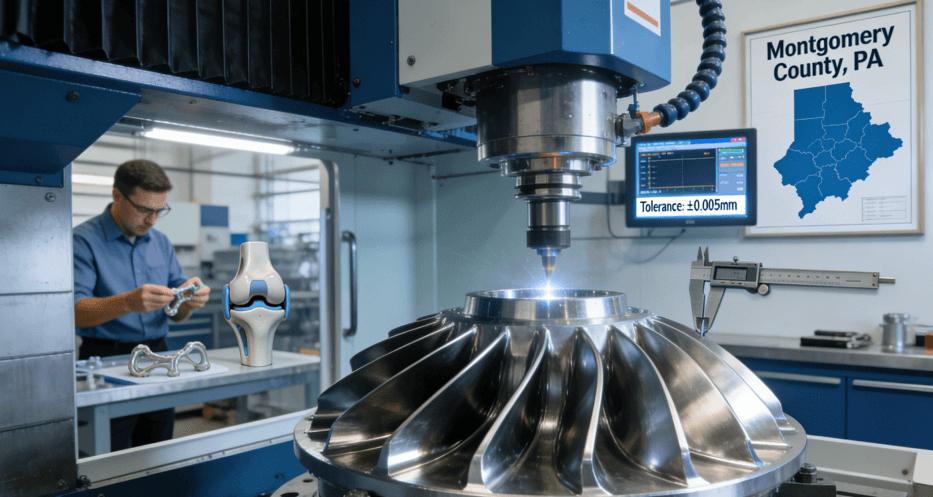
In Southeastern Pennsylvania, particularly Montgomery County, a dynamic hub for aerospace technology and high-value medical device innovation is rapidly emerging. However, local manufacturers face a critical challenge: reliably producing prototypes and end-use parts with extremely complex geometries, ultra-high precision, and strict material compliance requirements. Traditional 3-axis machining methods, often requiring multiple setups, introduce cumulative errors and struggle with intricate free-form surfaces, creating a significant bottleneck for innovation speed and product performance.
This article explores how 5-axis CNC machining, with its "single-setup, complete machining" capability, provides a pivotal solution. We will analyze its application in meeting the stringent demands of the aerospace (e.g., engine components) and medical sectors (e.g., custom implants), emphasizing the importance of partnering with properly certified local manufacturers. So, how exactly is this technology revolutionizing local high-end manufacturing? Let's delve deeper.
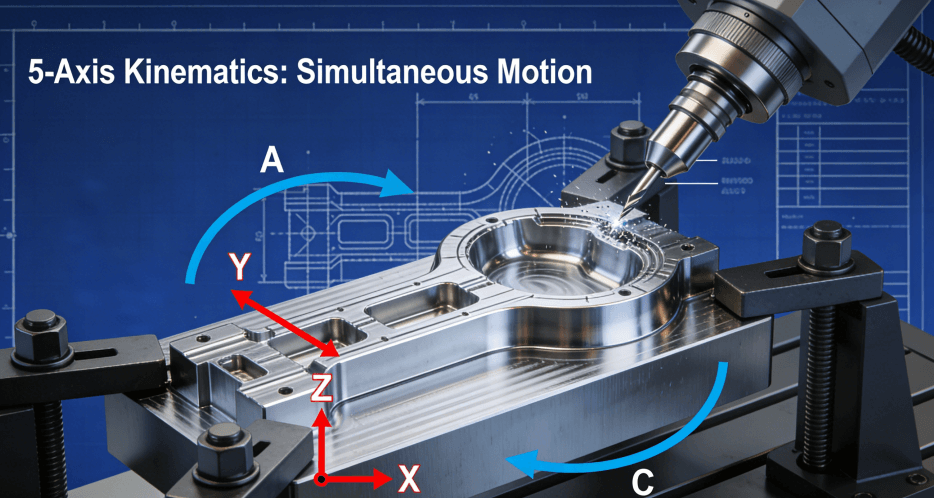
At its core, 5-axis CNC machining adds two rotational axes to the standard X, Y, and Z linear motions. This fundamental enhancement unlocks transformative advantages for manufacturing complex components.
Figure 2: The simultaneous movement of five axes provides unparalleled freedom for manufacturing intricate geometries impossible with traditional 3-axis machines.
The integration of two rotational axes (e.g., A/C or B/C) allows the cutting tool to approach the workpiece from virtually any angle. This dynamic tool orientation is the foundation for machining undercuts, deep cavities, and contoured surfaces in a single clamping, eliminating the need for multiple setups.
Adherence to geometric dimensioning and tolerancing, as defined by standards like ASME Y14.5, is fundamental for precision components. Traditional 3-axis machining's reliance on multiple setups inherently risks cumulative errors and unstable datums. 5-axis technology ensures all features are machined relative to a single coordinate system, guaranteeing consistent adherence to tight tolerances and significantly improving overall accuracy.
Beyond precision, the technology offers superior surface finish quality. By maintaining an optimal cutting angle, tools can utilize their side-cutting edges more effectively than just the tip, reducing scalloping and the need for secondary finishing. This also leads to better chip evacuation and reduced tool wear, directly enhancing production efficiency.
The local aerospace cluster demands nothing short of perfection, driven by the need for lightweight structures and uncompromising reliability.
l Machining Demanding Aerospace Alloys: Components like turbine blades and structural airframe parts are often made from challenging materials like titanium alloys and nickel-based superalloys. 5-axis machining excels here by allowing optimal cutting angles that manage heat generation, reduce cutting forces, and prevent work hardening, which is crucial for maintaining material integrity.
l Achieving Aerodynamic Perfection and Weight Reduction: The ability to machine complex, organic shapes in a single setup is vital for high-performance airfoils and lightweight, topology-optimized structures. This capability enables local aerospace firms to achieve the high strength-to-weight ratios and perfect aerodynamic surfaces required for next-generation flight. For companies needing to produce complex parts like the high-pressure turbine blades described in 5-Axis CNC Machining for aerospace and medical devices, this technology is the only viable solution. Furthermore, machining these critical components requires strict process controls, often mandating that manufacturers adhere to AS9100D aerospace quality standards.
In the medical field, precision is directly linked to patient outcomes, making 5-axis CNC machining an indispensable tool for local innovators.
The shift towards personalized medicine requires implants (e.g., knee, hip) and surgical tools that perfectly match a patient's unique anatomy. 5-axis technology can seamlessly translate CT/MRI scan data into complex, customized geometric parts with the necessary biocompatible surface finishes, reducing surgery time and improving patient recovery.
Medical devices demand exceptional surface quality to minimize infection risks and ensure proper function. The single-setup process and advanced toolpath control inherent in 5-axis machining are critical for consistently achieving the required surface finishes below Ra 0.4µm. This level of precision is non-negotiable for ensuring the biocompatibility and long-term performance of implants and surgical tools.
However, technological capability alone is insufficient. In the highly regulated medical sector, robust quality assurance systems and complete part traceability are fundamental pillars. Therefore, selecting a manufacturing partner with the relevant industry-specific certifications, such as ISO 13485 for medical devices and ISO 9001 for quality management systems, is paramount. These certifications provide a verifiable framework for rigorous process controls, from raw material inspection to final part validation, ensuring every component is produced to the highest standards of safety and efficacy. This due diligence in partner selection is a decisive step in mitigating risk and guaranteeing compliance for critical healthcare applications.
Selecting the right manufacturing partner is as crucial as the technology itself. Local engineers should prioritize a comprehensive checklist.
l Technical Capabilities and Quality Systems: The partner must possess state-of-the-art 5-axis CNC equipment and demonstrate expertise in handling relevant materials. A robust quality control system, including in-process inspection with on-machine probes and final validation with CMMs, is non-negotiable. Certifications like AS9100D (aerospace) and ISO 13485 (medical) provide independent verification of their quality management systems.
l Collaborative Engineering and DFM Support: A true partner offers more than just machining; they provide valuable Design for Manufacturability (DFM) analysis. This collaborative approach helps optimize designs for cost, performance, and manufacturability from the outset, avoiding costly revisions later. When evaluating a partner, assessing their comprehensive 5-axis CNC machining services is the first step to ensuring a seamless transition from prototype to production.
The adoption of advanced manufacturing technologies like 5-axis CNC machining has a profound positive impact on the local economy.
These sophisticated machines create demand for highly skilled programmers, engineers, and machine operators. This fosters the development and retention of a high-value technical workforce within the North Penn Area, moving beyond traditional manufacturing roles to more specialized, knowledge-intensive positions.
By providing local aerospace and medical companies with world-class manufacturing capabilities, these advanced shops fuel a virtuous cycle of innovation. They enable faster prototyping, reduce time-to-market, and support the growth of high-tech industries, thereby contributing to a resilient and sustainable local economy in Southeastern Pennsylvania.
5-axis CNC machining has evolved from a niche technology into a core competency driving innovation in Montgomery County and the surrounding region. By delivering unparalleled precision, efficiency, and the ability to handle complex geometries, it empowers local businesses to transform ambitious designs into reality. This local advanced manufacturing capability is fundamental to the continued growth and leadership of the aerospace and medical device sectors in Southeastern Pennsylvania.
Q: What are the key tolerances achievable with 5-axis CNC machining for medical devices?
A: For critical medical implants, advanced 5-axis machining can consistently hold tolerances as tight as ±0.005mm, with surface finishes achieving Ra < 0.4µm. This precision is essential for fit, function, and biocompatibility and requires a rigorous quality system compliant with standards like ISO 13485.
Q: How does 5-axis machining handle the difficult-to-machine materials common in aerospace?
A: The technology excels with materials like titanium alloys through strategic process control. Continuous tool orientation adjustment maintains an optimal cutting angle, promoting better chip evacuation, reducing cutting forces, and managing heat. This leads to minimized tool wear and preserved surface integrity, underpinned by adherence to AS9100D standards.
Q: Can 5-axis machining be cost-effective for low-volume production or prototyping?
A: Absolutely. The "single setup" capability drastically reduces labor for fixturing and reprogramming and minimizes errors between setups, lowering scrap rates. This makes it highly efficient for producing functional prototypes and low-volume batches, accelerating development cycles.
Q: What file formats are best suited for quoting and manufacturing with 5-axis CNC?
A: For accurate work, 3D solid model files are essential. The most reliable format is STEP (.step), as it contains precise geometry. Other acceptable formats include IGES and Parasolid. While 2D PDF drawings are useful for specifying tolerances, they are insufficient alone for programming complex 5-axis toolpaths.
Q: How does partnering with a local manufacturer benefit projects requiring high precision?
A: Local partnership in Southeastern PA enables closer collaboration and real-time communication. It allows for quick design iterations, physical sample reviews, and face-to-face problem-solving, significantly shortening feedback loops and ensuring the final product is optimized for performance and manufacturability.
The author is a precision manufacturing expert with extensive experience in the aerospace and medical device sectors. They are part of a team at LS Manufacturing, which helps engineers and researchers solve complex part challenges. With relevant certifications, the team ensures high-quality solutions through advanced technologies. For a professional assessment of your project, contact them today for a free, no-obligation DFM analysis and quote.