
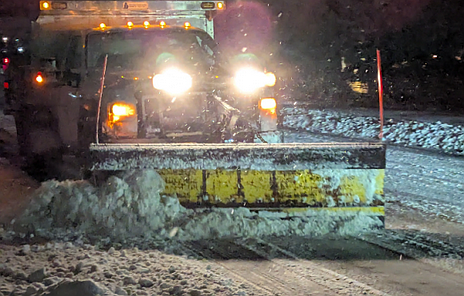
Winter storm and snow (Credit: LevittownNow)
The forecast from The Old Farmer’s Almanac largely lines up with that outlook for the region, which includes cities from Washington D.C. to Boston
Forecasters from both a federal agency and a centuries-old publication are predicting a relatively mild and dry winter for a swath of the Mid-Atlantic and Northeast.
The National Oceanic and Atmospheric Administration’s three-month outlook for January through March 2026 calls for slightly above average temperatures and below average precipitation for the region.
The forecast from The Old Farmer’s Almanac largely lines up with that outlook for the region, which includes cities from Washington D.C. to Boston.
The almanac predicts the region will experience a winter that is overall “milder and drier.”
The prediction calls for above-normal temperatures and below-normal precipitation and snowfall.
The publication notes that fewer snow days “could ease commutes.”
While the general trend is expected to be warm and dry, the almanac points to specific periods for cold and snow.
The coldest stretches are forecast for mid- to late December and early and late January. The majority of the expected below-normal snowfall is most likely to occur around the holidays and later in the season, with the snowiest periods anticipated in late December, early January, and late February.
The almanac’s outlook for Pennsylvania splits the state’s forecast.
While the Philadelphia region is expected to have a mild and dry winter, western parts of the state are predicted to face a cold and dry season.
National Weather Service data from Trenton showed 10 inches of snow in 2025, 19.2 inches in 2024, 2 inches in 20223, 16.4 inches in 2022, 27.3 inches in 2021, and 6.8 inches in 2020. The winter of 1996 was the snowiest recorded with 60 inches of snow.
While the The Old Farmer’s Almanac continues to publish, the similar Farmers’ Almanac is shutting down after 208 years. The publication typically put out a seasonal forecast. It closed down due to a “chaotic media environment.”










