Having at least 3 people watching you at the same time on average is what Twitch means by average 3 viewers. Why do you hear a lot about having 3 concurrent viewers? Why does it matter, and what do you need to know about it? This guide has all your answers. Let’s dive in and clear all the confusion!
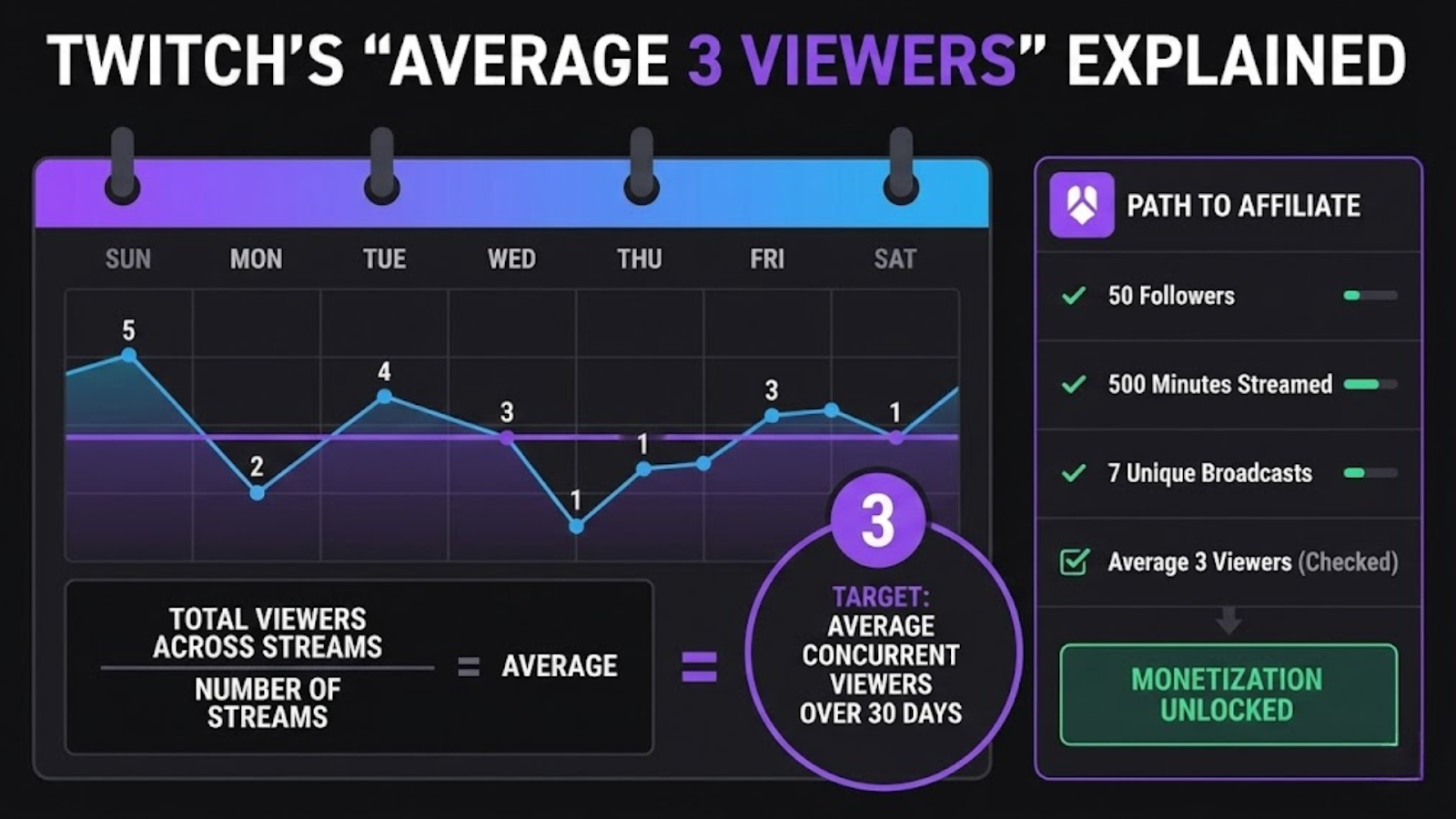
If you want to earn money from Twitch streaming, you need to become a Twitch affiliate. How do you become a Twitch affiliate? There are certain requirements that you need to meet to become an affiliate. Those requirements include a minimum of 3 average viewers on your streams. These are concurrent viewers, not total views.
Twitch’s own analytics page explains that average viewers is the average number of people watching your stream at the same time while you’re live. They check how many viewers you have repeatedly throughout the stream and then average those numbers.
So if your stream constantly hovers around 3–4 people watching at once, your average is roughly 3–4. If most of the time you’re at 1 viewer and sometimes you spike to 5, your average might still be closer to 1–2.
Twitch’s official requirement to become an Affiliate includes: Reach a minimum of 3 average viewers over any 4 stream days in the last 30 days. Your days below 3 average viewers don’t count against you, though. That means if Twitch is looking at your last 30-day window. They want you to have at least 4 separate streaming days where your average concurrent viewers for that stream were 3 or more. If you have streams with 1–2 viewers, those days simply don’t help.
So the average of 3 viewers in the Affiliate context really means that you’ve proven that on at least four different days in the last month, your stream could hold at least three people at once on average. It’s a small stability check.
Twitch doesn’t give the full technical formula, but their analytics explain the core idea very clearly. They repeatedly check how many people are watching you during the stream, add all those numbers up, and divide by how many checks they made.
It’s just like you take random screenshots of your stream. One record 2 viewers, one did 1 viewer, one did 6 viewers. Then you add those numbers together and divide by how many snapshots there were. That gives the average concurrent viewers for that stream.
Yes, everybody counts as long as they’re watching your stream.
Twitch’s official viewer-count article explains that viewer count includes people who are watching the live video, even if they are not typing in chat.
So, people who are silently lurking still help your average viewers. Someone who opened your stream and left it playing on mobile counts as well.
If you open your own stream as a viewer while logged into Twitch and actually watch the live video, Twitch can count that as a view. However, it’s not recommended to self-inflate your viewer count. Too many views coming from the same network and location aren’t right. It can help slightly at the very beginning to build social proof, but not algorithms find it as it happens multiple times.
Twitch introduced the 3-average-viewers requirement so that Affiliate status goes to people who have at least a real audience.
It helps them filter out channels that go live once in a while. It helps them reward streamers who are consistent and serious about streaming. This whole process ensures that the monetization goes to streamers who are most deserving.
Because Twitch is averaging concurrent viewers over time, and long periods with 0 or 1 viewer can drag down your average. Here’s how:
You stream 6 hours with 0–1 viewers most of the time. The average ends up around 1. Another scenario where you just streamed for 1 hour with 3–4 viewers who stick around. The average ends up around 3–4.
The second scenario gets you much closer to hitting the Affiliate requirement, even though you spent less time streaming.
This is why many experienced streamers recommend avoiding streaming for many hours with 0 viewership. Instead, go live when you have some chance of people joining.
Aim to get at least 2-3 clips out of each stream that you can post on TikTok, Instagram, and YouTube as shorts. Make a Discord community and get active on X. Post on these platforms regularly. Use the right keywords to increase your reach.
All of your posts must have a CTA that tells viewers to join you on Twitch at these specific times. Your bio should have a clear, consistent schedule of your streaming.
Once everything is set up right. You can use reliable Twitch service providers to buy Twitch viewers that can help you achieve this goal, but ensure you’re buying stable and high-quality viewers that mimic organic growth.
Instead of obsessing over the number every day, use your data to analyze things step by step.
Most new streamers struggle because viewer averages drop whenever someone stops watching or leaves during the stream. Twitch calculates your average across the entire stream session. This means even small dips count. The only solution is to keep people engaged so they don’t get bored, and if your stream count drops to 0-1 viewer, then cut your stream early to save a better average.
Yes. Anyone who has your stream open, even if they never type in chat, counts toward your viewer average. Lurking is a common culture in Twitch; people come, watch, but never say a thing, and leave. All of it counts
Sometimes it feels like Twitch isn’t counting all your friends or family as viewers, even when they say they’re watching. Twitch doesn’t publish every technical detail of how it filters views. But what we do know is that the viewer count is based on people actually watching the live video.
When Twitch says average 3 viewers, it means you need at least three people watching you at the same time on average, on at least four different stream days within the last 30 days, based on Twitch’s own calculation of average concurrent viewers. It’s not about total views, not about how many people clicked your channel once.