There is often a binary choice for travelers to choose from in the world of high-altitude adventure. Either you are a trekker or a mountaineer. But what if you had the liberty to be a part of both of these experiences?
Yes, you heard right. In the Himalayas of Nepal, specifically in the Khumbu region, you do not have to choose. In fact, the most immersive experiences come when you blur that line. This is using a stunning, high-altitude trek as the ultimate acclimatization tool for a technical summit. Let us propose a strategy that will be your “Holy Grail” in Himalayan expeditions.
The synergy that combines the pristine, turquoise serenity of the Gokyo Lakes with the technical, exposed granite of the Ama Dablam Expedition is the ultimate manifestation you can indulge in. This is not just a vacation. It becomes a part of your evolution. You start as a walker, and you finish as a climber.
If you are asking why combining a walk and a climb is necessary? Why can't I just fly straight to the base camp and climb?
It is because your walk becomes a major catalyst in active acclimatization and mental priming. You shock your body if you fly into Lukla and rush directly to the Ama Dablam Base Camp. This won’t give your mind a chance to settle into the rhythm of the mountains. By following the Gokyo Lakes Trek, you engage your body in a slow, deliberate courting of the altitude.
This isn't just about killing time. It helps you build red blood cells while gazing at the most beautiful lakes in the world. When it is time for you to strap on your crampons at the base of Ama Dablma, you won’t be gasping for air. Your breath becomes a rhythmic, acclimatized engine that is ready for the vertical world.
Just like everyone else, your journey begins in Lukla. Then, you will proceed to walk to Namche Bazaar, which is also known as the Sherpa Capital. But here is where your path diverges. While the masses head right towards Everest Base Camp, you turn left.
Your route to Gokyo Valley should be a reminder for you to slow down. Here, the silence is heavier, which is only broken by the passing yak trains’ bells. So, take your moment enjoying the slow pace accompanied by a quiet trail, rhododendron forests, and waterfalls. Keep in mind that this phase entails your physiological conservation.
As you walk, you build red blood cells for the Ama Dablam Expedition, where a massive amount of the explosive energy will be drained. Trekking Gokyo like a race drains your battery before even reaching the climb. No doubt that you will be acclimatized, but exhaustion profoundly creeps in.
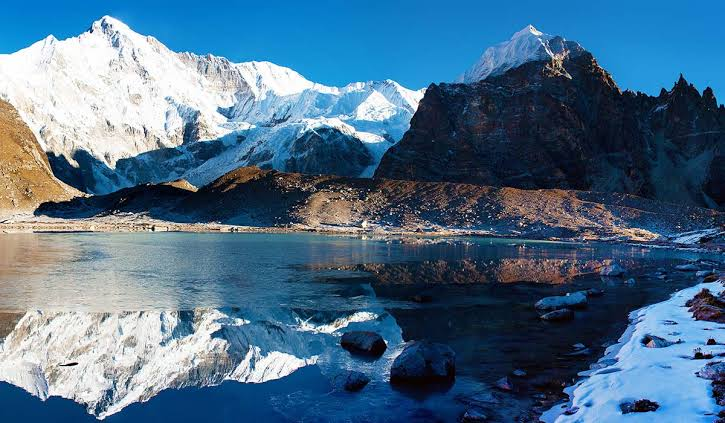
After ascending past 4,000 meters, you are welcomed by a landscape shift. The surroundings transition from green to the stark greys and browns of the alpine zone. Then, a spontaneous entrance of colors elevates the stretch again. The unanticipated change leads you to the Gokyo Lakes. Gokyo Lakes are the six interconnected glacial lakes that appear like spilled ink on the valley floor.
As you walk along the shores of the third lake, Gokyo Cho, the spectacular reflection of Cho Oyu will be seen. The mesmerising view is enhanced by the world’s sixth-highest mountain, adding beauty to the silent serenity it offers. Then, your first real test begins. There will be days you’d have to spend as you hike your way up Gokyo Ri (5,357m).
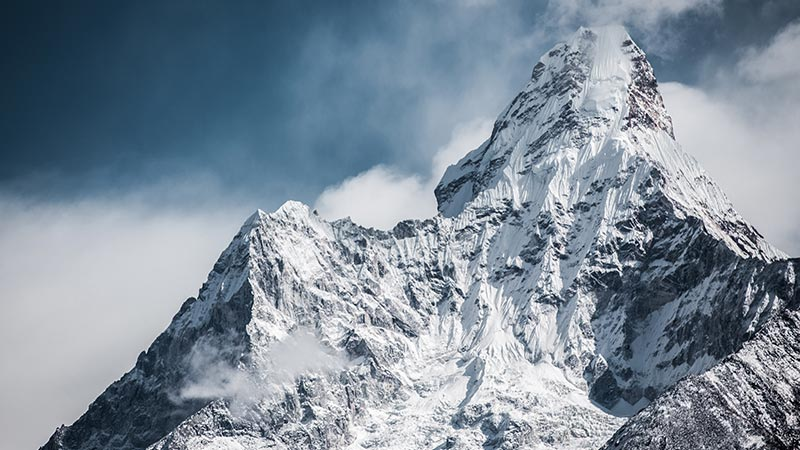
From this vantage point, you will see Ama Dablam in the east. She looks distant, sharp, and intimidating. But you are yet to be prepared for her. Let this serve as a reminder to continuously work on your breath.
The Cho La Pass, which is at a height of 5,420m, marks the transition from "trekking" to "expedition mode". This connects the Gokyo Valley with the Khumbu Valley. You are now navigating the loose scree, scrambling over boulders, and walking across a glacier. This is no ordinary trail. Remain focused, patient, and disciplined.
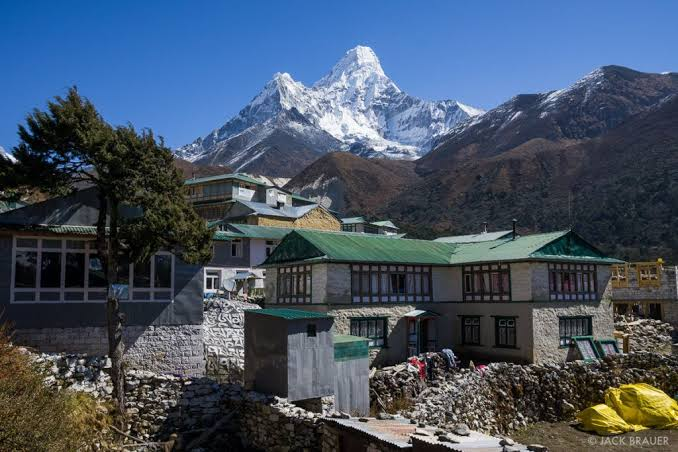
The Cho La pass prepares you psychologically for the arena you are approaching. As you descend the other side toward Dzongla, you will see the humongous pyramid of Dablam dominating the skyline. It is not just about admiring the scenery anymore. Brace yourself for ascending the largely growing Dablam, looking at you intimidatingly.
Breaking away again after briefly descending from Cho La and linking up with the main trail, you head into the Mingbo Valley. Finally, you arrive at Ama Dablam Base Camp (4,600m).
The base camp is one of the most grassy, pleasant base camps in Nepal. There will be a change in the dynamics here. Teahouses are traded for tents and hiking boots for double plastic climbing boots. Let this aware you that the trekking phase is over.
You will notice that you are already acclimatized. The 10-day high trek in Gokyo and Cho La Pass has made you remarkably strong. Instead of nursing the headaches in tents, you can enjoy the advantage your trek has rewarded you with. Eat heartily, laugh, and take a moment to thank yourself.
The move to Camp 1 (5,700m) is your reality check. The trail dissolves into a boulder field and then into steep granite slabs. You are now moving vertically. You will feel the weight of your harness, the jingle of your carabiners.
Camp 1 is perched on a rocky outcropping. You will have the precarious experience of sleeping on the ridge of the mountain. Looking down, you can see the trails you walked days ago that seem like mere scratches in the earth.
This is the most famous section of the climb. To reach Camp 2 (5,900m), you must negotiate the Yellow Tower. This is a vertical rock pitch, graded roughly 5.8 or French 5c. But you are doing it at nearly 6,000 meters wearing bulky gloves and boots.
This is where the "trekker" is fully left behind. You must trust your jumar. You must trust your feet. When you pull over the lip of the tower, you arrive at Camp 2. It is one of the most dramatic campsites in the world. Camp 2 is a nest of tents clinging to a jagged pinnacle of rock with barely enough room to walk. The exposure here is absolute. If you drop a water bottle, it falls for thousands of feet.
Summit day begins in the dark, usually around 10:00 PM or 11:00 PM. The climb from Camp 2 to Camp 3 involves Mushroom Ridge, a sharp snow crest that requires delicate footwork. You are walking a tightrope of snow.
From Camp 3 (6,300m), you need to push for the top. The Dablam looms to your right. You are kicking your crampons into hard ice as your lungs work like bellows. All thanks to your time in Gokyo, your body remembers how to process this thin air.
Standing on the summit of Ama Dablam at 6,812 meters is a spiritual experience. You look down at Everest, Lhotse, and Makalu. But most importantly, you look west. You see the Gokyo Valley. You see the tiny turquoise dots of the lakes where you stood two weeks ago. You see the entire arc of your journey from the humble valley floor to this sharp, freezing point in the sky.
Inevitably, there arises a question of how do you prepare logistics for this dual experience. Here’s a strategy. We call it the “Base Camp Duffel” system. As you carry a light daypack, porters help you carry the trekking gear.
The heavy climbing gear will be sent directly to the Ama Dablam Base Camp. This way, there will be no need to carry this heavy pack through Gokyo. It meets you there, helping to keep you light and agile during the trekking phase.
The change of narrative brought from combining a trek with a technical climb impressively builds your acclimatization. You spend weeks living in their shadow, learning their moods, their weather patterns, and their scale. Rewarding you with the ability to inhabit the mountain rather than just seeing or conquering it, you will feel like you are granted permission to be there.
Requiring roughly 25 to 30 days, this itinerary is indeed demanding. You will willingly need to suffer the cold and the thin air. However, the ultimate immersion into the high Himalayas will feel like a complete, holistic, and exclusive feeling that neither activity alone can offer.
If the idea of coming home with photos of both serene lakes and terrifying vertical drops sounds like your calling, pack your boots already. Get ready for the stories you will have of drinking tea by a stove in Gokyo and stories of hanging from a rope at 6,000 meters.
The Himalayas are waiting to show you their full spectrum, from the peaceful valleys to the savage summits. Are you ready?