Architecture is a field that blends function and form, purpose and practicality, and comes with its own unique challenges and opportunities. Whether the task is to build a home, a public office, a hospital or a school, architects and architecture firms have to balance pragmatism and ambition in every project, a task that’s only grown more complex over time. In the modern age, new construction and architecture projects must consider a swathe of legal regulations and strive to match or exceed sustainability goals, especially when it comes to energy. As a result, the role of a leading architecture firm has evolved from being merely builders to being connected community fixtures, developing with care to the people most affected by new projects.
In precisely that vein, HOLT Architects stands proud as both an integral member of the Ithaca, New York community and a sustainable builder. Led by principals Kelly Maher, Paul Levesque, , Quay Thompson and Steve Hugo , the award-winning architecture firm has planned and designed hundreds of innovative and affordable multi-family housing, mixed-use, community, healthcare, and higher education facilities throughout the state. Their high-design aesthetic is balanced and supported by creative, functional, and high-quality sustainable solutions.
At the core of HOLT’s mission are the paired pillars of sustainability and quality of life; the firm believes in creating enduring, sustainably designed and built environments that improve the lives of occupants and their broader communities. By approaching projects with energy efficiency and indoor environmental quality in mind, HOLT Architects are able to deliver long-term cost savings, healthy and happy occupants, and sustainable building outcomes all at once. With a number of successful projects completed in their home community—known for its highly progressive energy code—and a company policy of making sustainable ideas happen proactively, HOLT Architects sets itself apart as a sustainable firm in the field.
“In our role as architects, designers, and project managers, we act as guides in a process that fosters a collaborative, visual exchange of ideas, leading to the creation of spaces that respond to distinct goals,” says Steve Hugo “We thoroughly understand your needs and goals first—then work together to synthesize a vision and create engaging architectural solutions. As a firm we aim to be a part of a positive future for the built environment.”
Sustainable Signature Projects
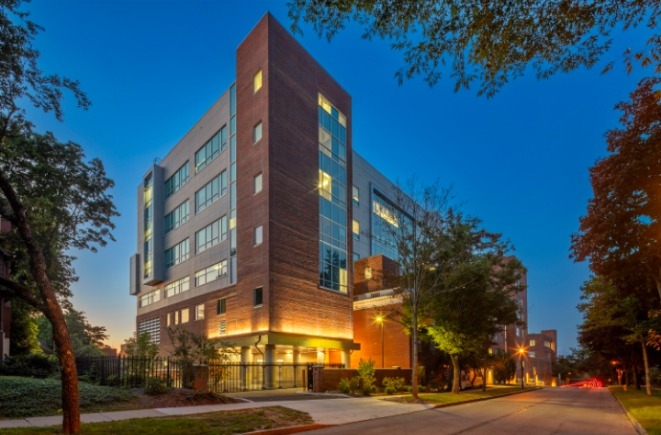
HOLT Architects isn’t the kind of firm to make claims without proven case studies to back them up. The firm’s most notable projects carry its trademark blend of sustainability and quality, whether it’s a housing project like the Village Grove Affordable Multi-Family Housing complex (which was awarded 2025 Project of the Year by NYS Association for Affordable Housing); or the award-winning Highland Hospital Patient Tower, an 80,000 square foot addition to the existing Highland Hospital Building. Every project is designed with a focus on sustainability—regardless of if the client pursues LEED certification or not—ensuring that energy efficiency is maximized and indoor environmental quality is achieved.
While some projects may carry impressive name-brand recognition, like His Holiness the Great 14th Dalai Lama Library and Learning Center (the Dalai Lama’s only facility in North America), other projects better exemplify HOLT’s sustainable projects in scope and execution. For example, HOLT Designed the Peggy Ryan Williams Building at Ithaca College,using sustainable site selection practices, reduced energy and resource consumption, and enhanced indoor quality; they used geothermal heating and cooling, sustainable local materials, wind and solar energy for electricity, green roofs, porous pavement, low-maintenance native grasses, and more. Upon completion, the building easily met the rigorous standards of LEED® Platinum Certification—the highest rank in the world’s most recognized green building rating system.
“Our diverse and award winning portfolio is a result of approaching every project and every client differently and uniquely,” Paul Levesque says. “Collaboration directly influences and helps shape our projects, and what makes a collaborative project great is the collection of ideas, but then the careful distillation and editing that is required to yield great architecture.”
Proactive Development And Innovation
HOLT Architects are able to find such success in their projects because they do not wait for innovation and progress to find them—they’re constantly pushing the envelope and looking for new solutions to enduring problems. HOLT designs projects to maximize the gain of both the client and the client’s community, and that means taking a sustainable approach. This dedication to sustainability is no green-washed platitude, it’s a bone-deep commitment that makes good sense environmentally, socially, and economically.
“The planning, design, and construction costs typically account for only thirteen percent of a building’s total life costs,” Quay Thompson explains. “Nearly ninety percent of the long-term cost is operational: maintenance, heating, cooling, and daily energy use. When we design with a focus on sustainability, we create buildings that honor their communities through thoughtful design, and that perform better over time through reduced energy use, lower operating costs, and greater long-term resilience.”
It’s for this reason that HOLT pursues sustainability in all of its practices, even if formal LEED, WELL, Passive House, or Net-Zero certification isn’t pursued. Energy efficiency, healthy materials, and resilient design practices are core aspects of HOLT’s design ethos, and the firm views that as part of their responsibility as designers to address the growing dangers of climate change. With over 60 years of practice across New York State, HOLT Architects has developed a firm vision and internal policy for proactive and progressive developments designed to elevate the everyday experience, strengthen communities, and push the boundaries of what built environments can achieve.
Collaboration and respect are core tenets of HOLT’s internal working environment. When the team is tasked with designing a new project for a given community, the first step is to research the culture and history of the area—not to recreate the past or present a false face, but to reflect and compliment the neighborhood’s scale, proportion, and orientation to the context. Gathering this information often takes the form of forums that allow locals and community leaders to gather and share input, and highlight aspirations for the development. This process often leads to innovations in construction and engineering that are a twist on an interpretation of the past—with over 100 community-based projects under its belt, HOLT has seen the benefits of community buy-in time and time again.
“HOLT’s vision extends beyond individual projects to long-term partnerships with institutions, municipalities, community developers, and engineering and design partners across New York and the Northeast,” says Kelly Maher. “By working collectively, we help communities tackle their most pressing needs: housing affordability, healthcare access, student success, climate adaptation, and economic vitality.”