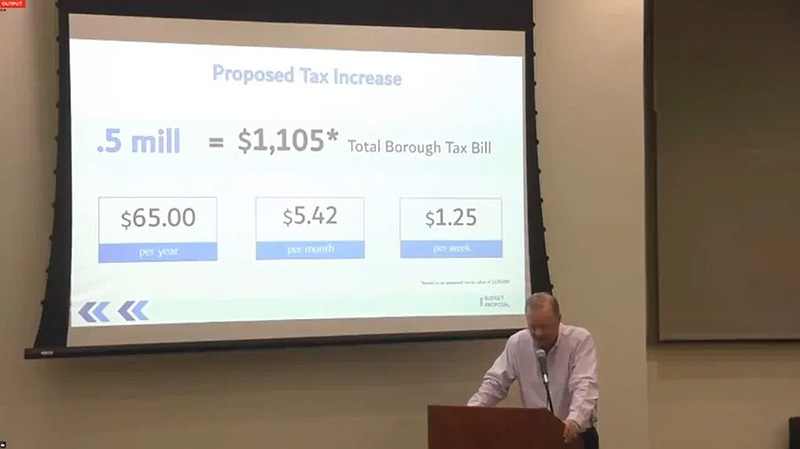
Lansdale Finance Director Christopher Shannon, at podium, speaks about a proposed 2026 borough tax increase during the Nov. 19, 2025 council meeting. (Screenshot of meeting video)
All three rates were raised for 2025
2026 could bring another triple hit to Lansdale’s taxpayers.
Council has voted ahead a draft budget with proposed hikes to the town’s tax, electric and sewer rates, arguing all three are needed in the face of rising costs in several areas.
“To keep up with these rising wholesale costs, and continue to provide reliable service, the borough must make changes,” said finance director Christopher Shannon.
In late 2024 council approved a $21.6 million borough budget that included the first electric rate increase since 2015, the first tax increase since 2022, and a sewer rate increase that had been part of a series of rate hikes approved in 2023, and said the increases for 2025 were lower than the increases requested by staff but all three would need to be revisited in upcoming years.
Shannon kicked off the budget presentation on Nov. 19 by announcing that the long-discussed 2023 financial audit for the town, which staff have said was delayed due to staff departures and a change to new accounting software, is now complete, and the 2024 audit is currently underway, and should be done soon, with the 2025 audit slated to start in February.

“For year 2024, all initial audit submissions have been completed. Our finance team currently is working with the auditor to address any questions and regrets — any requests for further information, I hope there’s no regrets,” Shannon said.
Public works projects completed in 2025 include the East Main Streetscape, a $3.8 million project largely covered by a $2.7 million federal grant; roughly $453,000 in road microsurfacing and paving “at several locations;” a $399,000 inlet and pipe replacement project on Norway Drive, a similar outfall replacement on Ridge Street that cost roughly $219,000 and one on Cherry Street that cost roughly $126,000, and just shy of $17,000 in culvert work on Squirrel Lane.
Parks and recreation projects included the $3.2 million renovations of the Whites Road pool complex, a $327,000 project to install a new restroom at the same park, a $510,000 upgrade to the playground at Fifth Street Park, largely covered by grants; a $335,000 project to pave trails in four parks, and installation of a new ‘traffic garden’ at Wedgewood Park where the entire $8,500 cost was also covered by grants.
“They did a great job, in terms of getting a lot of grant funds this year,” Shannon said.
Police projects tackled in 2025 included purchases of two new police vehicles, a $177,000 body-worn camera upgrade, new computer upgrades, and new dispatch consoles for police vehicles, while IT projects tackled around town include a new VOIP phone system, a server integration combining library software with the rest of the borough, and $100,000 in network and wireless upgrades. Major electric department projects included a $1.8 million substation upgrade on Ninth Street, another $1 million in electric switchgear upgrades, and $400,000 in new meters for that department, while major sewer plant work included a $3.8 million aeration upgrade project funded by $2.1 million in grants, and a $1.3 million implementation of UV filtration systems there.
“While we have made significant progress, important work remains for ’26 and beyond,” Shannon said.
“An optimum mix of funding is essential to maintain this momentum, and ensure we can deliver the level of service our residents expect and deserve,” he said.
Increased costs proposed for the 2026 budget include a $50,000 contribution to Hatfield-based VMCS-EMS, the ambulance corps that has made the case to several local towns they cover for a steady stream of annual funding, and a hike in the price of electricity used by the borough itself, and of that power the town buys wholesale and then resells to residents and businesses. Total electric revenue is projected to reach $11.6 million in 2026, Shannon told council, but higher costs due to aging grids, fluctuating natural gas prices nationwide, and increased demand due to data centers have all led electric costs to sharply increase.
“Lansdale’s not alone in facing higher electricity costs. The electric market is highly volatile. Nationwide, communities across the country are seeing rates go up,” Shannon said.
“The proposed 15 percent increase for 2026 ensures we can continue meeting high standards for residents, and businesses. Reliability is one of the main benefits of our local electric system, and this rate adjustment ensures that will continue,” Shannon said.
“Prior to May of 2025, Lansdale didn’t have an electric rate increase in ten years. But the sewer rates have been reviewed and adjusted in recent years,” to support infrastructure upgrades there, he said.
Electric costs are expected to increase in 2026 for both the wholesale power purchasing price and for the capacity charge that guarantees that power is supplied when needed, the finance director said, thus the recommended electric rate increase to keep up with those costs.
“To keep up with these rising costs, the borough must make changes. Simply put, we can’t keep the system running strong without adjusting our electric rates, consistent with increased costs. But these increases aren’t unique to Lansdale,” he said.
That rate increase would cost the average residential electric customer roughly $336 for the year or roughly $28 per month, the finance director said, before showing a chart of recent rate increases from regional utilities PECO and PPL alongside the Lansdale rate hike.
“Simply put, we can’t keep the system running strong, without adjusting our electric rates, consistent with increased costs,” he said.
Staff are also requesting council consider a tax increase of 0.5 mills to 8.5 mills, a hike that would raise the average resident’s tax bill to $1,105, based on an average assessed value of $130,000; the increase would cost that taxpayer an additional $65 per year or just over $5 per month. Totaling the tax rate, electric and sewer increases, the average resident’s bill would increase by just under $38 per month, with roughly $28 of that amount going to electric, just over $5 for the general fund taxes and the remaining $4 for sewer.
“We understand that every dollar counts, and we don’t take that lightly. These funds help us invest in programs that are not only beneficial, but in some cases are required by law,” Shannon said.

Projected general fund tax revenues for 2026 total $6.8 million, of which $3.6 million would go into general fund expenses such as employee salaries; 34 percent or $2.3 million would go to debt service; $600,000 or 8 percent to the library, and $180,000 or 2.6 percent to fire services. The roughly $400,000 in new funding would likely be split between an increased library allocation, the VMSC contribution, and “renewed economic development efforts,” the finance director told council.
In 2026 staff are also recommending the town proceed with a $3.2 million bank financing through regional infrastructure authority PennVEST to cover several streambank and sewer piping projects, and borrowing rates are “very favorable” compared to financing through a longer-term bond on the open market, he said. The finance director then showed a list of capital projects requested by department heads for 2026 including $2.5 million for parks — of which roughly one-third could be covered by grants — the $3.2 million for wastewater plant work likely to be financed through PennVEST, and $1.6 million in public works projects that could also be largely covered by grants.
Council make the case
Several council members then took turns asking questions and sounding off about specifics. Councilman Rich DiGregorio asked if staff plan to apply for a capital project bond separate from the PennVEST financing, and borough Manager John Ernst said that’s still being discussed.
“The answer is yes, we’ll be eligible, but we’ll have that decision to make, and that will depend on what projects council wants to make sure we get done,” council President Mary Fuller said.
Councilman Andrew Carroll, chairman of the electric and economic development committees, added thanks to staff for their work preparing the budget, and said he “fully support(s) all the recommendations,” including the rate hikes.
“It’s unfortunate that electric rates are going to have to go up the way they are, but I don’t think it’s an option. If you understand the actual operating costs of our department, you would see it’s not financially feasible to do it any other way,” he said.
Councilman BJ Breish added his own thanks for a “very long, arduous task” in developing the budget, and said he supported the increased donation to VMSC, before asking for more details on the increased library funding and economic development efforts. Carroll answered that the budget includes $120,000 in funding for salary and startup costs for a full time main street manager, a topic of lengthy debate by that committee, and that new hire could help seek grants to partially offset those costs.
“The time has come to bring on some fulltime people that are going to be dedicated to filling vacancies, expanding what is already a wonderful and vibrant town, help us polish the work we’ve done, and bring some new blood to the town. That investment, seemingly expensive to some, will pay dividends for decades to come,” he said.
“There’s so much at our doorstep, and with expanding our internal bandwidth by adding this new position, the dividends will be rolling in in no time, if things go even halfway according to plan,” Carroll said.
Mayor Garry Herbert said he thought the heavy emphasis on grant-funded projects could mean a new hire dedicated to seeking outside funding may make sense.
“We need to dedicate a role within the borough to grant work, where we have someone working fulltime on identifying, and accessing, and winning grants for us,” he said. “Having a dedicated resource to grant development, might seem like a good idea going forward. It may well be the main street manager, or could be part of that role.”
Library director Mindy Lipsky added that the increased funding for the library is based on an overall budget review she’s done since arriving in town in 2023, and said she’s seen a 48 percent increase in total book circulation and 22 percent increase in visits in that time, and she’s seen people use the library for job searches, professional certifications, and more.
Councilwoman Carrie Oglesby then moved that council advertise the budget for public inspection and feedback prior to a final vote to adopt in December, and council voted to do so unanimously; she then made a similar motion to prepare and advertise a tax ordinance with the new millage rate of 8.5 mills, and council unanimously agreed.
Lansdale’s borough council next meets at 8:30 p.m. on Dec. 3 and the administration and finance committee next meets at 6:30 p.m. that night, both at the borough municipal building, 1 Vine Street. For more information visit www.Lansdale.org.
This article appears courtesy of a content share agreement between North Penn Now and The Reporter. To read more stories like this, visit https://www.thereporteronline.com