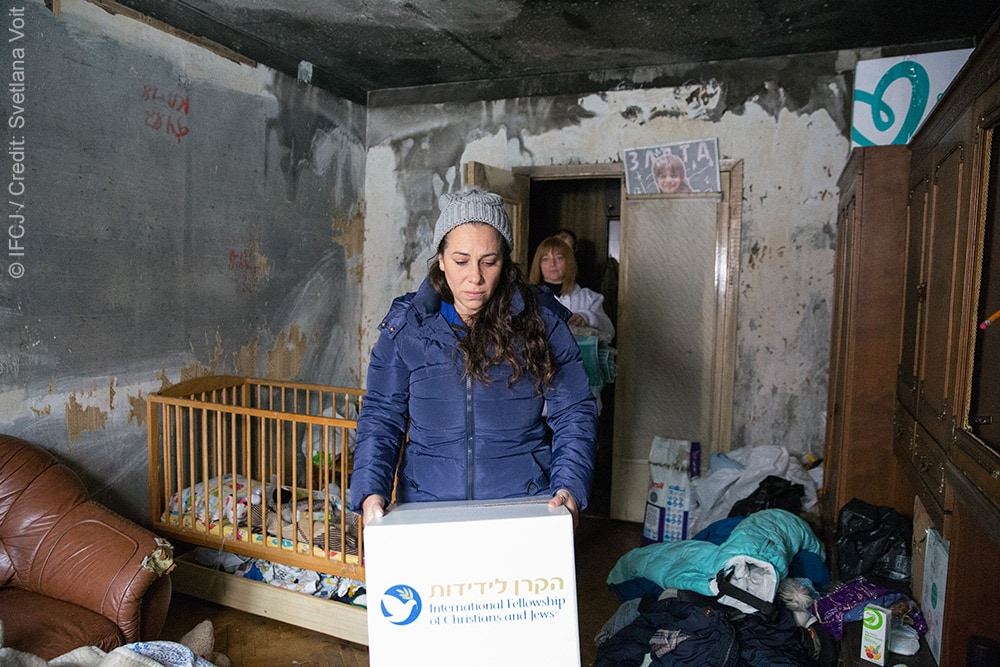
When Yael Eckstein walked into the dimly lit apartment, carrying boxes of prepared meals and groceries, she wasn’t greeted with a hug. Instead, a 92-year-old Holocaust survivor was in bed and began to weep.
“How did you hear about me?” the woman asked, tears streaming down her bruised face from where she had fallen running to a bomb shelter during a recent missile attack.
“I said, ‘God sent an angel, but you’re never going to be alone again,’” Eckstein recalled. “And she told me, ‘During the Holocaust, I was hiding. I was hungry, and nobody came to save me. Now I’m in Israel, and I thought again no one would come. And then you walked in and said Christians in America have remembered me.’”
For Eckstein, this encounter is reflective of the mission that has driven her life and leadership.
As president and CEO of the International Fellowship of Christians and Jews (IFCJ), Eckstein carries forward a vision her father, Rabbi Yechiel Eckstein, began over 40 years ago: to build bridges between Christians and Jews while caring for Israel’s most vulnerable.
Born in Evanston, Illinois, and raised in Chicago, Yael Eckstein grew up steeped in her father’s work. She studied biblical and Jewish studies and sociology at Queens College and Hebrew University in Jerusalem, moving to Israel permanently in 2005 with her husband.
Her first job at IFCJ was simple: stamping envelopes. But for 15 years, she worked under her father’s guidance, learning every aspect of the organization. Before his sudden passing in 2019, Rabbi Eckstein began preparing his daughter to step into leadership, a transition that some in the philanthropic world questioned at the time but that has since proven seamless.
Today, Yael Eckstein leads one of Israel’s largest and most impactful social aid organizations. In 2025 alone, IFCJ has distributed millions of dollars of direct aid within Israel, funded mobile bomb shelters, provided groceries, heating, and housing support for seniors, Holocaust survivors, and families living below the poverty line, and much more.
“We’re here at the International Fellowship of Christians and Jews on the ground ministering to the people who are hurting,” Eckstein said. “By bringing food, providing bomb shelters as the rockets were falling – these are practical ways to remind people that God is with them, that they are not forgotten.”
This year, Israel’s defense spending has surged by 23% amid escalating regional threats. The war with Iran, ongoing conflict in Gaza, and Houthi drone attacks have brought an unprecedented barrage: over 35,000 rockets fired at Israel in the past 650 days from seven different fronts, alongside dozens of Iranian ballistic missiles targeting major cities.
Eckstein described standing at the impact site of one such missile in Bat Yam, near Tel Aviv. The explosion destroyed six buildings, shattered windows for two miles, and left residents reeling.
“I was there with our volunteers and search and rescue teams, giving them words of encouragement and telling them millions of Christians are praying for them,” Eckstein said. “We gave them flashlights so they could work through the night, and then someone told me about this elderly woman nearby who needed help.”
Israel’s economic strain is not merely a macroeconomic statistic. Defense spending now consumes roughly 6.5% of GDP, one of the highest rates in the developed world. Meanwhile, over 29% of Israeli families live in poverty. Among seniors, nearly one in four cannot afford enough groceries.
“The country of Israel has been through something we’ve never seen before,” Eckstein said. “Even my children wake up in the middle of the night thinking there are sirens, even though the war is over. Trauma runs deep.”
As IFCJ’s global profile expands, so does its commitment to financial integrity. In early 2025, the organization completed a comprehensive salary and compensation audit conducted by Willis Towers Watson. The independent review assessed executive pay, including Yael Eckstein’s $1 million annual salary, concluding that compensation practices were fair, competitive, and aligned with nonprofit sector best practices.
“Financial accountability and responsible donor stewardship are at the core of our mission,” said Robin Van Etten, IFCJ’s U.S. CEO and global chief operating officer. “This audit reaffirms our commitment to transparency.”
For Eckstein, scrutiny is part of leadership. What matters, she says, is results.
“When you walk in the way of God, He blesses it,” she said. “Today is a much safer day for Israel and for the entire Middle East, but there is still so much to do. We have schools to renovate, soup kitchens to expand, and elderly centers to rebuild. We are focused on the basics: putting back this society to be strong, resilient, and a light to the world, just as we are called to be from here in Israel.”
Despite the bleak statistics, Eckstein sees miracles in motion every day. During the Iran missile attacks, IFCJ delivered and installed mobile bomb shelters in poor neighborhoods lacking protection. Often, sirens blared as crews worked, and local children ran inside for safety; minutes later, missiles struck nearby.
“It wasn’t even five minutes before the shelter was saving lives,” she said.
In southern Israel, residents are only now returning to the kibbutzim destroyed by Hamas on October 7. IFCJ is funding renovations of kindergartens and elderly centers; these vital community hubs for fellowship, faith, and resilience. Soup kitchens, Eckstein said, are in higher demand than ever before.
“After two years of war and so many working adults in reserve duty, businesses have fallen apart. The economy is weaker than at any time in my lifetime,” she said. “I’ve never known so many people who were out of jobs, with empty fridges, asking for aid.”
And yet, she sees hope rising through unity. When asked about the mental state of elderly Holocaust survivors during this time, Eckstein recounted her visit with the 92-year-old woman.
“Once again, the Jewish people are being targeted, singled out, and trying to eradicate God’s nation. But the flip side is this new generation of hope. During the Holocaust, it was Corrie ten Boom, one holy woman, who saved hundreds of Jews. Now we have hundreds of thousands of Christians through The Fellowship touching millions of Jewish lives each year. That’s the light in the darkness.”
For Yael Eckstein, the mission is clear: Jews and Christians standing together, in prayer and in action.
“Just as The Fellowship didn’t turn our backs on persecuted Christians in Syria, we stand with Israel’s most vulnerable today,” she said. “That’s the way we bring blessings to this world.”
For Yael Eckstein, Israel’s economic crisis is no longer just about security. What began as a defense emergency has spiraled into a deepening humanitarian crisis affecting nearly every sector of society.
The financial cost of this prolonged conflict has soared beyond $70 billion through July 2025. In many areas, recovery has stalled completely. Poverty rates hover between 22% and 29%, leaving over 1.24 million children directly impacted. Consumer spending has plummeted, wages remain stagnant, and the labor force continues to shrink as thousands remain displaced or enlisted in reserve duty.
Against this grim backdrop, IFCJ has dramatically expanded its work. In 2025 alone, it distributed more than 1.4 million meals, provided aid to nearly one million individuals and helped thousands of displaced families find temporary shelter and critical supplies.
Eckstein believes that in times like these, standing together is more vital than ever.
As she left the apartment of the Holocaust survivor that day, Eckstein promised her she would never be alone again. In the midst of war, poverty, and fear, she sees her role as simple.
“The best way to remind people that God is with them is to show them that they are loved,” she said. “That’s what The Fellowship represents. Light in the darkness.”