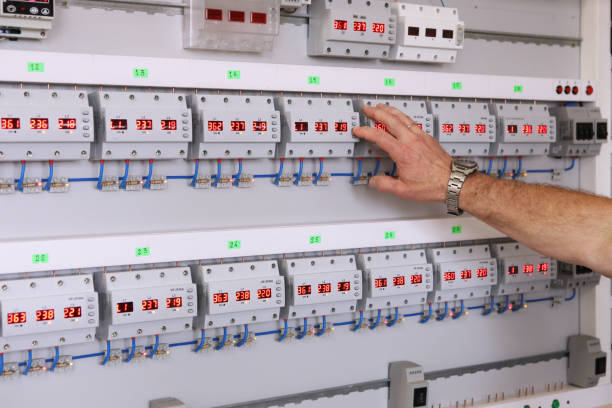
As business sectors embrace industrial automation, the need for an effective, reliable, and suitably structured power infrastructure increases. The epicenter of this advancement is a switching power supply. It is an innovative and powerful component that supports everything, from power programmable logic controllers (PLC) to distributed sensor arrays. In these scenarios, switching power supply suppliers have an equally important role of providing reliable and high-performance power systems that modern control systems need.
For B2B stakeholders in the manufacturing and energy management industries, having basic knowledge of what a switching power supply can do allows for easier infrastructural decision-making. This article will explain how switching power supply suppliers aid in the creation of scalable control systems from industrial electrical components design.”
Maintaining clean and constant energy supply is very important in modern control systems. This makes switching power supplies more useful compared to linear power supplies, as they offer better performance and efficiency due to lower operating frequencies. Less heat generation, lower compact size, and better form factors/adequate power level are benefits that come with switching supplies.
As with all power systems, switching supplies ought to provide AC mains power ports and regulated DC voltages for advanced automation building component, such as:
Smart factories and automated warehouses are examples of large-scale systems with key challenges in dealing with modular construction, international compliance, expandable guidelines, and power system modularity. These industrial automation environments are best served by switching power supply suppliers which ------.
A good switching power supply provider isn’t just an inventory dealer. Rather, they are partners. Their responsibilities go beyond the stock room to cover engineering consultations, compliance checks, adaptation, and even support throughout the product’s lifecycle. Let's analyze some of their contributions in deploying scalable control systems.
Choosing a power supply that most control networks rely on too little of a reserve load, over-estimate heat dissipated, or fail to apply EMI shielding can severely harm the entire network. A deeply specialized provider of industrial electrical components is in the best position to aid engineers in application optimization by offering the right power solutions.
In the customization phase, it is very critical to ensure the following requirements as well are fulfilled:
Achieving specific matches leads to enhanced protection from system instability, serves to increase downtime, as well as improved functionality when its needs grow.
Mixed tailor-made and pre-designed modular peripheral control units are frequently required at control power systems. Power infrastructures are also required to be flexible because components such as single output voltage peripheral control units, multi-channel units with 5 volt logic controllers, and 48 volt motor driving units.
Suppliers of Switching Power Supplies maintain close relationships with manufacturers to ensure an extensive range of stock pertaining to form factors and specifications. This makes it highly convenient for system integrators to scale without having to redesign entire platforms. Moreover, custom voltage power supplies are also offered for applications that require custom power supplies for mission-critical performance.
With the complexity of regulations in the automotive, aerospace, and medical manufacturing sectors, ensuring compliance with safety and performance standards becomes imperative. Compliance is crucial. A wide range of global certifications have to be obtained like CE, UL, RoHS, and EMC directives.
Having a specialized supplier assists firms in mitigating these complexities as they are provided with all the appropriate documentation and technical datasheets alongside third party testing results that prove all the power components are compliant. This aids in fast tracking the certification process alongside expediting the time-to-market rollout.
It is evident that the evolution from isolated islands of automation to fully integrated scalable ecosystems is no longer a choice but rather a requirement for sustained competitiveness in the long run. Whether it is configuring an advanced smart production line from scratch or updating the legacy infrastructure, they both prioritize scalability.
Suppliers familiar with the dynamics of modular systems are capable of recommending power architectures that increase in capability with the user's demands. This covers:
A cascaded power supply vendor who specializes in modular system designs can actually incorporate advanced simulation setups for evaluating future growth to ensure current spending does not lead to future limitations.
Power supplies never work in isolation, as they interface with dozens and sometimes even hundreds of other devices – industrial control boards, sensors, network switches, relays, or safety modules, to name a few. For example, the active interconnection of power supplies with industrial electronic components helps reduce signal noise interference caused by voltage drops and increases electromagnetic compatibility (EMC).
The most striking benefit for integrators and manufacturers on external platforms like niche providers is streamlined purchasing by paying fixed prices for complete systems. Partnering with a reliable vendor provides companies with the necessary components from a single supplier, which is beneficial for systems management, purchase operations, and routine updates.
In particular, more and more vendors of switching power supplies and industrial electrical components are augmenting their offer to integrated control panel sets or cabinets—sharply improving time to market and decreasing design engineering work.
Aside from taking proactive steps, suppliers frequently address prevalent challenges faced by the given industry during system design and scaling. Some of this includes:
Anticipating such issues and providing dependable options makes the supplier a critical risk mitigation component within any B2B supply chain.
Control systems must be agile and resilient within the context of today's industries. Conglomerate infrastructures, especially switching power supplies, are the heart of achieving this. Choosing the right switching power supply vendor allows acquiring the appropriate technologies, specific_market knowledge, integrated solutions, as well as maximizing deployment and lifecycle performance.
Firms oriented toward developing sophisticated automation systems should consider power supply sourcing as a strategic initiative rather than a procurement problem to be solved. Selecting vendors who also specialize in industrial electrical components guarantees interoperability, enduring dependability, and smoother business evolution.
The intelligent, scalable, and modular future of industrial control starts with a well-defined power strategy.