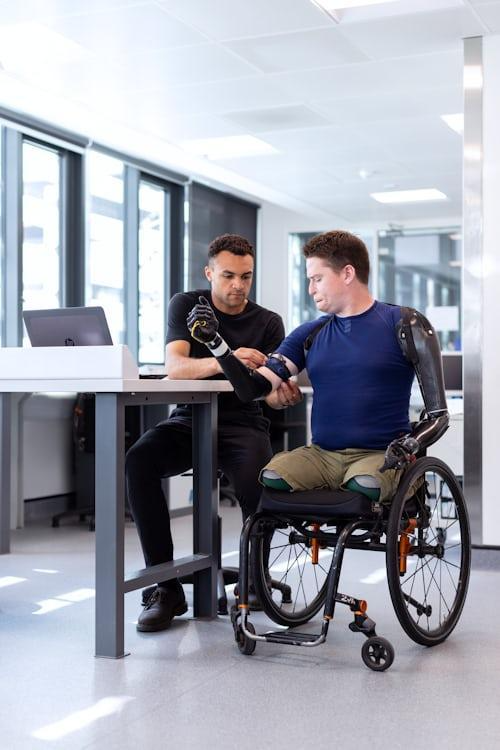
Congratulations on investing in a power wheelchair! You can now navigate your surroundings with remarkable ease as you explore virtually all locations that were previously inaccessible in your manual wheelchair.
Or, can you?
While a motorized wheelchair enhances your accessibility far more effectively than its traditional manual counterpart, you require several accessories to attain full independence. One such component is a wheelchair lift.
Read below as we explore what a wheelchair lift is and how this often underrated mobility aid can be a lifesaver.
Photo Credit: Unsplash.com
A wheelchair lift is a powered platform used to convey a wheelchair user over physical barriers, such as staircases.
Investing in a wheelchair lift eliminates the frustrations of having to enlist assistance to access higher levels of a building. For property owners, it’s also an ingenious way to make a building disability-friendly.
Most wheelchair lifts are meant for semi-permanent installations near building entryways. They may be positioned outdoors or indoors, enabling wheelchair users to navigate steep staircases with zero or minimal assistance.
There are also specialized wheelchair lifts designed for the transportation industry. Such platforms are typically found on bus or train stops, allowing seamless transfer of physically impaired passengers from their wheelchairs onto a vehicle.
Wheelchair lifts utilize constant-pressure operation. The devices feature an integrated button, which you must press and hold down to move them in the desired direction.
The lift stops as soon as you unpress the button.
Now, the constant pressure mechanism implies that considerable effort is necessary to operate wheelchair lifts. That may sound like a limitation for wheelchair users with reduced upper-body mobility.
However, this is by no means a design flaw. Rather, it’s a safety feature that ensures the platform only moves when required.
Most wheelchair lifts operate using a Screw Drive or Hydraulic Drive system.
In screw drive systems, you press a button to engage a motor. The motor then turns a large screw and nut to lift or lower the platform as required.
Meanwhile, hydraulic drive systems operate the wheelchair lift by pumping hydraulic lift in and out of a special cylinder.
Photo Credit: Unsplash.com
Installing a wheelchair is mandatory under US laws.
According to the Department of Transportation (DOT)’s Americans with Disabilities Act (ADA), bus and other public transportation companies must install wheelchair lifts at strategic spots. The act further mandates stakeholders to ensure the lifts permit wheelchair users to board and alight from a vessel from any direction.
But even in the absence of express regulations, there’s much to benefit from installing a wheelchair lift.
True to the name, vertical wheelchair lifts hoist directly up and down.
This design enables the platform to be positioned beside or away from the stairs, providing seamless transfer to different levels of a building.
Inclined platform lifts mimic the angle of a staircase, helping wheelchair users to travel over the steps.
The device functions similarly to stair lifts, except that it has a flat platform that can safely convey a wheelchair.
Photo Credit: Unsplash.com
Picture this!
After suffering a physical disability (whether from a severe accident or debilitating illness), your physiotherapist recommended using a power wheelchair. You heeded the medic’s recommendation and went ahead to purchase a high-end motorized wheelchair.
You’re finally about to cruise to work in your new mobility aid. This is a significant step towards managing your disability condition, and you can’t wait to showcase the investment to your coworkers.
But there’s one sticking problem. And sadly, you only discover this when you get to work.
Your workplace is not disability-friendly. Obviously, you never figured that out because you’ve just become the organization’s first physically impaired employee.
In the first few days, your colleagues excitedly help you get over the steep ramps and staircases. But they’re gradually wearied by your constant pleas as time goes by.
It’s during such scenarios that you can appreciate the significance of a wheelchair lift.
Wheelchair lifts provide you with a hassle-free way to access different levels of a building. The platforms let you bypass obstacles that would otherwise be impossible to navigate without assistance.
Whether it’s your multi-storied residence or a mezzanine office floor, you can trust a wheelchair lift to deliver.
Below are other reasons to invest in wheelchair lifts;
Wheelchair users often have to contend with the frustrations of summoning help whenever they’re faced with daunting barriers in their daily lives.
With a wheelchair lift, those will be a thing of the past. The platforms support smooth access over obstacles, restoring full independence.
Wheelchair users are inherently vulnerable. As such, their environments must be secure from plain and hidden dangers.
Most wheelchair lifts are engineered with safety in mind. The platforms feature non-slip surfaces, preventing your wheelchair from skidding dangerously during conveyance.
An integrated locking mechanism maintains stability, minimizing falls.
You can install a wheelchair lift on virtually any space that requires going over steep barriers.
Set up the platforms at home to navigate different levels of your residential apartment. Or, integrate them into your office’s entrance to make your workplace more disability-friendly.
Wheelchair lifts can be installed indoors or outdoors, too, depending on a building’s architectural plan. There are also portable options for frequent road travelers.
Wheelchair lifts can be tailored to accommodate different mobility needs.
For instance, vertical platform lifts are ideal for public areas with high traffic of wheelchair users. The platforms work incredibly fast, effortlessly carrying users across different stories of a building.
Wheelchair lifts may also be customized based on the desired noise levels. Hydraulic drive systems are quieter than their screw drive counterparts, making them perfect for residences and smaller offices.
If you’re shopping for a wheelchair lift for personal use, it’s best to also consider factors such as size and weight capacity. Choose a platform that can safely accommodate your wheelchair while leaving reasonable room all around to minimize tip-overs.
Photo Credit: Unsplash.com
Wheelchair lifts provide genuine benefits for individuals with impaired mobility. While the devices are primarily designed to improve access over physical barriers, their ability to minimize accidents makes them an invaluable safety investment.
It’s also exciting to know that there’s a wheelchair lift for all mobility needs. Even better, you can customize the gadget to suit your immediate requirements.
However, in-depth research is critical when buying a wheelchair lift.
Select a lift tailored for your mobility needs. Besides, check that the device comes with relevant safety features and is manufactured by a renowned brand.