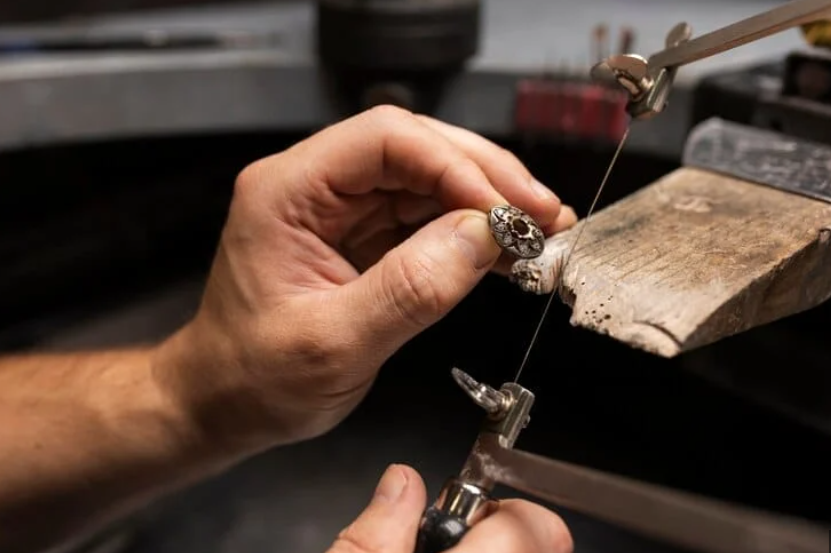
For millennia, jewelry has served as an artistry of synthesis reflecting human culture, sophisticated beauty, and craftsmanship. While ancient civilizations decorated themselves using shells and bones, the present society has exquisitely advanced towards the gleaming gold and diamond jewelry exquisitely crafted today. Jewelry has always helped human beings adorn themselves.
In the present day, the manufacturing of jewelry has to not only be an art, but it must undergo deep creativity while keeping in mind the advanced technology available or presenting traditional methods that withstand the test of time. Gold and diamond jewelry comes with its own history, and with the ever-changing technological jewelry industry, artisans and gold manufacturers are now given the capability to design beautiful and intricate pieces that are crafted while keeping precision, sustainable methods, and efficiency in mind.
Through this we will learn about the manufacturing methods used in jewelry today, gold plating, the innovation that has updated the process as time has elapsed, and the importance of selecting an ideal manufacturer and how this advice can be useful to brands, retails, and even the general consumers, or the reasons behind its importance.
1. The Timeless Allure of Jewelry
Jewelry has always served the purpose of identity since time crafted has known. Its symbolic representation involved showcasing culture and societal standards, identity, and even personal beliefs. Ancient Egyptian empirs used to pay homage to gold jewelry as it showcased beauty and eternal life during their reign. Or, in India gold ornaments depicting marital bond have always held a form of trust and a display of wealth. Family heirlooms are cherished and passed down based from one generation to the next worldwide along with religious pendants which mark deep emotional value.
Although the manufacturing process has likely changed throughout the years, the emotional connection to jewelry is remains the same. For contemporary shoppers, jewelry has to not only be visually appealing, but can also stand up to the test of daily wear and tear, maintaining its luster over time. Achieving this requires skill and mastery from the gold plated jewelry manufacturer.
2. Spark of the Creative Spirit: Idea to Design
Jewelry designing starts with an idea, and an inspiration for this idea can be taken from nature, architecture, history, and personal anecdotes. The idea then is sketched or rendered digitally.
The introduction of CAD (Computer-Aided Design) software allowed designers to build 3D models of the rings, complete with every curve, stone, and ornate clasp. CAD not only helps to ensure precision, but helps clients visualize the final product, enabling a smoother design process.
3. Materials: The Jeweler’s Palette
Choosing the material of construction for the piece is arguably the most crucial step in the jewelry manufacturing step. A given design can be limited to gold, silver, and platinum, or even more durable alloys, and will be dictated based on the jewelry piece’s intended function.
For brands aiming to strike a balance between luxury and cost-effectiveness, gold plating continues to be a favored option. A reliable gold plated jewelry manufacturer can deliver cost-effective gold jewelry with gold plating that enhances its appearance, while providing protection against tarnishing and low-cost dimming over time.
4. The Gold Plating Process
Gold plating is the process of placing a gold layer on top of a metal framework, such as brass or stainless steel, via electroplating. The process follows these major steps:
Preparation of the Base Metal: The metal undergoes cleaning processes to get rid of contamination such as grease or rust.
Electrolyte Bath: The jewelry is immersed into a bath that is made up of liquid containing gold ions.
Application of Electric Current: The application of electric current causes gold ions to attach to the metal and fully coat its surface.
Final Step: The jewelry that has undergone the steps of gold plating is then polished to bring out its glorious appearance.
The wearability of gold jewelry is a function of the gold’s quality, the craftsmanship and skill of the jeweller, as well as the gold’s purity and quality. Properly plated gold jewelry can be worn on a daily basis without experiencing any form of deterioration for a long time.
5. The Impact of Technology on Contemporary Jewelry Production
Like other industries, technology has contributed to the transformation of jewelry manufacturing in a way that was unimaginable in the earlier days.
3D Printing – Facilitates the creation of intricate designs that would be impossible to craft manually and enables rapid prototyping.
Laser Cutting and Engraving – Gives flawless accuracy for engravings and meticulous designs.
Advanced Casting Methods – Helps in waste minimization and maintains quality uniformity in large batch production.
These advancements help brands realize their visions and manage costs at the same time.
6. Blending Artistry with Eco-Friendly Practices
Today's consumers are increasingly interested in the ethical aspects of jewelry creation, alongside its aesthetics, paying attention to the methods employed in its production. The responsible sourcing of materials, fair to the workers, and environmentally friendly manufacturing practices are becoming the convention for the industry.
A sustainable gold plated jewelry manufacturer will incorporate recycled metals, use environmentally friendly production techniques, and rigorously comply with eco-friendly manufacturing at every production stage. Such practices are not only earth-friendly but also enhances the jewelry’s value by providing worry-free adornment to the wearer.
7. Customization: A Developing Approach
Personalized jewelry continues to grow at a fast pace in the industry. Customization allows customers to choose pieces that best narrate their personal sories. It could be a cherished engraved necklace, a birthstone ring, or a charm bracelet with custom charms.
Every jewelry mark has designers and skilled jewelry manufacturers with whom they collaborate. Customization is crucial in this competitive market as it allows brands to design and produce unique pieces that satisfy customer demands.
8. Quality Control: Striving for Excellence
Stringent quality control processes are conducted prior to a piece of jewelry being delivered to the customers. Quality control for jewelry entails inspecting for scratches and ensuring for the clasp and even, durable plating.
High-end manufacturers have dedicated quality control teams and ensure that each piece of jewelry custom made is in compliance with international standards. A custom jewelry manufacturer that pays attention to quality control, compares with low-end producers, has from jewelry spending standards, stands out on the market.
9. Custom Jewelry Production
Retailers and jewelry brands heavily rely on a wholesale turn-over for custom jewelry production. Through a specialized jewelry manufacturer, businesses are able to increase their order of production as it ensures there is consistency with the standards of quality sought.
As with the production of a seasonal or defined collection, responsive jewelry manufacturers for bespoke jewelry orders are a good partner who can supply competitive turn-over. They can supply big orders at attractive pricing and in time while maintaining the craft mark of refinement.
10. Why It Is Important to Select the Appropriate Manufacturer
Manufacturers differ in capability and performance. Picking the wrong one can cause order, quality, customer service, and numerous consumer dissatisfaction issues. In contrast, partnering with a skilled, reputable gold plated jewelry manufacturer guarantees that your designs are executed precisely as you wish and using the best available materials and techniques.
Conclusion: The Jewelry Manufacturing Industry's Outlook
The jewelry business is in a state of flux as it attempts to combine art and new technology. Sustainable and eco-friendly approaches, as well as elaborate personal tailoring, are available from the new generation of manufacturers.
The first step in building quality, chic, and inexpensive collection lines is to partner with a professional jewelry manufacturer built for brand-name aspirations.
From the perspective of a budding jewelry brand or a well-established retail business, the selection of the manufacturing partner will determine the quality and appeal of the brand and impact their image in that sphere. In as much as one would seek a reputable gold plated jewelry manufacturer for his gold plating, one would seek a dependable business for jewelry durability and design excellence.