Futures trading is fast-paced and highly leveraged, offering substantial opportunities but also exposing traders to significant risk. Futures trading plays an important role in global markets, serving as a key mechanism for both speculation and risk management, helping market participants navigate price fluctuations and hedge their positions. In 2025, the futures market is increasingly shaped by algorithmic tools, real-time data, and a growing variety of trading platforms. However, no tool or feature replaces the importance of having a clearly defined strategy and risk plan. Whether manual or automated, every successful futures trader shares one trait: discipline.
Core Futures Trading Strategies: Choosing the Right Approach for Each Market
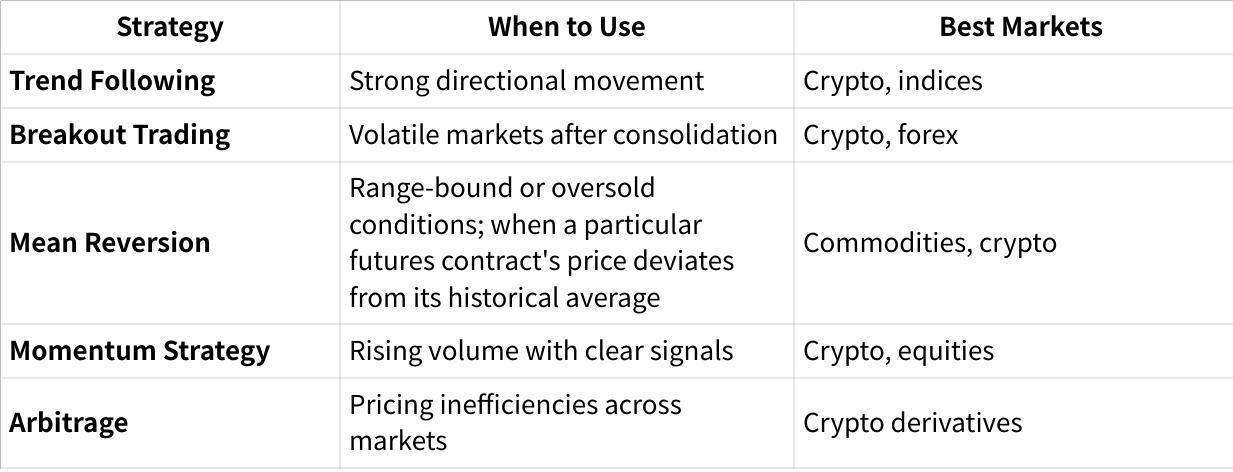
Each strategy serves a different market condition. When selecting a strategy, traders must consider their risk tolerance to ensure their approach aligns with their comfort level and financial goals. These strategies are applied to various futures contracts, which are standardized agreements that allow traders to hedge or speculate on the price movements of underlying assets.
Here is a breakdown of the most widely used futures trading strategies, along with their typical use cases and associated risks.
Each of these approaches can be executed manually or through automated tools. For each trade, traders analyze the relevant contracts and must decide which futures trading strategy and contracts best fit their goals and the current market conditions.
Day Trading Strategies for Futures: Fast Decisions, Focused Execution
Day trading in futures requires precision, speed, and clear execution rules. Most traders who use these day trading strategies aim to capitalize on short-term price moves without holding positions overnight. These day trading strategies for futures are popular among short-term traders:
Example: Pullback Strategy Execution
Day trading futures is possible nearly 24 hours a day due to extended trading hours, giving traders flexibility and continuous opportunities. Beginners should build confidence before they start trading.
Best Practices: Trade Plans, Risk Management, and Avoiding Emotional Trading
Trading without a plan is a fast route to losses. Implement these best practices:
Successful traders consistently use technical indicators like moving averages, RSI, and ATR in conjunction with risk controls to reduce emotional bias and increase profitability. Review your performance across multiple futures accounts if applicable.
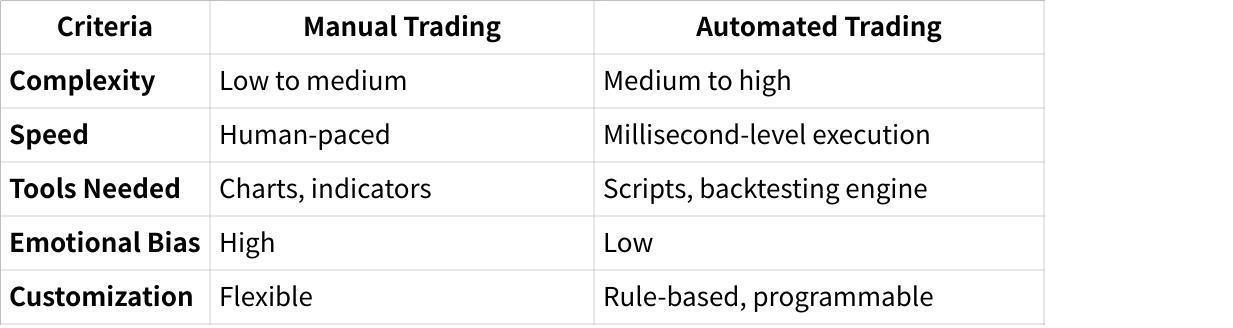
Automated Futures Trading Strategies: From Algorithms to Execution
Automated futures trading strategies allow traders to execute systems based on pre-coded rules. Automated strategies can be applied to a wide range of futures contracts, including those based on commodities, market indices, currencies, interest rates, and financial instruments. These are the most commonly used strategies in automated environments:
Futures contracts are standardized agreements to buy or sell an asset at a future date, with details such as contract size, notional value, expiration date, and delivery date. Some contracts settle by physical delivery, while others are cash-settled. Automated trading can be used to speculate on price movements, hedge a portfolio, or trade futures for profit. For example, trading bitcoin futures allows automated systems to identify breakout opportunities using technical indicators and volume analysis.
Click the image to view the sheet.
Platforms like Bitunix support algorithmic trading strategies with real-time data feeds, low-latency execution, advanced charting, and robust backtesting environments—key requirements for automation. Bitunix also supports trading a variety of futures contracts, including those on crude oil, S&P 500, currencies, and interest rates.
Key Tools & Technical Indicators for Strategy Design
To build effective strategies, traders use several tools and indicators:
Charting platforms must support custom indicators, order automation, and strategy simulation. Bitunix, for example, provides an integrated environment for strategy testing, real-time charting, and indicator customization.
Choosing the Right Platform: Strategy Meets Technology
When evaluating a futures trading platform, consider:
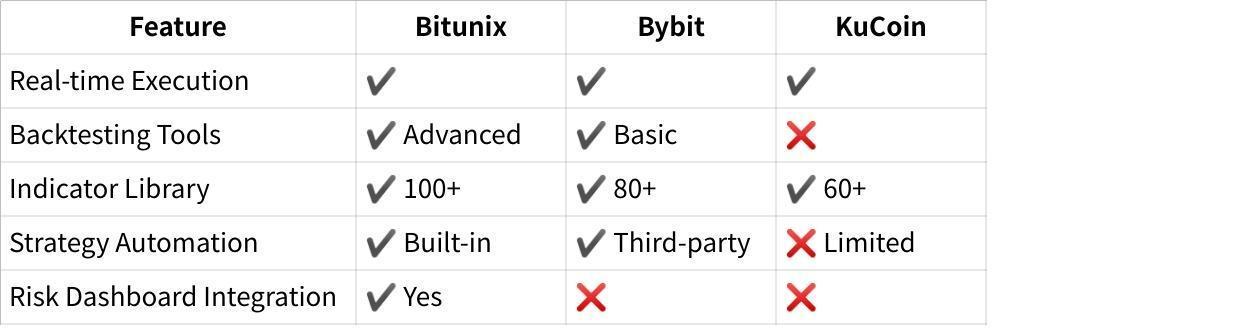
Platform Feature Comparison:
Click the image to view the sheet.
Bitunix stands out in offering integrated strategy automation, in-depth indicator tools, and a comprehensive risk control suite, making it ideal for both manual and automated traders.
FAQ
What are the safest day trading strategies for new futures traders?
Range trading and pullback strategies are generally safer due to clearer risk zones and better-defined setups.
Can automated trading outperform manual trading?
Yes, if properly coded and tested. Automation reduces emotional decisions and executes faster but requires oversight.
How do I implement a strategy using a platform like Bitunix?
Bitunix offers pre-coded strategy templates, real-time indicators, and visual order tools to implement and test any trading strategy.
What is the best indicator for trend following?
Moving averages and ADX (Average Directional Index) are widely used for identifying trend strength and direction.
Conclusion: Strategy + Tools = Trading Edge
Mastering futures trading strategies in 2025 is not about chasing trends, but about executing a consistent, disciplined plan using the right tools. Whether you prefer manual tactics like range and breakout trading or lean toward automated trend-following and mean reversion systems, having access to reliable platforms is essential. By combining a structured approach with platform features such as backtesting, automation, and real-time analytics, traders can improve their edge and navigate volatile markets with confidence.